
How To Reliably Create Wealth
11 pieces of advice from five world-class entrepreneurs

Peter Thiel
An eccentric character, formerly a part of the PayPal Mafia, and has a lot of contrarian ideas.
One thing’s for sure, with his work on Facebook, Paypal, and Y Combinator, to name a few, you can’t question his success. The two key lessons from his 2014 Stanford keynote have a lot of value in them.
1. Focus on the Market
Find a very small market, dominate it, and then find ways to expand the market itself.
Thiel advocates for Monopoly, and having a monopoly in a small market gives you a position of strength when that market expands.
“If you think your initial market might be too big, it almost certainly is”
He uses Amazon’s initial book business and eBay’s platform that started with Pez dispensers as an example.
Nobody thought these were valuable because of how small the niche was, but low and beheld, they expanded the market itself and here we are.
2. Be Leagues Ahead
You want something that’s a high order of magnitude bigger or better than the next thing.
The small market you’re trying to gain market share in will already be more accessible than going after a saturated market. What will make the process quicker? Offering a value proposition that’s leagues ahead.
You’ll take the market share by being two or three, ideally ten times better than the competition.
As an example, Thiel used Amazon again. Amazon was a bookstore, but they housed 10,000+ books — nobody else did this.
The sheer amount and variety of books they offered slowly crushed anyone else in that small market.
Joe Gebbia
The co-founder, design lead, and Chief Product Officer of Airbnb. He’s worth over $3 Billion today and got to where he was with a string of hilarious and exciting endeavours.
1. The Gym of Entrepreneurship
There’s a long road of trying things, making mistakes and failing before achieving success — but this is the necessary workout.
Gebbia talks about how, for years, he undertook projects that weren’t the “big idea,” that were simple but challenging.
He made a giant chessboard with all the pieces being actual sized wooden chairs — he did this for a college art project and got the college to pay for it.
He made cushions for his critique classes called CritBuns, and they were such a success that he took them to Japan for a tradeshow and sold every last one.

In the process, he learned how to negotiate, how to source material, how to design products, and how to become proficient in entirely new skillsets.
He’d already been training in the entrepreneurship gym way before Airbnb rolled around.
I hope if there’s any takeaway from the stories that I shared today, it’s that the simple act of spotting an opportunity, coming up with original solution and then taking that third, hardest step of putting something into the world, of trying something, putting your idea into practice — it doesn’t have to be the big idea.
And the last point is critical; it doesn’t have to be “the big” idea.
2. SW² + WC = MO
When a new idea gets introduced to the world, some will love it some won’t, who cares — move on.
This was advice that Gebbia remembered after his first pitch to a store went sour. He had tried to convince the store to buy CritBuns and stock them.
He reminded himself of this advice, and that allowed him to go to the next store, and the next, until one was excited to stock the product.
After that initial success, it was psychologically and practically easier to sell more and more — he had the validation he needed.
Ray Dalio
The billionaire hedge fund manager and philanthropist who founded Bridgewater Associates.
Dalio has made more money, connections, and impact than most people. He and his firm have pioneered methods of diversification, risk management, and market analysis that no one had ever dreamed of prior.
He made a whole new wave of impact in 2017 when he published Principles: Life and Work — and the lessons in this book will directly help anyone in their endeavours if taken seriously.
1. Create Your Own Set of Principles
We make mistakes, we learn from them, we forget them, and then make them again. If we wrote the lessons down and systematised our decision making, we’d make far fewer mistakes.
Dalio lays out his entire life experience in this book; he goes through how he made his mistakes and came up with principles to ensure he doesn’t make them again.
He essentially wrote a rule book or algorithm to deal with recurring issues, but he always advocated for not only borrowing from his but for creating your own.
He boiled this to a 5 Step Process that he shared in his book.
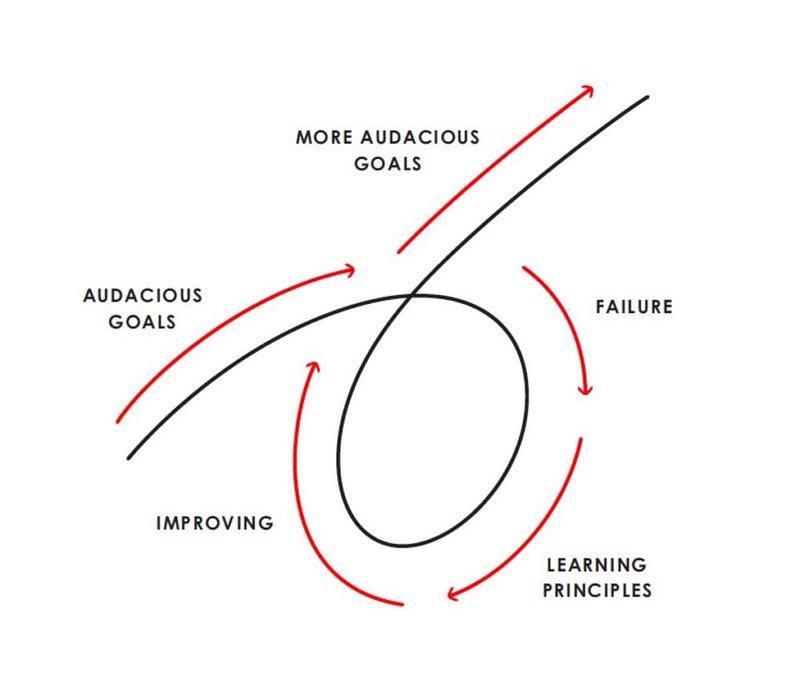
Going through this cycle, learning, and recording your own principles of life and business, will set the stage for improving as an entrepreneur.
But more importantly, a person.
2. Be Grounded in Reality and Truth
Understand the cause-effect relationships that govern reality and accept them to know your truth.
Being hyperrealistic will help you choose your dreams wisely and then achieve them.
Dreams + Reality + Determination = A Successful Life
Dalio wants everyone to be in tune with reality and sees ‘the truth’ as being an accurate understanding of reality.
Once you understand reality, you can work in those confines more effectively and achieve your dreams with hard work.
Dalio believes that once you’re grounded in reality, you can deploy your energy and work ethic to go after making an impact and savouring life — and once you work hard enough, they become the same.
To really understand reality, and yourself, the next point is pivotal.
3. Radical Open-mindedness and Transparency + Blind Spots
People are unique, have strengths and weaknesses, and are blind to them. To get better, surround yourself with skilled people and cultivate a culture of open-mindedness and transparency.
Dalio cultivated a culture in Bridgewater where he’d train new employees over 18 months to become open-minded and transparent — he took this very seriously.
Employees at Bridgewater would crowdsource strengths, weaknesses, and other information from each other in the form of baseball-card style sheets. And they wouldn’t get offended by these.
It allowed for a culture of viewing someone’s traits and working more effectively with each other.
Having a core group of skilled people keep you in check, and be open with you about your blind spots is a perfect solution to not making those mistakes — letting you plough through your goals.
Naval Ravikant
The co-founder of AngelList, a company that has $1 Billion in funds under management, and 23 unicorn startups in its portfolio.
Naval is the new generation philosopher; his tweets are wildly popular and resonate with many entrepreneurs and thinkers alike. He’s got a lot of ideas on a lot of topics, here are his thoughts on wealth and business.
1. Anyone Can Become Rich
If you don’t rent out your time, you own equity, give society what it wants but doesn’t know how to get, at scale — you will become rich.
Naval believes anyone can become wealthy. The points above are a part of his larger tweetstorm on ‘how to get rich without being lucky.’
The favourite takeaways (paraphrased):
- Don’t chase status, chase wealth — wealth is having assets that make money while you sleep.
- To create a fortune requires leverage — business leverage.
- Capital and labour are more traditional and are ‘permissioned leverage.’ For you to deploy capital, someone has to give it to you. For you to lead, someone has to follow you.
- Media and software are the new ‘permissionless leverage.’ You can create software and media that works for you as you sleep.
- Business skills are a combination of microeconomics, game theory, psychology, persuasion, ethics, mathematics, etc. — it’s not a skill in itself.
- Get rich quick schemes are other people getting rich off you.
The final point that Naval arrives in any interview is education. Not a degree specifically, but knowledge and understanding, followed by action.
2. Specialisation is for Insects
The lifestyle of doing one thing for the rest of your life isn’t how humans used to live, and it’s not how they should live now.
Naval subscribes to the life of the ancient Romans where the citizens would get an education, then they’d go to war, they’d come back and start businesses, they’d grow older and contribute to the political system.
His point was that they’d try their hands at multiple things in multiple facets of life, and they’d be much happier because of that.
You’ve got one life — just do everything that you’re going to do.
So even if you’re a specialist in one thing now, if life or passion calls, and you feel your curiosity in the specialisation fade — starting over is absolutely OK.
Follow your intellectual curiosity over whatever is ‘hot’ right now — Naval, Tribe of Mentors, Page 33
Richard Branson
His fame and fortune precede him, but the lessons in getting there are a tremendous example to all entrepreneurs.
As the founder of Virgin Group, he’s shared his story across many books starting with Losing My Virginity and Screw It Let’s Do It, published 1998 and 2006 respectively.
He steps through his career from starting as a record shop to founding his airline. The most compact and interesting interview for this journey was one by Tim Ferriss, in 2017, where Branson shared his life and business tips.
1. Limit The Risk Factor
If you’re making an investment or decision, implement a way to cap your downside in the event of failure.
Branson talks about how he first negotiated to buy a second-hand 747 from Boeing. What did he do? He just called.
He’d been frustrated at how British Airways treated customers, and he wasn’t satisfied with the experience. He thought he could do a better job.
He called and asked to buy one, and throughout the call, he realised that Boeing was already frustrated with British Airways because they had a monopoly — Boeing thought that competition would be good.
Branson used this frustration and capped his downside. He negotiated that if after the first year, things weren’t’ t working out, they could return the plane.
He essentially limited the risk to what was worth about 6-month profit from his record business — he saw that risk as being worth it, and he took it.
If he hadn’t capped his risk, that decision would have been a lot more complicated, and therein lay the lessons learned.
2. You Need to Be Fundamentally Different
Your value proposition can’t be the same as the competition or even marginal better — it has to be fundamentally different.
Peter Thiel says 3x to 10x better, Branson says fundamentally different — they both work hand in hand.
With Virgin Group, Branson differentiated his airline by making the food better, making the customer service better, and making the experience enjoyable and cheaper than the competition — this worked.
A failed venture, on the other hand, was Virgin Cola.
I think the lesson I learned from that was that if I’m going to take on a Goliath, we’ve got to be different and we’ve got to be much different than they are. With a cola, you’re just another cola.
Virgin Cola did make an initial impact, it was gaining steam, and the Virgin brand was carrying it in the UK, but of course, the lesson learned was that branding wasn’t everything.
Once they tried to swing at the US market, Coca Cola and Pepsi had the money and influence to crush Virgin in that domain.
So from that moment on, Branson made sure that he offered a value proposition that nobody else was offering.
Barring Naval, these entrepreneurs are all billionaires which mean it’s easy to attribute a lot of luck to their success, as well as unquestionable skill.
But even though luck is a factor, the lessons learned from these world-class entrepreneurs can lay the foundation of wealth for you and any other entrepreneur out there that wants to achieve a fantastic level of success.
Success isn’t billions of dollars, and following these tips won’t guarantee that. But becoming wealthy; in life, happiness, health, and of course, money — that’s something that these lessons can contribute to, we just need to implement them.
Best of luck, and I hope you got some value out of these.
Thank you,
Sah
I hope you enjoyed and got some value out of all of this. If you’re looking for something extra, you can get something from me every week here.


