
Spiritual and Scientific Contemplation in this Painting About the Moon
A vision of the hope seen on a twilight evening
I looked out of my window a few nights ago and saw a perfect crescent moon suspended in the darkening blue sky. Just next to it was the planet Venus, also known as the Evening Star, poised like it was trailing the sliver of moon.
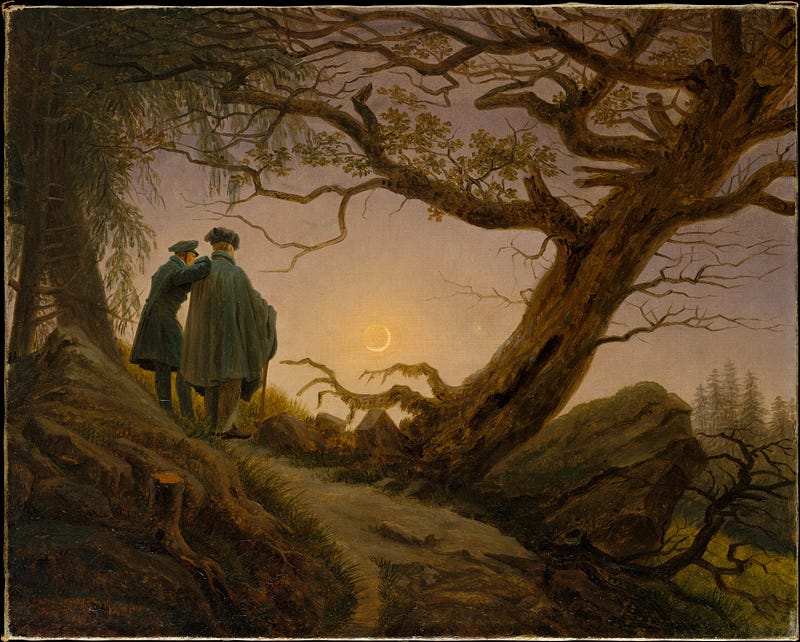
Immediately it made me think of this painting at The Met by Caspar David Friedrich, in which the moon and the Evening Star are likewise positioned in the same portion of the twilight sky.
Every time I look at it, I wonder if this painting leans towards optimism or pessimism. It was made during the Romantic period of art history, when artists like Friedrich considered the place of the individual set within the natural world.
The twisted trees and the boulder-strewn path are more than just picturesque details. They are suggestive of the struggles in life. But does the rising track and the sublime sun-lit moon suggest hope?
Setting and Style
Admiring the view are two men, who have stopped on an incline during an evening walk.
They have been identified as Friedrich, stood with his cloak and walking cane, then 45 years old, and his friend and disciple, the 25-year-old August Heinrich. Heinrich leans on Friedrich’s shoulder, giving the impression that they have been stood immersed in the moment for some time.
Notice how the large oak tree that dominates the painting is uprooted at a steep angle, perhaps having been damaged in a storm, and is also losing its leaves. It contrasts with the evergreen fir in the upper left of the painting — paralleling the two figures, the stout-looking artist as the oak and his “evergreen” student as the fir.
Framed under the trees, both are dressed in garments that lend a clue to Friedrich’s patriotism: radical German students had begun wearing the “Old German” fashion in reaction to the recent Napoleonic wars and the policies being enforced in their wake.
The Crepuscule Hour
Friedrich’s early paintings contained many references to his Lutheran upbringing, yet as his life progressed his paintings began to leave behind their overt Christian themes and dwell more on the sense of nature’s sublime and mysterious power. Symbols such as vultures, owls, graveyards and ruins began to appear as veiled portents, which some interpreted as reflective of increased personal despair in the artist’s private life.
The twilight hour was especially meaningful. Indeed, painting at what might be called the cutting edge of Romanticism, Friedrich had a near-sacred fascination with dusk. As the boundary between day and night, it is a liminal moment bearing many potential implications. Twilight seems to have operated as a signifier for the artist of both ambivalence and wonder.
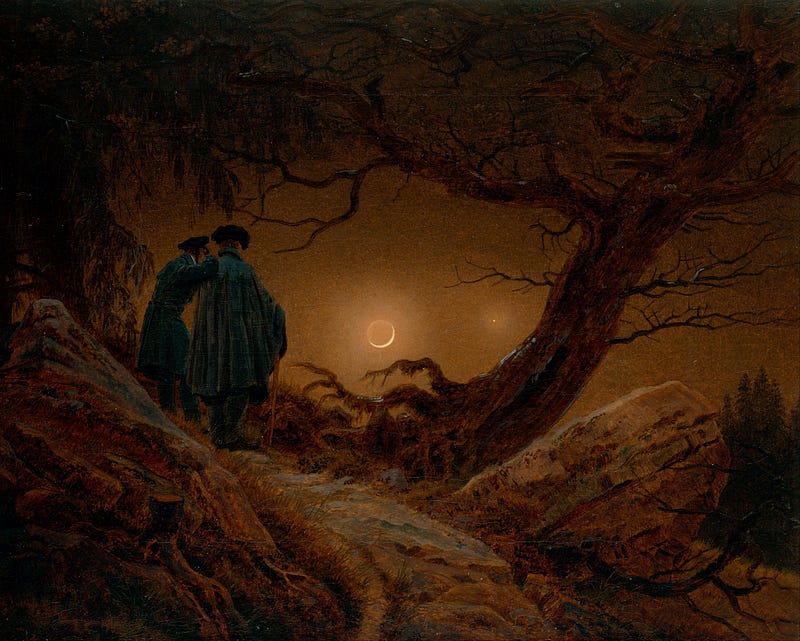
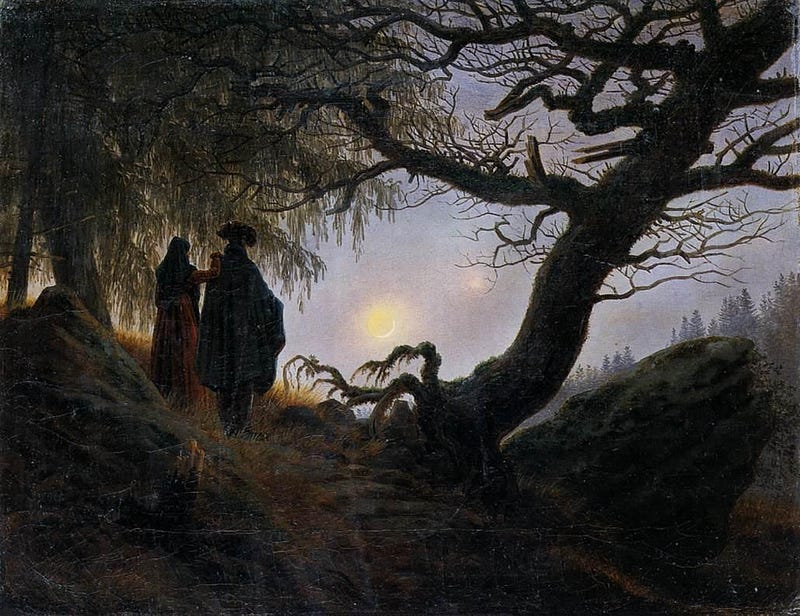


It is interesting, therefore, to consider that the painting hung in The Met was actually the third version of the image Friedrich made. In other words, it was a composition he returned to several times. In each work, dusk is captured with alternative intensity.
The first version of the work, painted in about 1819, is altogether more nocturnal, whilst in the second version the two protagonists are changed to a man and a woman and the sky is lightened to a pale sundown.
The unusual structure of the work marked an experiment for Friedrich, who tended to paint landscapes with level (and therefore infinite) horizons and wide-open skies. This painting is more tightly-packed, more closed in and intimate. The general V-shape silhouette created by the forest path and the uprooted oak tree seems to cradle the glowing moon, which is located at the centre of the painting.
In all three works, Friedrich conveyed the enigma inherent to the twilight hour, as daylight passes over to the captivating and occasionally haunting grandeur of night.
Moon in the Sky
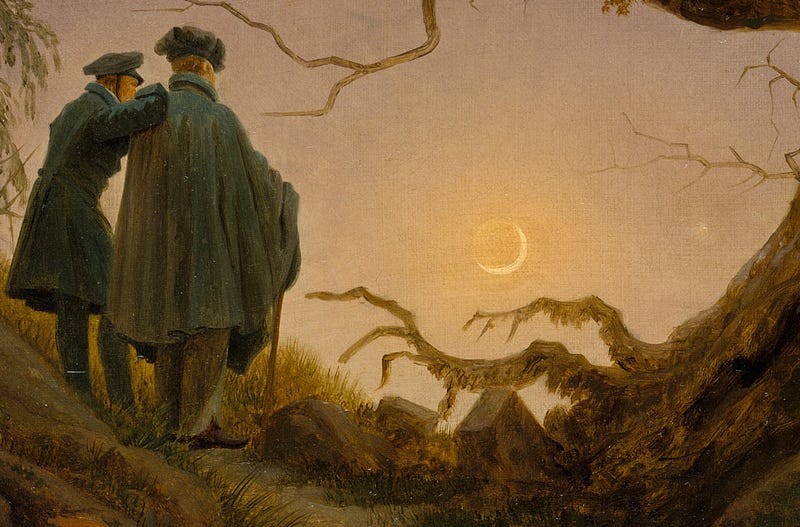
Friedrich would undoubtedly have been aware of the iconographical connotations of the moon. Treated all together, the symbolic details that load this add up to a reflection on life and spirituality in all its complex, meandering aspects.
In a broad sense, the various phases of the moon through the process of waxing and waning have been an apt symbol for philosophies that emphasise the cycle of death and rebirth.
Moreover, in many cultural traditions, the moon has been connected with femininity — though rather chauvinistically — as the passive recipient of the sun’s rays. In Christian thought, the moon was associated with the Virgin Mary, who not only reflected the glory of God (e.g. the sun) but in paintings is often seen standing upon a crescent-shaped moon. The idea stems from the Book of Revelation (Apocalypse), Chapter 12:
“And a great portent appeared in heaven, a woman clothed with the sun, with the moon under her feet, and on her head a crown of twelve stars…”
For Friedrich — who wrestled with his Lutheran upbringing throughout his life — the symbolic connotation of the moon was double-edged.
Indeed, one senses that for Friedrich the moon was an object of empirical curiosity as much as anything else. At the time of the painting, the moon had already been accurately mapped by telescopic observations, though there was still much speculation as to the nature of its surface landscape, the possible presence of an atmosphere, and whether or not it was inhabited.
The two men in the painting are clearly town-dwelling folk, and their contemplation of the evening sky is an intellectual one as much as a spiritual one.
As such, the artwork expresses the idea that direct emotions and personal encounters with nature hold as much — if not more — significance than the conventions of a God-fearing society. In this way, I can’t help but see the painting as hopeful, even if one’s faith was waning.
This conjunction, between spiritual and scientific speculation, underlies many of his best paintings. With Friedrich, there is always the question of where religion ends and nature begins.

If you liked this, you may also be interested in my book Masterpieces of Art Explained, an examination of some of art’s most enthralling images.
Would you like to get…
A free guide to the Essential Styles in Western Art History, plus updates and exclusive news about me and my writing? Download for free here.
Join me…
On Instagram for more great paintings on the go!