
How to Read Faster and More. Improve Your Reader Skills Today!
Learn some easy methods to increase your reading speed and improve your comprehension.
The more we research online, the more we learn from there. That’s what I found for myself recently when I started writing more significant stories on Medium.
And the more important thing to understand is if you even know something and want to share it with people, it’s better to learn more about it. Even if you are an expert or have excellent knowledge, ensure you have fresh information.
The same thing happened to me when I started researching this topic. Reading is such a simple process. We learn how to do it at 5–7 years old and then use it at school, university, and work. We know how to do it, and we do it.
I thought the same way before watching many Youtube videos and reading the exact number of articles on this topic. They repeat each other at some common points.
But sometimes I find distinct advice I’d like to share with you. Also, we will highlight the most crucial advice and summarise what we should implement today.
Reading Speed
Before we start, we need to understand how to count our speed reading. In simple words, it’s something like car speed, but we trust not in km per hour but in words per minute.
The only question in our heads is, what reading speed do I have, and how can I improve it?
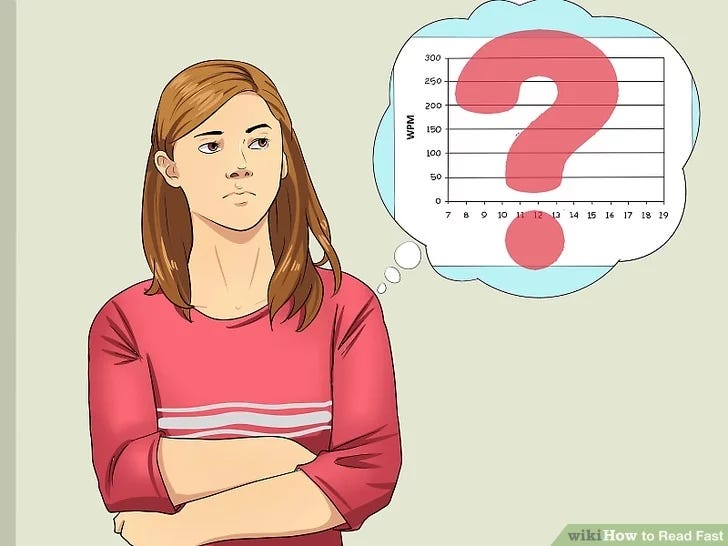
We need to count your WPM speed. It’s your speed, words per minute, that you can read usually.
You need to set a timer for 10 minutes and start reading. Then count all words you have read before and divide them by 10. It’s your WPM speed. Below is a table to find your results and understand your skill level.
Readers Skill Levels
- 200 to 250 WPM is the typical reading speed for individuals aged 12 or older.
- 300 WPM is the average reading speed of a college student.
- 450 WPM is you’re reading quickly, like a college student who’s trying to find the critical information. The goal is to understand most of what you’re reading.
- 600 to 700 WPM, you’re reading quite quickly, almost like a college student scanning for a specific word. Many individuals can reach this reading speed while maintaining around 75% of their usual comprehension.
- 1,000 WPM and above, you’re reaching the level of competitive speed readers. Approaching this level requires extreme techniques; most people can only remember a little at this speed.
Doubling your reading speed takes around 2–4 weeks, so it’s essential to be patient with yourself and stay committed to the process. Keep practicing!
Knowing your speed reading skill, you know your position in this table. And as all we know, we can improve it as any other skill.
So now, let’s learn about two approaches we can apply to improve our reading skills today.
Physical Approaches
Reading starts with your eyes, and at least 50% of the success of your assignment depends on it. Another part of this depends on different factors in your head.
How can we focus better on the text? How can we read faster? How do we apply it?
We have some terrible habits, and because of them, we are getting distracted or stuck in the same place in the book. Let’s discover some of them and find ways to deal with them.
1. Subvocalization
Our inner voice is the number one enemy that distracts us from the reading. Some people also read with their lips or voice, because we get used to doing it at school.
A method to stop this habit is to press your finger against your lips or to divert your brain’s attention by pressing your tongue against the roof of your mouth. In both cases, the physical effort you can apply to prevent reading with your mouth.
Another thing that distracts us is our inner voice. To self-talking, we need to work on our awareness.
On the other hand, it isn’t nice to read in a fully quiet or loud space. That’s why many readers use focus music from Lord of The Ring movie, classical or anything else. Important to have this music without any words. Then it’s easy to focus on your reading.
Also, it’s better to listen to some quite not distinctive music. You can search it by keywords like “focus,” “reading music,” etc.
2. Regression
After reading, our eyes get back to the sentences we just read. It can happen because of distractions or because we need to remember what we just read. But in this case, it’s okay to miss several minutes with movies because we will understand quickly.
Additionally, by principle, 20% gives 80% results; we don’t need to read each word in the book to understand it fully. So, don’t worry if you miss or forget some comments. Relax and enjoy your process.
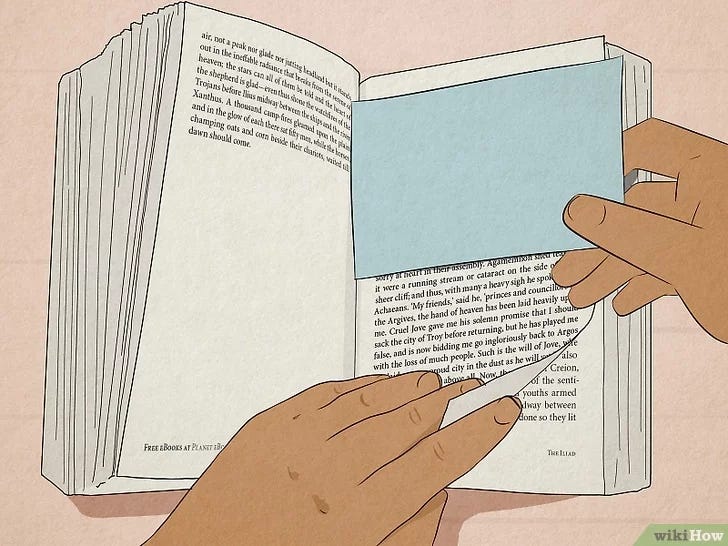
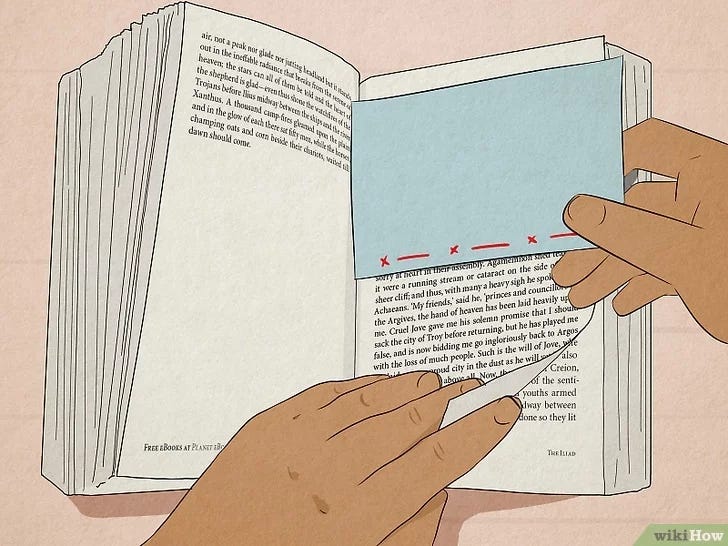
You should be curious first of all. And instead of passive reading, you need to become an active reader. It means that you understand why you are reading. And you know what you are looking for on any particular page. To not get distracted from the words you are currently reading, you can use your finger to point and focus on them.
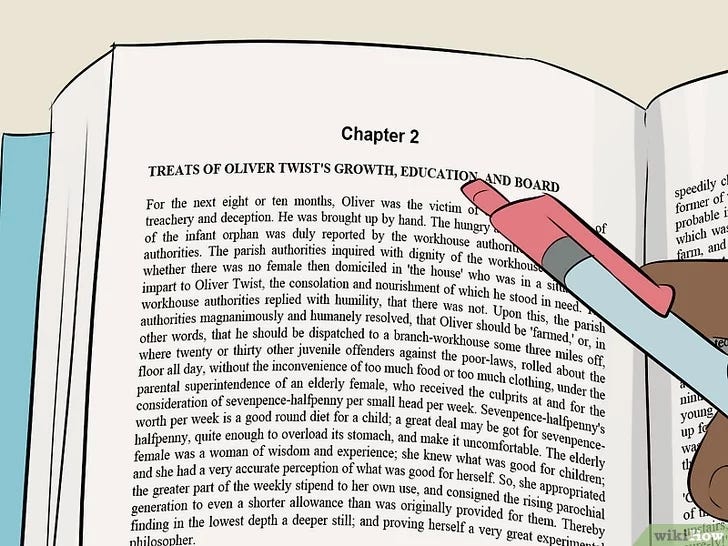
Or you can use some paper like the one in the picture below.
3. Fixations
Another bad habit all we have is focusing on each word in the text. To read the whole text, we need to read each word. The problem is the following. When we are focusing on each word, our eyes are moving from the left side of the page to the right side of this page.
Science says that, additionally, we’ll see space on the page on the left and right sides. It happens because of our peripheral vision. To use more innovation, we need to start reading from the 2 or 3 words from the start of the page. Finish, we need not on the latest word but on the 2 or 3 comments from the end of this page, as shown in the picture below.
Additionally, we can see that we have a symbol, “x,” at the same distance. These are points where we need to move our eyes to. So we start at the first “x,” then look at the “x,” and finish with the 3 one.
You can use even more symbols for this. But the main idea is that we need to move our eyes less than usual. Then we will be able to read each line faster.
4. Pro Skills to Read One Book per Day
At this point, I’d like to share challenging skills that will help you read faster and learn what you have read many times better. If it’s an entertaining book, you don’t need to use it; you can skip this point. But otherwise, it’s better to use it, as other tips pointed out above.
Tips to use:
- Before delving into this book, it’s essential to take note of the front and back cover. Understanding the author’s perspective and context will help you appreciate each sentence and read it faster.
- The table of content. In this place, you can learn the main points of this book. Usually, authors write actions to do, so you already know what it will be about. Also, it will help you if you want to read or skip a particular chapter.
- Skim. Spend only 10 seconds per page. Focus on main titles, subtitles, and diagrams.
- Scanning. Now you need to spend 30 seconds per page. Go to the subheading and look for keywords you are interested in. You will go through the whole page twice and more faster than other readers!
- Increase your speed reading with tips from point number 3.
With these tips, you will read faster and improve your comprehension. You have reviewed and know what’s coming up. It’s how to read a book a day. Time is precious. So waste it wisely.
I have learned these skills from the video below. So if you want to know them better, watch it.
Psychological Approaches
After understanding our physical limits and bad habits, it’s time to learn the psychological part. Usually, I have never thought about it, and almost nobody tells us what we can do about it. But after watching the following video, I have changed my mind.
In this video, the author tells us about essential routines and rules that we can apply to improve our skills from the psychological side.
Now let’s take a closer look at them.
1. Schedule Your Reading
When you have a habit or routine, it’s much easier to follow it when you do something randomly — the same thing with reading.
You can be distracted or without a suitable mood for this if you do it constantly every day at some particular time, for example, in the morning after waking up. Or in the evening before going to the bad. Your brain is getting used to it!
To find the best time in your schedule when you want to read. Set a goal when you want to finish this book. And then, when you have this Calendar event with reading time, do what you need to do. Relax and give yourself an enjoyable time.
2. Chapter is a ton of ideas, where only several are the main
As I noticed above, the principle is 80/20. You don’t need to read the whole book to understand the main points. Read the name of the chapter. Then title by title, read and look for the keywords you need.
3. Don’t be bored; skip if you need some paragraphs or even pages
If you don’t see anything interesting on the page, skip it. You won’t miss anything important. When you find an exciting chapter with the right words, you can take your time and read deeper.
4. Read several books at the same time
Often we feel bored with some particular books. Or feel little energy to read a lot from some book. It’s good advice in both videos by Mark Manson and Tim Ferriss.
You can read 2, 3, 4, or even five books simultaneously. Stay focused and remember what you have read in some of them. Use this rule as it suits you. Reading more than a book in a month is unnecessary, but you can find what fits you best.
5. Write notes about what you have just read
It’s good to write down your notes because of several reasons. First, you repeat the read content one more time and then learn it better. The second reason is that you create more ideas and think in other directions.
Also, if you need to refresh your memory on this material or get advice, you can find your notes and read them without problems.
6. Make Actions (Plan) from Advice
Each book you read with some purpose. If you are looking for advice on doing something, it’s excellent! But to understand direction is not enough. It would help if you converted it to action or even a plan of action. Then after applying them, you will use your knowledge in your life. Just try it, and don’t read just for reading.
3 Great Questions You Should Ask Yourself
If you have riched this point, my congratulations! Here we will look at some bonus tips and a video that can bring you more insights on this topic.
- What are the five best ideas in this book?
- I want to summarise all book ideas on just one piece of paper. How would I do it?
- What is 20% of advice from this book that gives 80% of the benefits?
You can enhance your understanding by watching the video below.
I also have two articles where I found most of the materials I’d like to share. They contain complete guides with step-by-step plans to improve reading skills and track progress.


