
How To Read Dante’s “Divine Comedy” #1
A little guide to fully appreciate Alighieri’s poetry (Canto I)
History
Dante began the composition of the Commedia during his exile, around 1307.
The chronology of the work is uncertain, but it is believed that Inferno was concluded around 1308, Purgatorio around 1313, while Paradiso would have been completed a few months before his death, in 1321.
The original title is Commedia, or rather Comedia, according to the definition of Dante himself; the adjective Divina was added by Boccaccio in Dante’s Trattatello in laude (mid-14th century) and appeared for the first time in an edition of 1555, edited by Ludovico Dolce.
It is a didactic-allegorical poem, written in hendecasyllables and in third rhymes. It tells the journey of Dante in the three realms of the Oltretomba, led first by the poet Virgil (who leads him through Inferno and Purgatorio) and then by Beatrice (who guides him to Paradiso).
The work aims primarily to describe the condition of souls after death, but it is also an allegory of the path of purification that every man must take in this life to obtain eternal salvation and escape from damnation.
It is also a courageous and heartfelt act of denunciation against the evils of Dante’s time, especially against ecclesiastical corruption and abuses of political power, in the name of justice.
Structure
The Commedia is divided into 3 Cantiche (Inferno, Purgatorio, Paradiso), each of which is divided into Canti: the numbers are:
- 34 Canti for Inferno (the first is a general introduction to the poem)
- 33 for Purgatorio and Paradiso, therefore 100 in total.
Each Canto is composed of hendecasyllabic verses grouped in linked rhyming triplets (with scheme ABA, BCB, CDC …), of variable length (from a minimum of 115 to a maximum of 160 verses).
In total. the poem has 14,233 hendecasyllabic lines.
In the work there are some parallels, which fall within the typically medieval taste for symmetries: the Canto VI of each Cantica is about a political topic, according to an ascending climax (Florence in Inferno, Italy in Purgatorio, the Empire in Paradiso).
Each Cantica ends with the word “stelle”:
- “and therefore we went out to see the stars”, Inf., XXXIV, 139
- “pure and willing to rise to the stars”, Purg., XXXIII, 145
- “the love that move the sun and the other stars”, Par., XXXIII, 145
The number “3” dominates the poem, symbol of the Trinity.
Themes
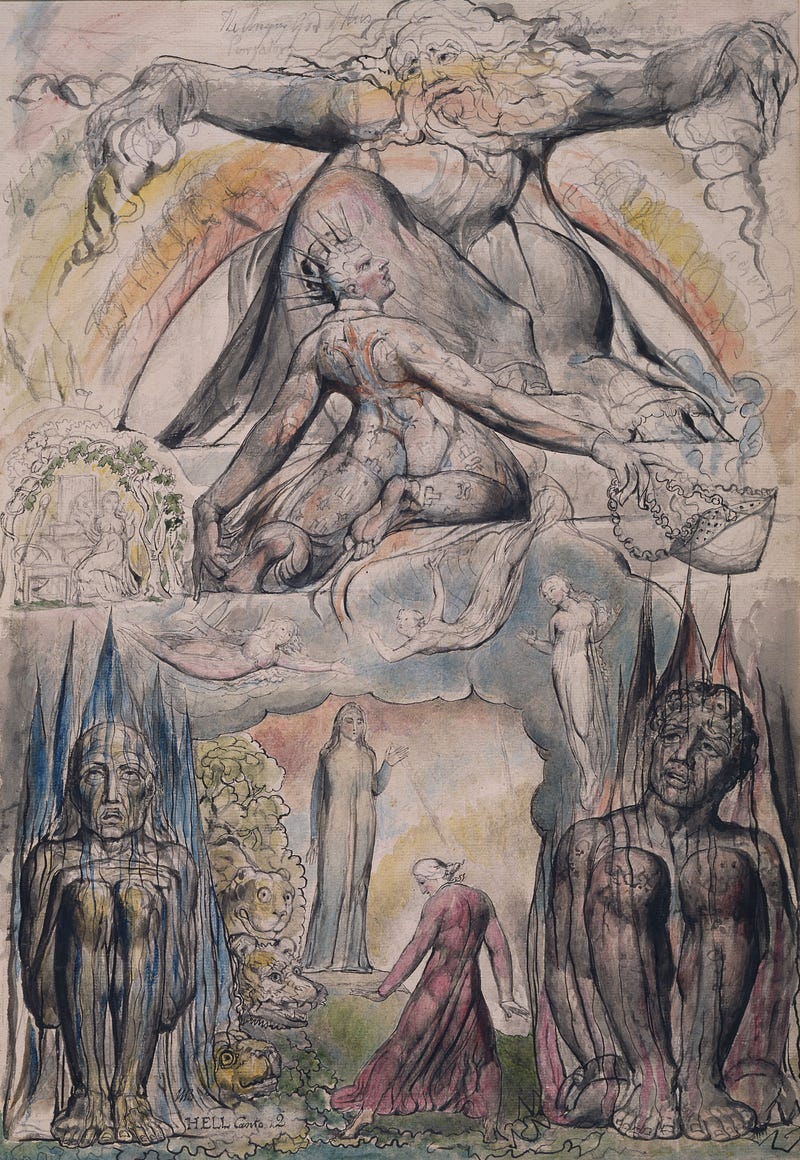
The Commedia is the story of a journey, which has a literal and another allegorical meaning. The literal meaning is that of the journey of a man, Dante, who on the night of April 7 (or March 25) of the year 1300 gets lost in a forest, where he encounters some wild beasts and is then rescued by the soul of the poet Virgil, leading him through the three realms of the Oltretomba.
This trip has the function of illustrating to the readers the condition of post mortem souls, as Dante himself clarifies in Epistle XIII to Cangrande della Scala, and takes place in the holy week of the year in which Pope Boniface VIII announced the first Jubilee of the Christian Church from 8 to 14 April 1300.
However, the journey also has an allegorical meaning, that is, a path of moral and religious purification that every man can and must take in this life to obtain eternal salvation. In this light, the various characters of the poem can have a double meaning, literal (or historical) and allegorical:
- Dante is for example the Florentine poet born in 1265 and author of the Vita Nuova (literal sense), but he is also every man (allegorical sense ).
- Virgil is the Latin poet, author of the Aeneid, but also the natural reason of the ancient philosophers capable of leading every man to earthly happiness.
- Beatrice is the woman loved by Dante and died in Florence in 1290, but it is also revealed theology and divine grace capable of leading every man to eternal happiness.
It is then evident that Virgil, an allegory of human reason, can guide Dante only to the Paradiso Terrestre located on the top of the mountain of Purgatorio, which in turn is an allegory of earthly happiness and possession of cardinal virtues (prudence, fortitude, temperance and justice), while Beatrice will guide Dante to Paradiso Celestre, an allegory of eternal happiness and possession of the theological virtues (faith, hope and charity).
The reading of the poem must consider this interpretation, called by Erich Auerbach “figural”, otherwise there is the risk of not understanding much of its basic meaning!
Style
The title Commedia refers to the medieval style theory and alludes to the fact that the poem starts badly, with the anguished loss in the forest, and ends well, with the ascent to the Empyrean and the vision of his God (on the contrary, the tragedy starts well and it ends badly, as clarified by Aristotle in the Poetics, which Dante knew indirectly).
Medieval rhetoric also distinguished three styles, the high and “tragic” one, the medium and “comic” one, the low and “elegiac” one (which corresponded to the three works of Virgil — Aeneid, Georgics, Bucolics).
The Commedia presents a mixture of all three styles, even if there is a certain prevalence for the “comic” one, especially in Inferno.
Language
As for the language, Dante uses the Florentine vernacular already used in previous works, although he also resorts to Latinisms, French, Provençalisms and loans from various other languages (some have even seen words of Arabic origin, while verses 140–147 from Canto XXVI of Purgatorio are in Occitan).
Dante sometimes resorts to strange and incomprehensible languages (the words of Pluto, those of Nembrod in Inferno), while elsewhere he coined bold neologisms (especially in Paradiso).
This has led scholars to speak of plurilingualism and pluristilism of the Commedia, which differentiates Dante from Petrarca and from the poets of Humanism and the Renaissance, who will prefer a more “pure” and regular language to his version.
Novelty
The novelty of the Commedia is not only the description of the places of the Afterlife, already proposed by other previous writers, but rather the fact that Dante does not limit himself to describing punishments and awards but indicates well-known personalities that the public of the time knew very well.
In other words, the author indicates to the readers examples (exempla in Latin) of punished sins or rewarded virtues that have “public” characters as protagonists, and therefore are known to all, because only in this way is it possible to arouse the greatest possible effect in the imagination (it is Dante himself to clarify it in Canto XVII of Paradiso, in the words of Cacciaguida)
This also responds to another function, that of using well-known and often “scandalous” examples to denounce the evils and injustices of the time.
This explains why Dante chooses the characters to be included among the damned, the penitents or the blessed on the basis of the notoriety criterion, or among the most important and well-known examples of that sin or that virtue, no matter whether real and historical or literary and imaginary.
We have characters who belong to ancient and recent history, to the “black” chronicle of Dante’s time (think of Paolo and Francesca), to the classic myth, literature, biblical tradition. Moreover, Dante does not distinguish between myth and history in a scientific and modern way, because everything is functional to the representation of eschatology, that is, the reality of the Oltretomba and the otherworldly fate of souls.
In the same way, Dante does not hesitate to reinterpret (in a Christian key) characters and events of the classical myths, according to a typical tradition of the Middle Ages: Virgil himself was seen as “magician and prophet” of Christianity, since it was believed he predicted the birth of Christ in Egloga IV.
Similarly, many demons and infernal monsters are classical divinities now degraded to the rank of devils, while we find the Latin and pagan poet Stazio among the souls of Purgatorio, Rifeo and Trajan among blessed of Paradiso.
The same Muses, Apollo, Jupiter are images used to overshadow his God.
Narrative
A further consideration must be made on the dual role played by Dante in the poem, being at the same time the protagonist of the journey he narrated (and which he describes as actually and physically occurred in a precise historical time) and poet, called to tell in verses the experience faced.
Dante clarifies in more than one step of the poem that he has had an exceptional privilege, that of visiting the three kingdoms of the Oltretomba alive and returning to Earth to report exactly what he has seen.
It is an extraordinary mission, to which he is called by virtue of his merits as a writer and poet, making him similar to Aeneas and Saint Paul, already protagonists of similar experiences.
In this regard, it is important what Dante himself stresses on several occasions during the journey, not only that is the absolute truthfulness of the things seen and narrated, but also the objective difficulty of explaining with human words what is non-human and otherworldly saw.
To do this, Dante will need the assistance and help of his God, therefore the Commedia is an “inspired” book, written materially by Dante but under the “dictation” of the divine grace that charged him with this extraordinary task.
The Commedia therefore becomes a sort of new Bible, and it is Dante himself who defines it as a sacred poem. In this sense, the author can well expect eternal fame, even for the absolute novelty of the matter he treated. Nobody before him had touched on these subjects in such an innovative way.
Inferno — Canto I
Listen (read by Iacopo Vettori)
Nel mezzo del cammin di nostra vita mi ritrovai per una selva oscura, ché la diritta via era smarrita.
Halfway through the path of human life (at the age of 35), I found myself in a dark forest, since I had lost the right path.
Ahi quanto a dir qual era è cosa dura esta selva selvaggia e aspra e forte che nel pensier rinova la paura!
Alas, it is difficult to describe what that forest was like, wild, inextricable and terrible, such that at the mere thought of it makes fear return.
Tant’è amara che poco è più morte; ma per trattar del ben ch’i’ vi trovai, dirò de l’altre cose ch’i’ v’ ho scorte.
It is so frightening that death is little more: but to describe the good I found in it, I will say what other things I have seen in it.
Io non so ben ridir com’i’ v’intrai, tant’era pien di sonno a quel punto che la verace via abbandonai.
I can’t explain how he got there, I was so full of sleep the moment I left the right path.
Ma poi ch’i’ fui al piè d’un colle giunto, là dove terminava quella valle che m’avea di paura il cor compunto,
But after I arrived at the foot of a hill, where the valley that had saddened my heart with fear ended,
guardai in alto e vidi le sue spalle vestite già de’ raggi del pianeta che mena dritto altrui per ogne calle.
I looked up and saw its peak already illuminated by the rays of the sun, which leads every man on the right path.
Allor fu la paura un poco queta, che nel lago del cor m’era durata la notte ch’i’ passai con tanta pieta.
Then the fear I had deep in my heart subsided a little that night I spent with so much anguish.
E come quei che con lena affannata, uscito fuor del pelago a la riva, si volge a l’acqua perigliosa e guata,
And like the shipwrecked man who with labored breath, thrown from the sea on the shore, turns and looks at the dangerous waters from which he escaped,
così l’animo mio, ch’ancor fuggiva, si volse a retro a rimirar lo passo che non lasciò già mai persona viva.
so my soul, who was still on the run, turned back to observe the passage that he never let pass alive no man.
Poi ch’èi posato un poco il corpo lasso, ripresi via per la piaggia diserta, sì che ’l piè fermo sempre era ’l più basso.
After I had rested my tired body a little, I started walking again along the deserted slope of the hill, so that the steadiest foot was always the lowest.
Ed ecco, quasi al cominciar de l’erta, una lonza leggera e presta molto, che di pel macolato era coverta;
And here appeared, almost at the beginning of the climb, a slender and very agile loin, covered with spotted fur;
e non mi si partia dinanzi al volto, anzi ’mpediva tanto il mio cammino, ch’i’ fui per ritornar più volte vòlto.
and it did not move away from me, on the contrary, it impeded my path to such an extent that I thought several times of going back.
Temp’era dal principio del mattino, e ’l sol montava ’n sù con quelle stelle ch’eran con lui quando l’amor divino
It was the early hours of the morning, and the sun was rising together with that constellation (Aries) which was with him on the day of Creation, when divine love
mosse di prima quelle cose belle; sì ch’a bene sperar m’era cagione di quella fiera a la gaetta pelle
moved those beautiful things for the first time; so gave me good reasons to hope well about that beast with mottled skin
l’ora del tempo e la dolce stagione; ma non sì che paura non mi desse la vista che m’apparve d’un leone.
the time of day and the spring season; but not to the point that I was not afraid of the sight of a lion that appeared immediately afterwards.
Questi parea che contra me venisse con la test’alta e con rabbiosa fame, sì che parea che l’aere ne tremesse.
The latter seemed to come against me, with his head high and with angry hunger, to the point that even the air seemed to tremble.
Ed una lupa, che di tutte brame sembiava carca ne la sua magrezza, e molte genti fé già viver grame,
And here appears a she-wolf, who in her thinness seems full of all desires and pushed many people to live miserably;
questa mi porse tanto di gravezza con la paura ch’uscia di sua vista, ch’io perdei la speranza de l’altezza.
this caused me such anguish, with the terror that inspired its appearance, that I lost hope of reaching the top of the hill.
E qual è quei che volontieri acquista, e giugne ’l tempo che perder lo face, che ’n tutti suoi pensier piange e s’attrista;
And like the one who willingly buys, and then the time comes when he loses everything, for which he cries and becomes saddened in every thought,
tal mi fece la bestia sanza pace, che, venendomi ’ncontro, a poco a poco mi ripigneva là dove ’l sol tace.
thus made me the beast without peace, who, coming against me, pushed me gradually downwards, where there was no sun.
Mentre ch’i’ rovinava in basso loco, dinanzi a li occhi mi si fu offerto chi per lungo silenzio parea fioco.
As I slid down to the forest, someone I could not see clearly because of the twilight appeared before my eyes.
Quando vidi costui nel gran diserto, “Miserere di me”, gridai a lui, “qual che tu sii, od ombra od omo certo!”.
When I saw him in the deserted place, I shouted to him: “Have mercy on me, whoever you are, a soul or a man in flesh and blood!”
Rispuosemi: “Non omo, omo già fui, e li parenti miei furon lombardi, mantoani per patrïa ambedui.
He replied: “No, I am not a man, I have already been, and my parents were from Lombardy, both natives of Mantua.
Nacqui sub Iulio, ancor che fosse tardi, e vissi a Roma sotto ’l buono Augusto nel tempo de li dèi falsi e bugiardi.
I was born under the government of Julius Caesar, although in recent years, and I lived in Rome under the government of the good emperor Augustus, at the time of the pagan gods.
Poeta fui, e cantai di quel giusto figliuol d’Anchise che venne di Troia, poi che ’l superbo Ilïón fu combusto.
I was a poet, and I sang of that righteous son of Anchises (Aeneas) who fled Troy after the proud Ilio (Troy) was burned.
Ma tu perché ritorni a tanta noia? perché non sali il dilettoso monte ch’è principio e cagion di tutta gioia?”
But why do you return to the evil of the forest? Why don’t you climb the joyful hill, which is the beginning and cause of all happiness?”.
“Or se’ tu quel Virgilioe quella fonte che spandi di parlar sì largo fiume?”, rispuos’io lui con vergognosa fronte.
“So you are that Virgil and that spring that spreads such a large river of words?” I answered him ashamed.
“O de li altri poeti onore e lume, vagliami ’l lungo studio e ’l grande amore che m’ ha fatto cercar lo tuo volume.
“O you who are the light and guide of the other poets, may the long commitment and great love that prompted me to read your work help me!
Tu se’ lo mio maestro e ’l mio autore, tu se’ solo colui da cu’ io tolsi lo bello stilo che m’ ha fatto onore.
You are my teacher and my model; you are the only one from whom I drew the beautiful style that made me famous.
Vedi la bestia per cu’ io mi volsi; aiutami da lei, famoso saggio, ch’ella mi fa tremar le vene e i polsi”.
See the beast that made me turn; help me from her, famous wise man, because it makes every drop of my blood tremble”.
“A te convien tenere altro vïaggio”, rispuose, poi che lagrimar mi vide, “se vuo’ campar d’esto loco selvaggio;
“You have to make another journey,” he replied after seeing me cry, “if you want to save yourself from this wild place.
ché questa bestia, per la qual tu gride, non lascia altrui passar per la sua via, ma tanto lo ’mpedisce che l’uccide;
In fact, the beast who makes you scream does not let anyone go on his way, but prevents him from killing him.
e ha natura sì malvagia e ria, che mai non empie la bramosa voglia, e dopo ’l pasto ha più fame che pria.
And he has such an evil and evil disposition that he can never satisfy his craving, and after every meal he is more hungry than before.
Molti son li animali a cui s’ammoglia, e più saranno ancora, infin che ’l veltro verrà, che la farà morir con doglia.
There are many animals to which it mates, and they will be more and more, until the hunting dog (veltro) arrives that will make it die with pain.
Questi non ciberà terra né peltro, ma sapïenza, amore e virtute, e sua nazion sarà tra feltro e feltro.
He will pay no attention to material wealth, but only to spiritual wealth and his birth will take place between felt and felt.
Di quella umile Italia fia salute per cui morì la vergine Cammilla, Eurialo e Turno e Niso di ferute.
It will be the salvation of that humble Italy, for which Eurialo and Niso, Turno, the virgin Camilla died in battle.
Questi la caccerà per ogne villa, fin che l’avrà rimessa ne lo ’nferno, là onde ’nvidia prima dipartilla.
He will hunt her down for every city, until he puts her back in Hell from where the envy (of the devil) made her come out for the first time.
Ond’io per lo tuo me’ penso e discerno che tu mi segui, e io sarò tua guida, e trarrotti di qui per loco etterno;
Therefore I think and judge for your sake that you should follow me, and I will guide you; and I’ll take you out of here to guide you to a place in the Underworld,
ove udirai le disperate strida, vedrai li antichi spiriti dolenti, ch’a la seconda morte ciascun grida;
where you will hear desperate cries and see the ancient souls of the damned, each of whom invokes definitive death.
e vederai color che son contenti nel foco, perché speran di venire quando che sia a le beate genti.
And then you will see those who are happy to suffer penalties (the penitents of Purgatory), because they hope one day to reach the blessed of Heaven.
A le quai poi se tu vorrai salire, anima fia a ciò più di me degna: con lei ti lascerò nel mio partire;
And if you want to go up to visit the latter, then there will be a soul worthy of me to guide you: when I leave, I will leave you with her.
ché quello imperador che là sù regna, perch’i’ fu’ ribellante a la sua legge, non vuol che ’n sua città per me si vegna.
In fact, that emperor (God) who reigns up there, does not want me to enter his city, as I was rebellious against his law (I was pagan).
In tutte parti impera e quivi regge; quivi è la sua città e l’alto seggio: oh felice colui cu’ ivi elegge!”.
God has authority throughout the universe and in heaven he rules; here is his city and his other throne; oh, happy he who chooses to reside in that place!”
E io a lui: “Poeta, io ti richeggio per quello Dio che tu non conoscesti, acciò ch’io fugga questo male e peggio,
And I said to him, “Poet, in the name of that God you did not know and that I may flee this evil and other worse ones,
che tu mi meni là dov’or dicesti, sì ch’io veggia la porta di san Pietro e color cui tu fai cotanto mesti”.
I ask you to take me where you said, so that I see the door of San Pietro and those you describe so miserable”.
Allor si mosse, e io li tenni dietro.
Then he set off, and I followed him.
references:


