
How To Read Books, But Only At Random
Life is a random sequence of events, roll with it and it will take you places.

How would you navigate if you had to read books at random in finding your desired solution?
I read books at random, only when I need to. It is only when something piques my curiosity do I open a book. But what do I do before? We live in a magical world where reading, has become as simple as writing a few words in the search bar. Press “Enter” to begin and the search continues. Until we find the links to our results that await on the other side of exploration, unlimited.
When I was in my university, I only read pieces or fragments of books. I never had any intent to finish them nor did I have any drive. My main goal was always to focus on the crux of what the book suggested. You can fairly learn the patterns of how a writer encodes the message hidden between the jargon. It takes time to realize this ability. But when it manifests, you become an intellectual.
Smart enough to understand, how the flow goes. It is the process of dissecting information from jargon. I have known many people over the years who fascinate on my ability to find solutions. As a software engineer, I find it easier when I randomize the probability of a solution by supplementing the problem space with a random instance of an event.
An event can be anything from a thousand links of a potential search. Or It can be a formulation of tactics that can be understood from numerous pieces of text. If the problem space is properly defined, one can easily find a solution.
There is a reason for that because when we place conditions on a properly defined problem — we are instantly able to find a solution using any theorem of probability. In some cases, I use Bayes theorem not to be confused with Bae’s theorem.
By definition — Bayes’s theorem, named after Reverend Thomas Bayes, describes the probability of an event, based on prior knowledge of conditions that might be related to the event.
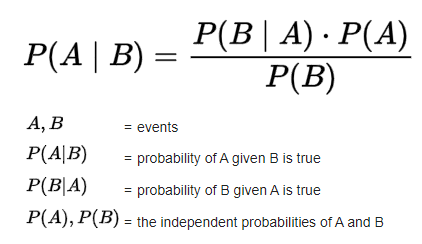
This theorem of probability makes finding a solution easier if the problem space is defined with the right conditions set. Event A can be the intervention of search, that I would do. Event B will be the possibilities of results that will occur when Event A occurs.
In fields of medical science, this theorem is usually used to test the medical accuracy of said tests — that indicate a person likely to catch a disease and the accuracy of the results acquired by those tests.
It has a wide array of applications when concerning real life. And it isn’t just a fancy way of doing mathematical probability. I use this method along with my own mental models that I have crafted over the years to find solutions. I let my subconscious mind think while my conscious mind does the grunt work. Isn’t that neat?
We can classify any problem space using this theorem. It is highly applicable when the given conditions are set. And one event generally leads to another. When concerning problem-solving, it is a handy tool to remove the B.S from the problem space allowing you to focus on the set outcomes.
80% of the time when this method is used, it allows me to find my solution given that the requirement is correct. For example, If somebody asks me to find a book online. They tell me the specifications of the book such as it has a file format of pdf. And the subject is regarding social studies. All of these are exciting details that allow me to further my searching abilities in creating an algorithm to find that book.
Not all web scraping technologies have to be used. They are only used when I’m unable to find the solution. In the given instance i.e. 20% of times where the solution found is incomplete. I usually refer it to the person who initially gave me the problem space. As there is possibly something he forgot to mention. Or I might have missed.
Though an incomplete solution is still a solution which further needs tinkering. It is an exciting journey to behold when you get right down to it.
When should you read books?
When I reach a point at random where I need guidance, I hit the books. The ones I have either on my shelves or the digital libraries I carry around either in my phone or laptop. I extensively search for the specific words that I need to scrape through the web to find an existing solution.
As most of the information online is stored on servers, & people usually ask the same questions. And sometimes you will find this eureka moment where what you’re looking for is in an archived thread, whether on Reddit or Warez.
Both forums equally equipped with people and information that’s readily available for any web lurker out there. When it comes to finding answers these days, it is easier to narrow it down to what you really want to do using probability.
Imagine a world, where we were taught to embrace randomness — our lives would have been so much easier. If we were able to equate randomness in everything we do.
randomness(R) | Life(L)= ?
If only it were that easy, to equate an Event R of randomness to occur in Life(L) — our problems would have never been seen as problems but opportunities as a result. The answer would solve our lives as a whole.
We would have been able to see the error in our ways, as opportunities rather than obstacles. But from a statistical perspective, an obstacle is also an opportunity to explore many hypotheses.
What I want to say, is that read with a sense of randomness that seeks to explore the truths hidden behind the jargon.
Rather than just reading empty words, that can never be applied realistically. Unless you use probability to dissect those methods and use them in your own way. Only then can they be deemed useful. As they say, some things work in the right hands — you just need to adopt a mindset of solving such problems.
“The 50–50–90 rule: anytime you have a 50–50 chance of getting something right, there’s a 90% probability you’ll get it wrong.” ― Andy Rooney
The solutions, however, will come when you aim to plot the random behaviours of your problems. Perhaps then you will read to learn, to solve. As time is of the essence when you’re searching for problems to solve. The ball of text or the writing on the wall doesn’t matter unless you choose to do something about it.
The Takeaway
I hope you take this chance, to carefully understand how probability and randomness can actually benefit your life. As it’s all but a game of choosing at random, perhaps you might recognise the patterns to make a sense of it all if you choose to follow the following steps.
- Define your problems at random.
- Dissect them into events, A, B…Z.
- Find the necessary conditions you need for each to occur after the other.
- Map your solution, and contain the element of randomness to a variable that you can account for; if any mistakes or errors do arise — you’ll know who to blame.
- Implement your hypothesis, and reflect on your results.
- Improvise as determined and follow the random lines to the next learning space.


