
Strategy to Read a Self-Help Book

Self-help books are very much different from normal ones. These books are not merely to acquire information, but for an attempt to form new habits and a new way of life. They definitely need special attention than usual weakened or casual travel reads if you want to learn a life-changing skill. It is very natural to skip special attention to them. But think of it like this, whenever you read any book that comes under the self-help category, you are actually not just reading a book but engaging yourself in a self-educational process that is both intriguing and priceless.
“Formal education will make you a living; self-education will make you a fortune.”― Jim Rohn
Here are a few generalized pieces of advice that are merged after deep research and analysis of major data. If you wish to get the most out of a self-help book, then go through the following pieces of advice and find time to apply them.
1. Choose from yourself, not from a Google search.

Sometimes we think of getting a new book. Then what people do is a Google search to find a book that is highly rated, and they get that one. Here is where it goes wrong, you may not find yourself much involved, even if it is an excellent copy. Instead, you can google for a category of books and understand what the author is trying to convey, then analyze if it best suits your needs. Following this procedure will make you more involved in the selection process and eager to read the book.
2. Before you start, ask yourself Why.

Before starting to read a book, just ask yourself these 3 questions,
- Why have I picked this book out of many on the market?
- What are the changes it is going to bring to me?
- How progressive will my life be after these changes in me?
Think deeply to find satisfactory answers to these 3 questions before you proceed further. Doing so will help you mentally know the importance and purpose of investing time and energy in reading that specific self-help book.
3. The magical requirement!

This is one indispensable requirement, one very much essential, infinitely more important than any rule or technique. Wait, are you feeling it as some kind of complicated requirement? Don’t do that because it’s a very simple fundamental requisite. It’s just this: a deep, driving desire to learn, a vigorous determination to increase your ability. Now it may sound simple, right!
But if you are like “how do I develop that deep desire ……” then I am telling you a simple way to do that. Just constantly recall how important those changes in your life are and how as a person those habits are going to elevate your way of life. Say this to yourself over and over again.
Practicing this will make you disciplined, committed, and determined.
“Discipline automates habits which, in turn, determine your outcomes.” — David Khalil
4. Give a glance before you start
Give a glance at each chapter to get a bird’s eye view of it. Don’t be lured by the self rewards for completing the book. You are not reading for entertainment or reference. You are learning a skill that acts as a tool for your betterment.
Start by reading a specific chapter rapidly, then instead of rushing to the next chapter go back and reread the current chapter thoroughly. Doing this will mean saving time and getting a lot better results in the long run.
5. Make stops until you feel confident!
It’s completely ok to stop and think over what you just read. After reading, good readers often think about or reflect on what they read. They mentally summarize major points or events in the text or even go to other sources to find additional information about the topic of the reading. Move on when you feel you have a good picture of what you just read.
6. Be Active in the process
“If you teach a man anything, he will never learn.” — Bernard Shaw
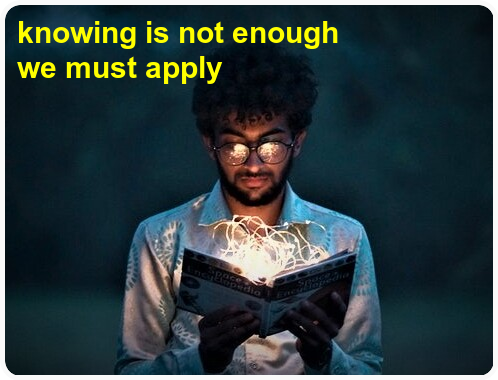
He (Bernard Shaw) is right. It is a proven and known fact that learning is an active process. We learn by thinking and applying some known principles.
The above-mentioned points are for extracting and understanding knowledge from the book. Knowledge is only worth it when it is used. To make all that effort towards a fruitful result, you have to effectively apply the principles (rules from the book) at every opportunity. This can be a tough job to actively apply knowledge to enhance the situation. But with regular practice, one day it will become a habit.
Consistently following the above-mentioned suggestions all the time could be difficult. Try these to achieve it,
- Set a day in a week to analyze the entire week. Try to find new ways to make some more improvements and learn from past mistakes. (Analyze the past, live the present, and prepare for the future)
- Review the book frequently to make the most out of it. (highlighting the main content out of the paragraph can help you to refer easily every time you review)
- Journaling can be very much helpful to make new habits and track the progress you have made over time.
- Reward yourself when you make progress. (By rewarding yourself at the moment, your brain elicits positive emotions, leading to the realization that your efforts result in a positive reward)
Proved scientific fact: People who read books live longer!!!
That’s according to Yale researchers who studied 3,635 people older than 50 and found that those who read books for 30 minutes daily lived an average of 23 months longer than non-readers or magazine readers.
Credits and major source:
Dale Carnegie (writer of HOW TO WIN FRIENDS AND INFLUENCE PEOPLE), https://www.ncbi.nlm.nih.gov/pmc/articles/PMC5105607/#R3.