
How To Prove Fermat’s Last Theorem For Cases n=4, 8, 12, 16, …
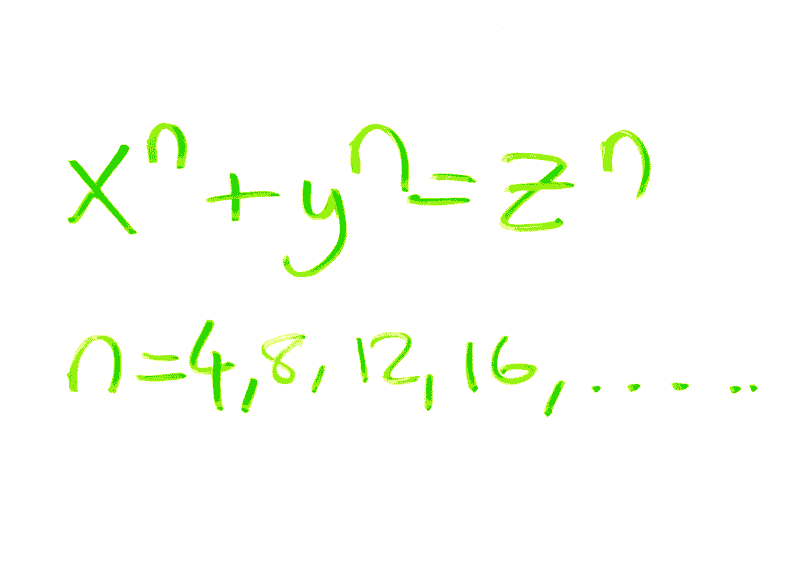
Are There Positive Integer Solutions To x⁴+y⁴=z⁴?
We are familiar with the equation x²+y²=z² from our school days because we associate it with Pythagoras’ Theorem.
One goal in Mathematics is to find natural number solutions to equations like this e.g. 3²+4²=5². By natural numbers, we mean positive integers: 1, 2, 3, 4, 5 ….
Note: Zero is not generally considered a natural number and solutions using a zero e.g. x=0, y=0, z=0, or x=0, y=1, and z=1 are thought of as trivial solutions. Where zeros are not used, Mathematicians refer to them as non-trivial solutions.
For x²+y²=z² there are in fact infinitely many solutions in natural numbers. These are known as Pythagorean Triples, which you can read about here.
What about higher powers? Do the equations x³+y³=z³, x⁴+y⁴=z⁴, x⁵+y⁵=z⁵, …, have non-trivial solutions? The French Mathematician Fermat in 1637 claimed there were no such solutions.
More formally, Fermat stated that the following equation has no solutions in natural numbers when n is a natural number ≥ 3:
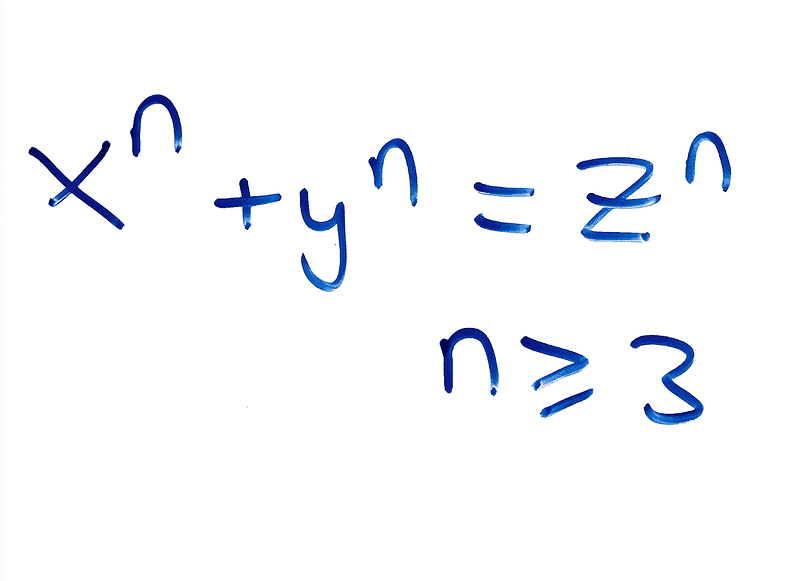
This is quite a remarkable claim since we have infinitely many values for n to choose from!
Fermat also claimed to have proof which he did not share. This theorem took until the 1990s (over 300 years) to prove and became famously known as Fermat’s Last Theorem. You would probably need a graduate degree in Mathematics to understand its very long proof.
In this piece, we will examine the relatively easy cases where n is divisible by 4 (n=4, 8, 12, 16,…). This proof is accessible to just about anyone.
Proof For Fermat’s Last Theorem (Case n=4)
Our attack plan for the case n=4 will be to show that the equation x⁴+y⁴=z² has no solution in natural numbers.
This will imply the equation x⁴+y⁴=z⁴ has no solution in natural numbers because if there was, call it x=A, y=B, z=C then A, B, C² would be a solution to x⁴+y⁴=z² which is a contradiction.
Let’s suppose x⁴+y⁴=z² does have a solution in natural numbers. We will try to arrive at a contradiction.
Assume we have selected the solution with the smallest possible z. Now note x², y² and z form a Pythagorean Triple since (x²)²+(y²)²=z². In this previous piece, we showed how Pythagorean Triples can be represented and so we can write:
- x²=m²-n²
- y²=2mn
- z=m²+n²
Where m and n are some integers.
Observe in this previous piece we can set m and n to be coprime integers (meaning they have no common factor greater than 1).
Now note, equation 1 above can be rearranged to x²+n²=m² which forms another Pythagorean Triple which we can write as x=r²-s², n=2rs, and m=r²+s² where r and s are also some coprime integers.
The equation m=r²+s² implies m, r and s are pairwise coprime (meaning any two from this set are coprime) since any factor dividing m and r would divide s and any factor dividing m and s would divide r. We know the only factor dividing both r and s is 1.
Rewriting equation 2 above as y²=4rsm, we see that r, s, and m must each be a square since they are pairwise coprime. We can then write r=a², s=b² and m=c² for some integers a, b, and c and we have a new solution a⁴+b⁴=c².
This contradicts the minimality of z and shows the equation x⁴+y⁴=z² has no solution in natural numbers which in turn means neither does x⁴+y⁴=z⁴.
Proof For Fermat’s Last Theorem (Cases n= 4, 8, 12, 16, …)
What about when n is any natural number divisible by 4? From the case n=4, it immediately follows that there are no solutions in natural numbers because suppose there is a solution to x⁸+y⁸=z⁸, then this would imply (x²)⁴+(y²)⁴=(z²)⁴ is a solution for case n=4 which we have proved is not possible! A similar argument would follow for all other n divisible by 4.
Thus we have proved Fermat’s Last Theorem for all cases where n is a natural number divisible by 4.
Closing Remarks
- Observe from the technique used above that Fermat’sLast Theorem only needs to be proved for all prime numbers > 2.
- Here is an intriguing book that documents the 300-year history of this problem**.
- It’s perfectly normal to spend time trying to understand a proof. If anything is unclear, please leave a comment below!
**Consider a Medium membership with my referral link here. You will be supporting my writing and there is no extra cost to you. Alternatively, you can buy me a coffee below. Many thanks!***

** an Amazon affiliate link


