
The Writing Process
How to Properly Tell Others to “Eat Sh*t”
Scholarly belligerence explained…
Let’s talk about giving credit.
I’ve been a card-carrying member of Medium since mid-April (2019) and have spotted an unsettling trend. I’m talking about giving credit/citing sources. I thought these people were just lazy, and have many followers, so precluded themselves from such a trifle. If this is you, shame on you! Use your influence to model good form and craftsmanship.
If you don’t know how to give credit, here’s a quick and dirty tutorial. Why should you listen to me? I wrote more than a few research papers, earning a master’s in sociology. While I don’t have dozens of papers published in peer-reviewed, scholarly journals, I spent four years as an assistant librarian in a middle school library — Harvard it was not, I know, but we held those students to a high standard of academic rigor as concerns the research process and giving credit. Furthermore, from what I’ve encountered here, middle school research skills are a good place to start.
That said, let’s start by examining the difference between “common knowledge” and scholarly material.
Common Knowledge vs. Needs Reference
I’ll start by saying that any phrase that starts with “common…” (e.g. “common sense”, “common knowledge”, “common man”, “common good”, etc.) is a loaded term. I don’t want this to turn into the drunken college freshman “what is ‘normal’?” amateur philosophy hour. But I ask you truly, what does “common knowledge” mean? Moreover, what knowledge is common?
Let’s talk about koalas. Did you know that koalas are indigenous to Australia? That bit of intel doesn’t need a citation. Not because “everyone knows that”, but because the fact is if you want to observe a koala in its natural habitat, the only place on earth you can accomplish this is Australia.
Did you know that koalas are marsupials and, therefore, not “bears”? Some of the nerdier aspiring zoologists may have known that, but I wouldn’t assume that everyone knows that, so I’d provide a source*. There is no penalty for providing a source when there’s no need for one, so error on the side of caution.
Moving on, I was more than a little disturbed to learn that, after developing beyond the accommodations of its mother’s pouch, a “joey” (baby koala) will feed on “pap”, a soft substance packed with micro-organisms from its mother’s anus.
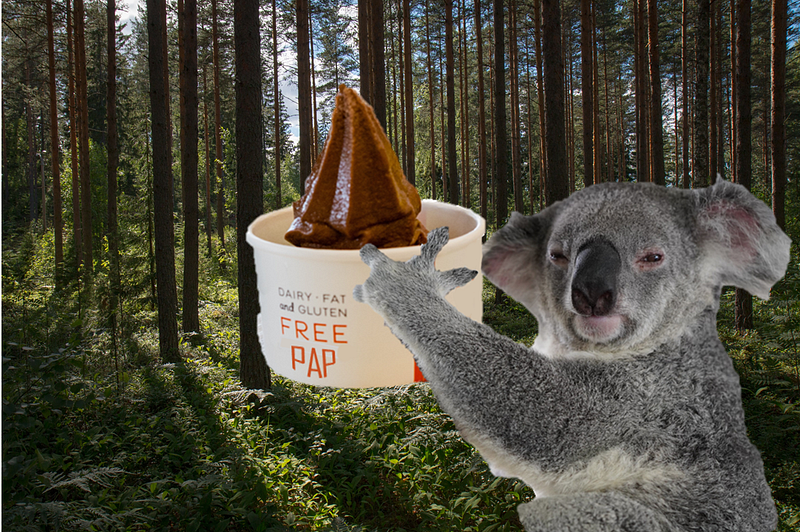
If you already knew that and you’re not a zoologist in Australia, I wonder about you…
…how did you come by this information? Did you observe the sloth-like behaviors of a family of koalas? Did you suckle the brown eye of some unsuspecting mommy koala? Had you done so, you would’ve not only earned the everlasting disgust and disdain of respectable human beings, but you would’ve discovered** that the nutrient-filled ass-batter “is a specialised form of faeces (or koala poo). Unlike normal hard, dry Koala pellets, ‘pap’ is soft and runny in consistency.”
That was a long and sensationally abhorrent way to demonstrate the concept of ownership. Unless you’ve observed or been a part of this nutritional scatting ritual, you have no right to claim the information as your own.
I don’t know about you, but if I was in any way privy to a marsupial sucking on its mother poopshoot. I’d want to be recognized for my contribution to science. Recognizing such a contribution is easier than you think…
Citation vs. Giving Credit
I have been using “give credit” and citing a source interchangeably — this is not correct. According to THIS ARTICLE^ from bluecorona.com, a citation would entail giving the author’s name, date of retrieval, domain name, link and what have you. Providing a source is as simple as linking to the website, much as I just did. Indeed, Corey Wainwright, from her Hubspot blog ARTICLE^^, says “Aside from mentioning the person’s name, it’s also nice to provide them with an inbound link — either to the page from which you drew your quote, or to another meaningful page on their site.”
If you think this is a pain in the arse, you’re probably a younger millennial that never had to compile a works cited page.
You see, there was a time when the medium for written discourse was a flimsy, super-thin bleached white rectangle called “paper”. Here’s the thing about paper, you can’t put clickable links on them. So, it is necessary to give credit so that you might stay “academically honest” and avoid a run-on sentence in “plagiarison” (plagiarism+prison) — here’s the sign above the entrance –
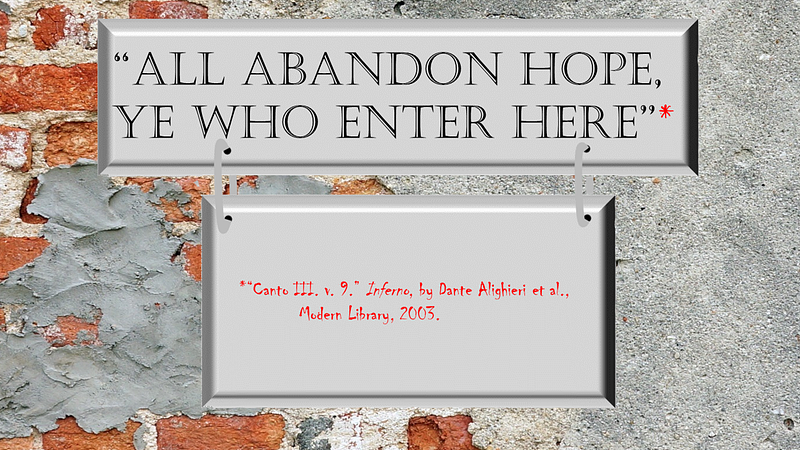
I digress. Anyway, the digital handicap of paper meant that one must include a “works cited” page, AKA “bibliography”, or “references” page. This cumbersome undertaking required the writer, already befuddled and careworn from writing a research paper about koala poop and what have you, to encode key information about the periodicals into a syntax attractive only to crusty, bookish curmudgeons.
To prove my point and cover my arse, I’ve converted the above articles about koala marsupials into the ancient “Modern Language Association” (MLA) style script –
“Koala.” National Geographic, 21st Century Fox, 9 May 2019, www.nationalgeographic.com/animals/mammals/k/koala/.
** “Australian Koala Foundation.” Life Cycle of the Koala | Australian Koala Foundation, Australian Koala Foundation, www.savethekoala.com/about-koalas/life-cycle-koala.
And here, dear reader, are the two articles about citing sources written as an “American Psychological Association” (APA) style incantation –
^Blue Corona. (2019). The Difference Between a Link and a Citation. [online] Available at: https://www.bluecorona.com/blog/links-vs-citations [Accessed 25 Jul. 2019].
^^Wainwright, C. (2019). How to Cite Sources & Not Steal People’s Content on the Internet. [online] Blog.hubspot.com. Available at: https://blog.hubspot.com/blog/tabid/6307/bid/33098/how-not-to-steal-people-s-content-on-the-web.aspx [Accessed 25 Jul. 2019].
In the long, long ago, even the most lethargic students were expected to conjure this information from “books” (clunky meticulously ordered stacks of “paper”) and “journals” (similar to a “book”, but fewer pieces, or “sheets”, of “paper” — though the pieces were typically larger) and arrange them such that they would appease the curmudgeons with only a STYLE GUIDE. The malaise of today’s student gorges on APPLICATIONS whose only purpose is to organize the information into the citation style of choice. Heck! There is even software that will produce an entire citation based on the “International Standard Book Number” or ISBN of a “book” and the “Uniform Resource Locator” (URL) of a website.
I would like to demonstrate this magic for you, but that is outside the scope of this article. That is a missive for another time. Presently, I feel that it would benefit you, dear reader, if you were to apply the information from above.
Practice
I task you, dear reader, to venture forth to find a research supported answer to one of the following questions –
1. How many licks does it take to get to the Tootsie Roll center of a Tootsie Pop?
2. Where’s the beef?
3. What’s in the box?
4. What is the airspeed velocity of an unladen African swallow?
5. Could you describe the ruckus?
6. How often do you really look at a man’s shoes?
I’m giving you latitude regarding the scope and focus (the “scocus”? “Fopus” maybe?) of the search. For instance, did you know that “ [Generation Y] is most likely to buy shoes that they have seen on celebrities; only 2% of seniors have bought shoes seen on a celeb.” We know this thanks to a 2013 survey*** from Beso.com. I would prefer something newer, but this illustrates the point nicely that we see another man’s (or woman’s) shoe often enough and about 1/5 of Millennials (née Generation Y) will dawn those foot coverings in a superficial show of hipness.
I’m open to your suggestions for other topics too. Be sure to provide a link. Bonus points for working in the author’s name. Doubleplus bonus for providing a proper citation.
For good measure —
*** Join Beso Shopping! (2014). Retrieved July 27, 2019, from http://www.beso.com/beso-by-numbers-2014-shoe-week
FIN


