
How to Promote a Paywalled Newsletter for Free
My takeaways after a month of trial and error

The Context
At the end of May, I launched a reader-funded newsletter on personal finance called Money Talk.
This is the first time I’ve written about personal finance in over a decade as a journalist and the first time I’ve been involved in an editorial newsletter, that is, a newsletter that’s designed to be the product rather than to promote one.
Since then, I’ve been busy “marketing” my new product. Mainly to the internet, but also to people I know who might find it useful. It’s a steep learning curve because I didn’t have any existing and relevant networks I could reach out to.
I also didn’t want to sink a huge amount of money on promoting it at this stage because, A. it’s meant to be a side-hustle, which I’m hoping could turn into a full-time gig in the future, and B. money is tight right now.
So my strategy is all about what I can find on the internet for free.
Here’s My Challenge
There are several reasons why promoting my newsletter is proving to be a bit of a challenge:
- I’m starting from scratch, it’s a developing product and I’m a team of one, there is only so much I can do at any one time and there isn’t a lot of content as proof of worth yet.
- I’m promoting something in a sphere I’m not known for, how do I establish credibility and trust when people know me for writing about food and travel?
- I’ve launched straight into a paid publication, all the good stuff is behind a paywall and I need people to part with their cash before seeing the product.
Needless to say, it’s a hard sell.
Why I Didn’t Use Google for Help
It may surprise you but I didn’t just Google “how to promote your newsletter.” And I still haven’t, I will explain why later.
My first stop was Facebook. I was already in several Facebook groups for journalism work and it struck me that there must be similar networks for newsletters. And there were, including one specifically for Substack writers.
“Great”, I thought, “this is going to be really easy”.
After a quick scan of the different groups, I realised the posts were largely about two things: how to grow subscriber numbers and how to monetise a newsletter. Substack’s reader-funded model takes the hassle out of the second issue but the first is my stumbling block. Fortunately, there appeared to be a formula people can follow to promote newsletters:
- Tell everyone who will listen about it.
- Distribute your links widely, including social media networks and sites like Indie Hackers, Reddit, and Medium.
- Get influencers to share your product.
- Offer people a freebie such as an e-book to get them to sign up.
- Cross-promote with other newsletters.
- Advertise.
That gave me plenty to work with. And when I delved deeper, I found more communities focused on each of those action points, providing me with even more leads. Basically, I didn’t need Google, I just followed the white rabbit.
Why I Didn’t Use Google for Help
Having been a journalist for over a decade, I’m no stranger to promoting content.
But because Money Talk was a reader-funded newsletter, people had to actually part with their money and not just hand over their email addresses.
According to the latest research from the Reuters Institute, getting a British audience to hand over money for content is harder than perhaps anywhere else in the world. It’s clearly an uphill battle. To tailor it to my product, I adapted the marketing formula for free newsletters into something that could work for a small reader-funded newsletter like mine.
Here’s what I tried and how it worked out:
1. I signed up the people I knew (temporarily)
My first post was sent to around 200 people I knew, whittled down from thousands of contacts I had in my Gmail.
The “first wave” were friends and colleagues who I thought would want to hear about my new project. I didn’t have explicit consent to add them to the mailing list, but it’s considered acceptable under GDPR/Can-Spam laws as they were A. people I knew and B. people I believed my email would be relevant to. All of Substack’s emails have an unsubscribe option so people can opt-out at any time.
In my first post, I explained why I was launching Money Talk and what it was going to be about. As I mentioned in my first Medium post, some people unsubscribed straight away but others signed up to be paying subscribers before seeing the product. Many also got in touch to congratulate me. This, I think, was a fairly successful launch and an indication that I had chosen the right group of people to tell.
I didn’t want to email everyone individually for the first post because I think that changes the dynamics a little, I didn’t want them to feel obligated to sign up or go through the awkwardness of having to respond. With a mailing list, you can just ignore or unsubscribe.
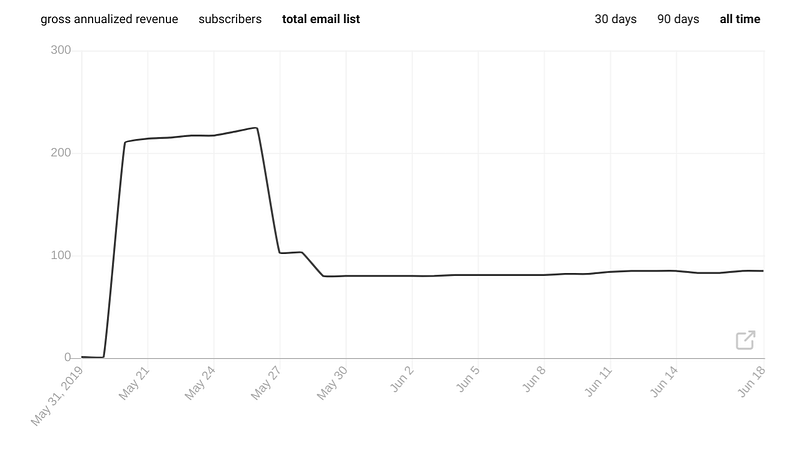
But before I sent out anything else to the general list, I did a cull. I manually unsubscribed anyone who opened the email once but didn’t get in touch. Later, I also removed anyone who hadn’t opened my email at all. I took that as a sign that they weren’t really interested in hearing from me but were too polite to unsubscribe, and I wanted to be respectful of that.
The graph below shows this dip in my subscriber numbers.
2. I turned to social media
The first thing I did after sending the launch post was sign up for the relevant social media accounts. I didn’t have a detailed action plan at this stage, which in hindsight would have been helpful; I was really just motivated by the need for action.
Twitter and Facebook were the most obvious ones but I didn’t even think about Instagram until almost a month in. In fact, I created a LinkedIn page before I went down the Instagram route.
Instagram is a low priority for me. Experience from my personal account suggests that the click-through rate from links is low so I don’t want to spend a lot of time on it. Plus, I don’t have a plan of action or the resources to spend time on it either.
Since the launch, I’ve been sharing snippets of content from the newsletter on Money Talk’s channels as well as my own.
I’m conscious about not overdoing it though because I don’t want to spam anyone’s feeds. Most people follow my personal account on social media for my usual beats, food and travel, so it’s quite jarring to see money content.
There’s a steady trickle of people signing up for free through Twitter, though by no means an avalanche as my posts have been quite passive so far. Again, I think a strong call to action on my personal account would feel quite jarring although it would be found on the Money Talk account.
I also shared Money Talk in some of the Facebook groups I’m in when it’s been relevant. This hasn’t been very successful for me because when there is an obvious opportunity to promote a product, people are too busy promoting to genuinely engage.
The most effective platform for me has actually been LinkedIn, even though I rarely used it in the past. In fact, I got more free and paying subscribers from posting there than from people I emailed, perhaps because the subject of money is much more suited for a work environment.
That said, advertising on LinkedIn, which I will talk about later, hasn’t been nearly as successful.
3. I launched a podcast
A little side project I launched was the Money Talk podcast, which I’m hoping could reach new audiences through audio.
At the moment it’s just an excerpt of the content that paying subscribers receive, but I already have a (vague) plan of what I want to do with it in the future in terms of value-added content. It’s also a potential income stream because Anchor, where I host my podcast, lets you monetise podcasts.
However, based on my previous experience of podcasting, it takes time to build up a listenership and following. It means I will have to promote it alongside the newsletter for the time being.
Given it’s a different medium, it’s also hard to track if and when people do find me through the podcast. But given the current number of plays, I can’t imagine many people have signed up because of it.
4. I wrote an e-book
One of the recurring tips I read was using a freebie such as an e-book to get people to sign up.
I’ve seen it on blogs and I’ve even subscribed to some myself for the freebies in the past. It could work and it boosts my credibility.
So, I decided to write an e-book, also titled Money Talk. It’s currently available for sale on Amazon and Google Play Books.
Why am I selling it rather than giving it away as people have suggested?
First, I actually spent a good chunk of time on the e-book and I think there’s valuable advice inside. It’s worth paying for. I’m planning to update it with new content as I develop my newsletter, which means those who bought it will automatically receive the updates to their devices.
This isn’t possible for those who have just been sent a link to download a PDF, they are getting a one-time thing, whereas I’m offering them ongoing value.
Second, the people who sign up for a sales gimmick are not the readers I’m looking for. If people want to sign up for your newsletter, they will whether or not they get a freebie. If they’re not that interested, they can easily sign up, get the freebie and then unsubscribe.
Third, it sets the wrong expectation. Giving away valuable free content feeds into the thinking that content should be free. Why would people who expect content to be free want to pay for it? It means they might sign up for my free newsletter but they probably won’t ever convert to paid.
To be clear, I’m not opposed to teasers or free trials. The difference is readers are previewing the product they want to buy and not signing up because they want something else.
That’s why I include screenshots of the newsletter when I promote it on Twitter, for example.
This e-book is a stand-alone product for me, but it’s also promotional material for the newsletter. Inside, I’ve included a link to Money Talk as well as a promotional code so readers can sign up for a free trial before they become paying subscribers.
I’m playing the long game here, but it’s one that I can also monetise. For the time being though, no sign ups yet.
5. I did some link sprinkling
Like promoting a blog, you want to get as many people to link to you as possible to spread the word.
Changing the profile links on my social media accounts and updating the sign off on my email were the easy bits. To really spread the word, I have to go beyond my network.
Unfortunately, my newsletter is too small and too new to consider a link swap with another newsletter. Plus, there isn’t a similar product here in the UK. So I had to think strategically.
I submitted my newsletter to listing sites such as Radletters and I’m answering relevant questions on Quora. Indie Hackers has also been invaluable for advice and to promote because the audience is so engaged. In fact, I’m documenting Money Talk’s growth timeline on there to build engagement.
I even posted my newsletter on Substack’s webinars, like everyone else. And of course, I’m writing here on Medium. But this is an ongoing thing: I’m always going to be looking for new places to promote my newsletter.
So far, a handful of people have signed up for the free newsletter. The visible uplift to the visitor numbers of my Substack page (newsletters are saved on a micro-site on Substack) is perhaps more promising. If I can successfully tease the paywalled content I offer, something I’m working on next, these could potentially turn into future subscribers.
6. I advertised
You might be wondering why I’m advertising even though I said at the beginning I didn’t want to spend any money.
Well, I haven’t spent any of my own money. While sharing my newsletter on LinkedIn, I spotted an advert offering free LinkedIn advertising credits (yes, it’s a bit meta) so I signed up. I was given £100 to use on their platform and I created an advert with the aim of generating as many clicks as possible.
I’ve already burned through more than half of my budget and so far the click-through rate is zero. It’s not very promising. What’s more, the maximum click-through rate I can hope for is just 17, working out to be £5 per person, that’s more than what I charge for a monthly subscription. Basically, it’s a bit of a dud.