
How to Price Your Freelance Writing Services and Make $5K+/Month
Written by someone who’s doing just that

I’m making $5K/month from freelance writing, but it’s been a three-year slog. I had to eat sh*t for a long time.
Writing before work, writing on lunch breaks, the occasional f*ck up — that sort of thing.
So please don’t quit your job and tell your boss they’re a d*ck just yet. Instead, see if you can write 50 articles alongside your 9–5 job.
Done that?
Okay, if you’re serious about dipping your toes into freelancing, one question that comes up is how do I price my services?
I sure as heck didn’t know. When I started, I plucked a number from the sky.
$20/hour? Why not.
Quite often, I underpriced. I didn’t have the heart to tell clients I worked more hours than we agreed, so I didn’t charge them more.
Hence, “the occasional f*ck up”.
Luckily, though, I learnt from my mistakes, and I’m now making $5K/month from freelancing.
So in this article, I want to share some pricing tips and help you “seal the deal” with new clients.
But first, let me set the scene.
It was 9:30 pm, and I was hunting for jobs
It sounds like the worst-ever Twilight, am I right?
Bear with me.
So I was on my laptop — hunting for jobs — when I got an email from Write Jobs PLUS+. This Patreon page is a goldmine for freelance writers.
I opened it up and spotted an opportunity for a cool-looking company. They were looking for a freelance SEO writer to write some blogs.
Okay, tell me more.
I clicked the link, and it took me to the job post.
The description made me smile:
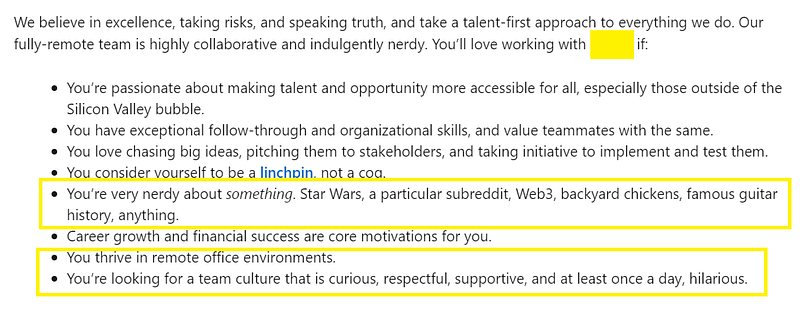
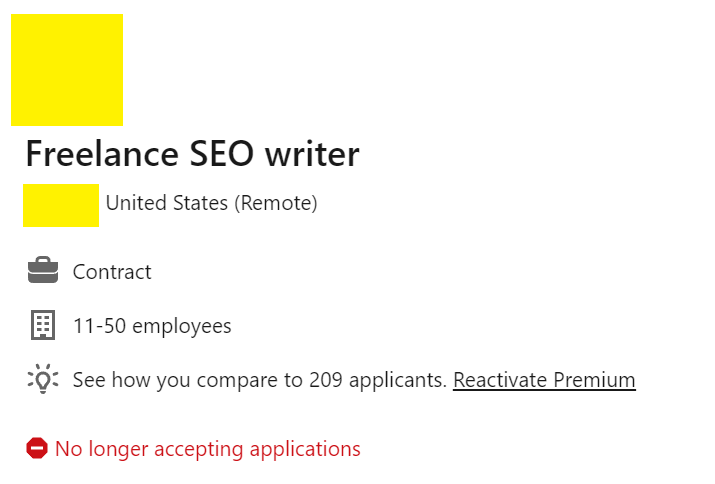
I was smiling, that is, until I saw that 149 people had already applied.
It had over 200 applications by the time it closed:
Undeterred, I bent my CV into shape and put together a goofy little thing. I spent a few hours on it but wasn’t expecting to hear back.
They might have hired someone already.
So much so that I threw in this cheeky one-liner to make my application stand out:
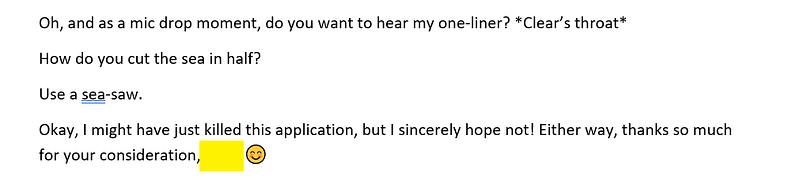
Top tip: Try to match the job description’s tone in your application. If the hiring manager throws in some humour, throw it straight back.
Bonus top tip: Always copy your application answers into a separate Word doc in case your browser times out!
So imagine my surprise when I received this email a few days later:
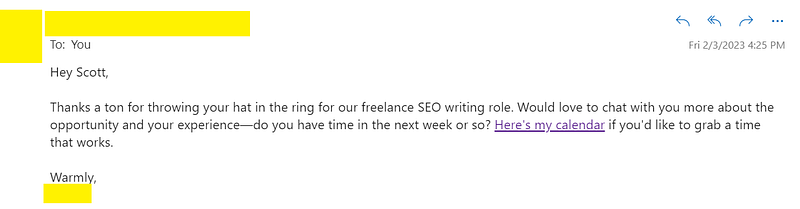
I hopped on a call with the Head of Marketing, and we instantly connected.
Strangely, we didn’t talk about writing much. She said my portfolio had done most of the heavy lifting, so she was confident I could do the job. (Thanks, Medium!)
Your portfolio > anything else.
She just wanted to know if I had any questions about the role and how much I would charge for the blog posts…
… Which brings us full circle!
Here’s how it went down.
“We prefer paying retainers as we find it easier this way. Does that work for you?”
I couldn’t believe my ears.
That’s so dreamy! Yes, yes, yes!
I didn’t actually say this and managed to keep my sh*t together (just about). So here’s what I did instead. First, I asked a few questions about the company and the job.
For example, I asked how many words each post would be. Knowing the expected word count is crucial. So, too, is knowing how many posts a week they’re looking for and what the end goal is.
“We’re looking for two posts a week, and we want to rank on page one of Google US for our target keywords.”
Tick, tick, tick.
She told me to think about it and send a retainer number by the end of the week.
So here’s how I thought about this number:
- How much do I currently charge clients for blog posts around 1,500–2,000 words in length? My ballpark figure is around $0.45/word (I started at $0.20 with my first client), which would be $900 for a 2,000-word blog post.
- Will all blog posts be this long? No — some will be shorter. Also, once I get into the swing of things, I can write the posts more quickly. They’re on similar topics.
- Let’s do the maths. Let’s take an average post length of 1,500 words x $0.45/word = $675 | $675 x 8 posts a month = $5,400 | Let’s make it a round number to sweeten the deal: $5,000
That sounded like a lot to me.
The most I’d ever billed to a client in a single month before was just under $2,000, so this was a big jump.
I doubled checked the maths. It seemed solid. I weighed it up and debated reducing the number some more before thinking, “f*ck it”, and pressing send:
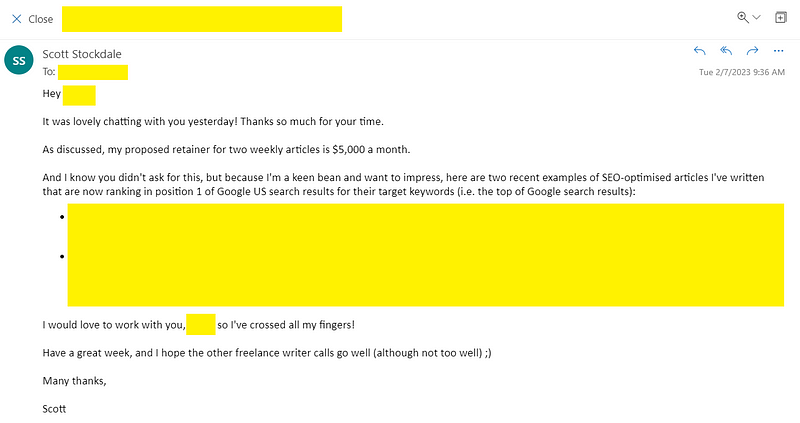
Top tip: At every touch point, remind the potential client why you’re the best freelancer for the job. You want to reassure the client that they’re in capable hands.
Notice above how I include two writing samples the client might not have seen before, with a commentary of results.
I also threw in a cheeky line at the end.
“Have a great week, and I hope the other freelance writer calls go well (although not too well) ;)”
We’d built a good rapport, so I felt it was appropriate. But, of course, I wouldn’t say this to most clients.
All that was left to do was wait.
“Hey Scott! Quick curveball question…”
I saw the first few words pop up in my inbox.
Oh sh*t, this can’t be good.

“No right or wrong answer here, just working through a few potential scenarios on our end.”
Goddamn it; I haven’t got the job.
That was my gut reaction. I’d seen this sort of thing before. This gig wasn’t to be.
I debated back and forth on how to play this one. Why were they asking this? Should I ask about their scenarios? As I drafted my reply, I even considered lowering my retainer price.
Ultimately, I took the email at face value and gave my honest thoughts. If it meant I didn’t get the job, so be it.
Other opportunities would turn up:
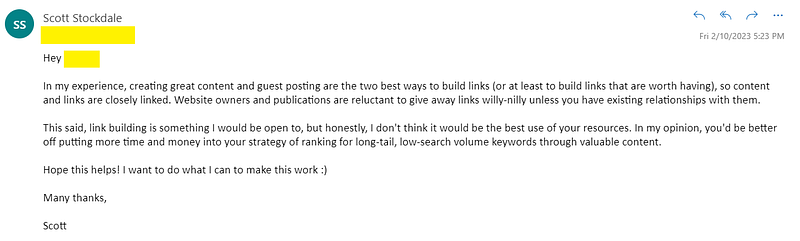
I sent the email and then tootled to the cinema to watch The Whale. (Incredible film, by the way!)
I needed a distraction.
When I got back home, I checked my phone and found a wonderful email waiting in my inbox:
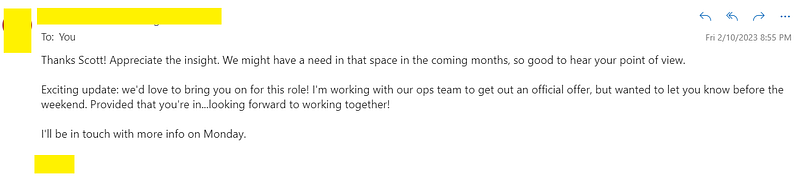
“Exciting update: we’d love to bring you on for this role!”
I got the gig! 🥳️
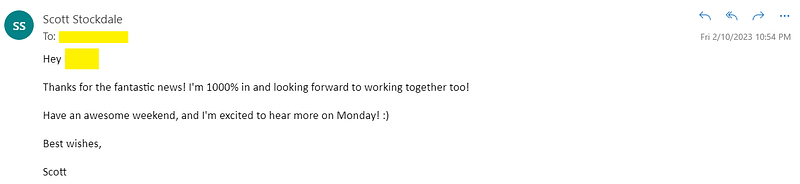
I did a little jig in my kitchen before firing this off:
So what have we learnt from this?
You can take several key takeaways from this story — not just about pricing, but how to approach client work.
Here are my two cents:
#1: Even if you’re late to the party, you might not be too late
So what if a job post has over 100 applicants? I’ve got news for you. Most freelance gigs will! It’s competitive out there.
It’s still worth tossing your name into the hat, though. The cream rises to the top. If you’re good enough, you’re good enough.
#2: Let your personality shine
So what if you sound like a Duffus?!
When it makes sense, throw an emoji into an application. One-liners can work too. It’s always better to stand out than blur into the crowd.
Side note — You can find another tongue-in-cheek application in this article. I sent the application to a potential client on Upwork. Spoiler alert: I got the gig.
#3: Stick to your guns
Be optimistic, know your worth, and stick to it.
If this opportunity doesn’t work out, there will always be another one :)
Want to ditch the 9–5? Get my free 19-page blueprint: Everything I Did to Quit My 9–5 Job & Transition Into Profitable, Sustainable Solopreneuring :)


