
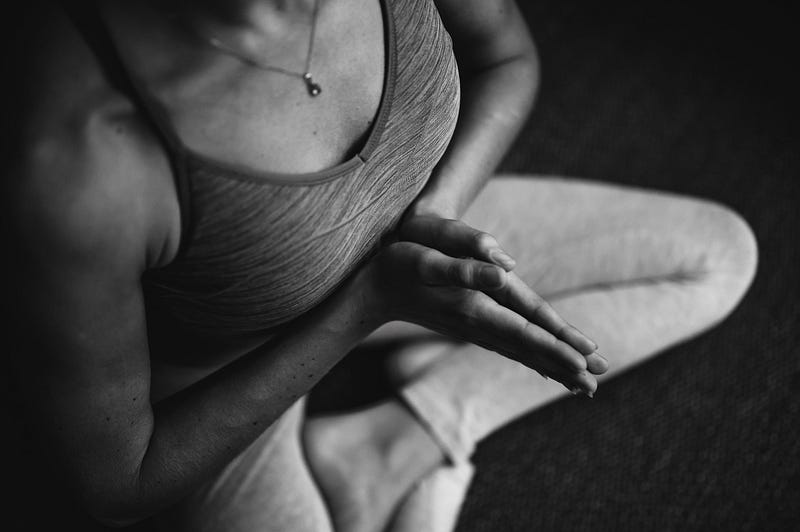
How to Practice Yoga from the Inside Out
Learn how to let your body move you
“The body has its own intelligence, and being able to listen to and learn from that intelligence is an essential part of yoga…It’s the body that ‘decides’ when to hold, when to back off, when to deepen, and when to come out of the posture.” — Joel Kramer
When I read Joel Kramer’s article “Yoga as Self-Transformation,” my attitude towards yoga, and my practice, shifted dramatically.
Although I had been taking yoga classes for years, I began to practice yoga for the first time. I finally understood what yoga is about: practicing from the inside out.
Yoga is not about forcing your body into postures. It is not about working up to headstand or whatever other posture you have in your sights. In my view, the practice of yoga is to learn how to be body-directed rather than mind-directed. In modern society, we are intoxicated by our minds, so learning to be body-directed is a challenge for most people — it was for me! Based on my experience, below are a few pointers for making the shift to practicing from your body rather than your head.
1. Breathe Your Body
If you allow the movement and the breath to truly synchronize, the mind moves out of the way. Most yoga instructors queue an inhale with body opening postures and an exhale with the body folding postures, which is great. To take this a step further, try letting the breath lead the body. Kramer says, “By using the breath, instead of the mind, to guide and control movement and stretch, the body can let go, surrendering to the posture more easily.”¹
2. Learn the Difference Between Discomfort and Pain
There is a fine line between discomfort or intensity and pain. Kramer writes about “playing the edge,” and the encouragement to slow down and recognize the body’s pain signals has helped me more than any other guidance. Because we often want to get into the “correct” posture, we blow right past our physical and psychological limits. The competitiveness in yoga classes can also contribute to ignoring our body’s messages. So, what is the line between discomfort and pain? Kramer says, “If you are running from the feeling, it’s pain. Intensity that is not pain generates an energy and sensuous quality that turns you on.”² We can learn to work very skillfully with discomfort, and I feel that is the real “work” of yoga and life. But you must tune in to the body enough to recognize your limits and resist the urge to blow past them for the sake of achieving an external goal.
3. Work with Your Lines of Energy
When I started holding my attention point in the center of my chest and practicing from that place, I understood yoga. I center my awareness in the heart and then run energy from the heart out the lines of the body — down the legs, out the arms, and out the top of the head. Until you can feel all the internal lines of energy concurrently, you can start with one line at a time. Try to feel what happens when you gently flow energy from your heart down the leg. There is no force involved, it is simply that rather than using an external idea of the posture, you direct the movement from the inside — you could say that you move from the inner body. Although teaching alignment can be helpful, everybody will look a little different in a pose. Feeling how to adjust yourself based on how freely the lines of energy flow is true yoga. Kramer says, “External methods are useful at times, but I feel it is only when alignment is done internally, by the body’s own intelligence, that a posture is truly ‘understood.’”³
I recently read an article by a kung fu teacher where he told a story about learning the “Lifting the Sky” qigong pose from his sifu. Although he had been studying martial arts for several years, he said that “Lifting the Sky” was the first pose in which he practiced true qigong. I knew exactly what he meant from my experience with yoga. The first time he really connected with the inner body and let the body lead the practice, he realized true qigong. I mention this because I realized that learning to move from the inner body is a skill that can be applied to any modality of movement and produce amazing results.
Once you learn to live from the inside out, it is not only your yoga practice that changes. The quality of your life changes, and you feel different. You act from a place of greater self-mastery — from the inside out.