
How to Practice Healthy Instagram Use During Home Isolation
Don’t let Instagram make life more difficult than it already is…
Is your mental health suffering because of your Instagram use during the coronavirus isolation? Don’t worry, you’re not alone.
It’s normal to feel slightly more blue as we tend to spend more time on our Instagrams, but fear not — there are steps we can take to practice healthier Instagram habits and protect our mental health during these often difficult times:
How Instagram Negatively Impacts Your Mental Health
Before we take a deep dive into healthy habits, it’s important to understand how Instagram use damages our mental health. The exact reasons will vary from person to person and from circumstance to circumstance, but most of us are affected by the following:
We see more content that makes us feel unnecessary fear, outrage, anxiety, etc.
To capture as much of our attention in order to monetize it, Facebook created the Instagram algorithm which shows us the most engaging content first. Because, in essence, we’re all on Instagram so others can see our content, this algorithm creates an environment in which are incentivized to tailor our photos, videos and captions to capture more of people’s attention and get more engagement in order to increase our reach.
In times of uncertainty, like the one we live through now, that usually means more content that triggers feelings of fear, outrage, anxiety, because those are the feelings that are most likely to cause us to like, comment, or share a post (and that makes the post show up higher on people’s feeds).
More triggering content on Instagram (triggering content comes in all flavors, shapes, and colors), the more opportunities there are for us to stumble upon a post that will make us feel scared, or anxious, or outraged and that negatively impacts our mental health.
It makes you feel less satisfied with your life
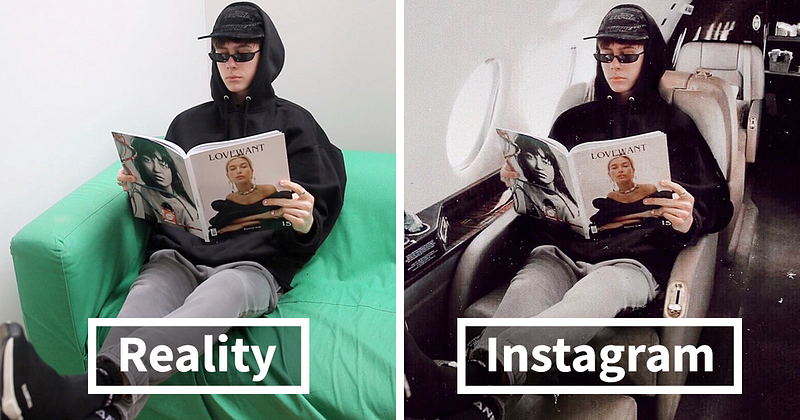
Another reality we don’t usually think of when using Instagram is that everyone creates content that projects an idealized version of themselves and their lives but we treat it as if it’s a portrayal of the real them.
Seeing people’s lives through the lens of Instagram often leads to an internal dissatisfaction because we compare our ordinary-feeling lives to the idealized version of others. How can our real lives ever compare to the romanticized version of everyone else’s? They cannot and, over time, and even subconsciously, this can lead to a level of discontent with certain aspects of ourselves and that negatively impacts our mental health.
In times of social isolation, we have more time on our hands and we are more likely to use Instagram (a whole lot more of it). Because of that, we are more likely we are to get exposed to both, triggering and dissatisfaction-causing content, all of which has a real and damaging impact on our mental health.
How To Practice Healthy Instagram Use
So, how can you take care of your mental health when it comes to Instagram use? Here are the most essential and simple ways to build healthy Instagram habits:
Set a daily Instagram use limit
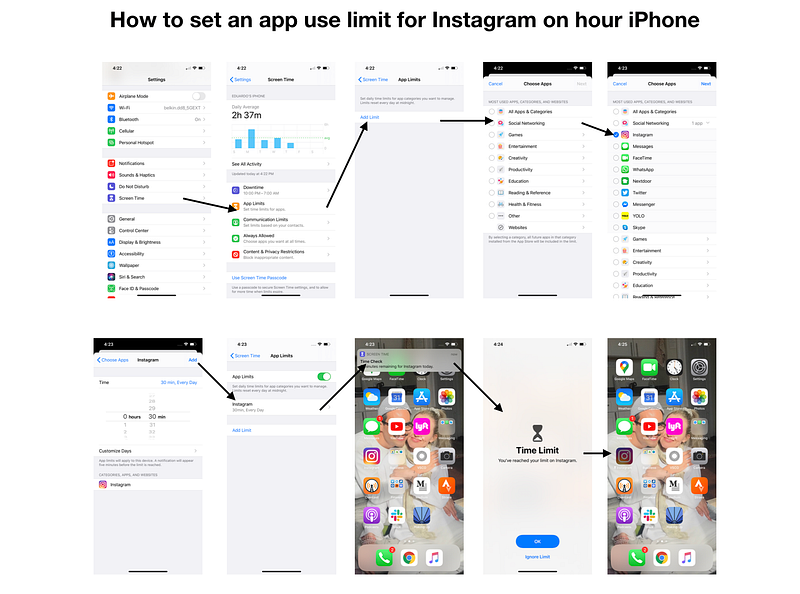
The best way to reduce the negative impact Instagram has on your mental health is to use it less! The easiest way to use it less is to set a daily use limit of the app on your phone. Although Instagram doesn’t allow users to set usage limits (and they say they care about our wellbeing 🤔), iPhones and Androids do. You can set usage limits for Instagram on an iPhone by going to Settings → Screen Time → App Limits → Social Networking → Set Your Time Limit → Add, and you’re all set. Here’s a guide on how you can do it on Android as well.
Once you’ve set a limit, your iPhone will notify you five minutes before you hit your time limit. Once time’s up, it blocks you from using the app and darkens the app icon on your home screen.
You can always ignore the time limit and keep using the app. But this way at least you’re aware of how much time you’re spending on Instagram and won’t have to rely solely on willpower. Relying on willpower to stop using Instagram can be draining, especially when it’s engineered to make you addicted to it.
Post less
Creating and posting content on our accounts fuels a great deal of our Instagram checking. The more we post, the more we check the app because we like to know who liked and commented on our content.
When we stop and think about the fact that every second that we spend creating content for the app is a second that we’re working for Instagram and Facebook for free (our free content is what Facebook uses to capture people’s attention in order to sell it to advertiser), spending more time creating posts for Instagram starts to lose a bit of its appeal.
The more content you create, the more time you spend on Instagram so make an effort to post less or don’t post at all during your time in isolation (unless you have to for work or for your small business). It’ll greatly reduce the number of times you check and use the app during a day.
Turn off all Instagram push notifications
If you’re anything like me, when you get a notification from Instagram, you tap on it (usually without reading it) and spend the next few minutes mindlessly scrolling until you realize that you don’t even know how you got there in the first place.
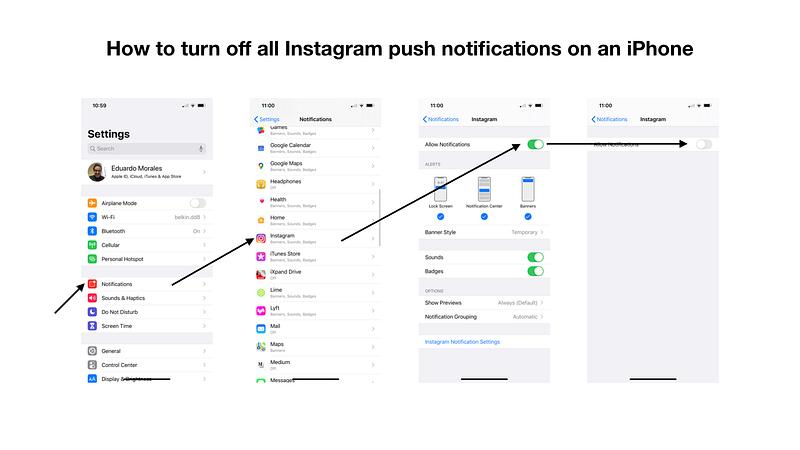
You can avoid notification-induced mindless scrolling by turning off your push notifications all together! Instagram only allows you to turn them off for eight hours in the app (and they say they want to protect our mental health 🤔) so, the best way to do this is directly through your phone, where you can turn them off indefinitely. To do this on your iPhone, go to Settings → Notifications → Find Instagram → and turn off the Allow Notifications feature. Here’s a guide on how to do it through your Android phone.
Turning off notifications will not only reduce your app use, it’ll also help you become more aware of how often you open the app out of habit (and perhaps addiction?), and protect your mental health.
Temporarily mute all nonessential accounts
Temporarily mute all accounts that are nonessential to your life while in isolation. This is a simple but effective way to avoid a large percentage of content that will trigger you.
For example, I muted 517 of the 520 accounts I follow on my personal account (when you think about it, there are honestly very few accounts that are essential to your life while in isolation and anytime, really)— leaving my wife’s, my mom’s, and the always essential @doggosdoingthings content on my home feed. Truth be told, I haven’t felt outraged or anxious by any of their content and I still consider myself a thoughtful and aware friend and citizen.
Yes, it might take a while to mute the nonessential accounts in your life (there will be many), and a minority of your friends might feel a bit miffed that you’re not liking or commenting on their content, but if they’re real friends, they’ll get over it and you can always unmute them once you’re out of isolation and life is back to normal.
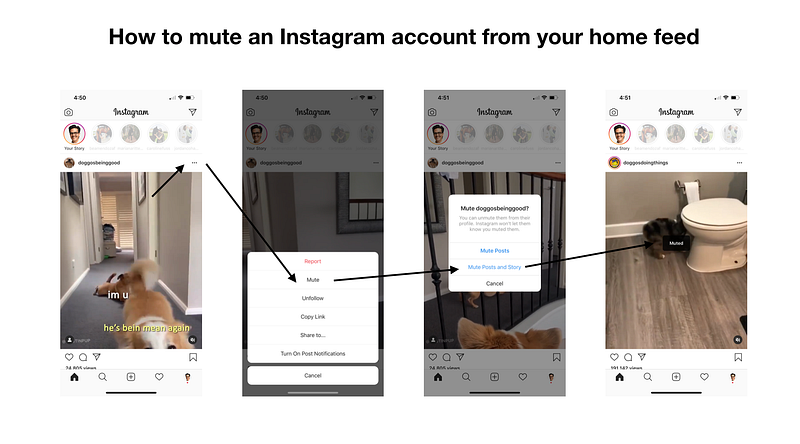
Mute accounts on your home feed by tapping on account’s “…” icon on the upper right hand side of the post and then → Mute → Mute Posts and Story.
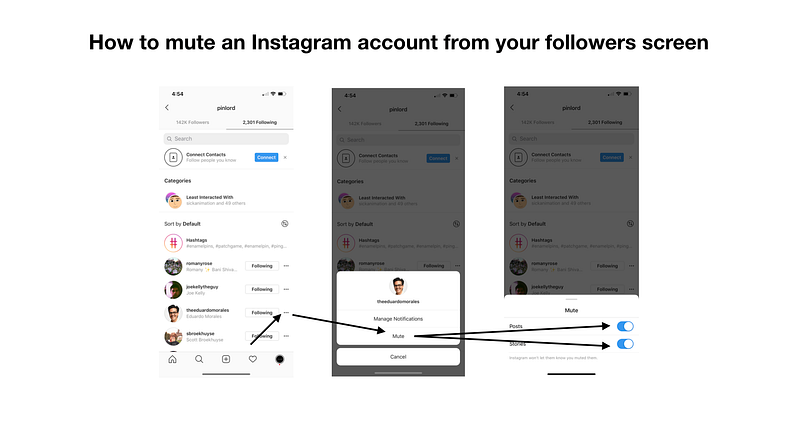
You can also do this by going to your follower list, tapping on the “…” icon on the right hand side next to the username of the account you want to mute→ Mute → turning on mute on both posts and stories.
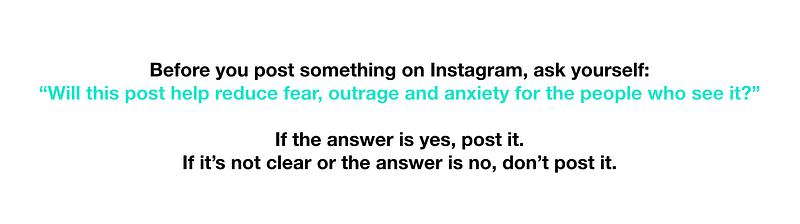
Don’t create or share content that stokes people’s fears
Another way to practice healthy Instagram use is to be more mindful of the content that you create and share. If you want to consume less fearful, outraging, anxious, and triggering content it’s important that you stop creating or sharing it as well.
We’re so used to posting and sharing content that we think might do well on Instagram, that we rarely take time to consider the impact our content might have on other people’s psyches. There are already enough people in the world sharing content that they think will outrage others into action. Think about ways you can be someone who shares content that loves people into action.
Be patient and understanding with yourself
Be gentle and compassionate with yourself and your Instagram use during these times. If you binge on Instagram for a day or two and notice that your mental health suffered, don’t be too hard on yourself.
Because most of us have been actively practicing not being thoughtful about our Instagram use for many years, don’t be surprised if you find it difficult to suddenly start using the app less. Simply by having the intention to develop healthier usage habits, you’re already taking better care of yourself and others. Instagram is literally engineered to make you addicted to it so don’t beat yourself up if it’s hard to ween yourself off of it.
One last thing…
If you feel uncomfortable by the space created from reducing the amount of time you spend Instagram, make an effort not to escape that feeling (i.e., don’t go back onto Instagram or watch more Netflix). Instead, try a meditation app, paint, or call a loved one that you haven’t spoken to in a while. Not being so attached to Instagram is a wonderfully nurturing gift you can give yourself during this time. Treat it with the importance it deserves.

In Summary
Spending time on Instagram can negatively impact mental health. Take care of yourself and reduce harm to your mental health by setting an Instagram time limit on your phone, post less, turn off push notifications, temporarily mute all nonessential accounts, don’t create or share content that stokes people’s fears, and more importantly, be patient and understanding with yourself if you struggle to reduce your Instagram use.
Your mental health is important. Not only for your own well-being but for the well-being of others. Make an effort to take care of yourself and to practice healthy Instagram habits. You deserve it ❤️
Thanks so much for taking the time to read my article! If you enjoyed it, you can support me by signing up to my Instagram Small Business class, sharing this article and giving it a bunch of claps. You can also follow me on Instagram to get updates whenever I publish a new piece ❤
Oh, and btw, if you want to learn about other strategies that will help you take better care of your Instagram use, check out these articles on how Instagram is hiding likes to protect themselves not their users, Is Instagram dying?, why you’re losing Instagram followers and four things to remember if Instagram’s got you down. If you want to learn about how Instagram works, read what Instagram really is and how works, how the Instagram algorithm works, Instagram niches and why they are the key to growth, the best Instagram bots, how to automate in Instagram bot that isn’t spammy, how to automate your Instagram posts, how the Instagram algorithm works, how to check if you’re shadowbanned, how to create a repost account, how to pick the right Instagram username, Instagram bots 2021, as well as how to find the most valuable influencers on Instagram, how to measure what an influencer is worth, how to reach out to influencers, and how to measure your influencer marketing ROI.