
How to Plot a Good Story — An Ultimate Guide for Beginners
Boost the quality of your stories with plotting

FYI, boost your first-draft writing game with this free copy of How To Write A Killer First Draft in 6 Steps
How often do you feel like you have a great story but when you are done writing it, the feedback isn’t as positive as you expected? It sucks so bad, and I would know.
When I first started telling stories, I wanted so badly to kill this sucky feeling. I wanted to create the kind of stories I loved, those plotted with such expert precision that they held your attention from the first scene to the last and delivered a terrific emotional experience at the end. Thanks to this desire, I became obsessed with answering the question of how to plot a good story. I read countless books on the topic and tinkered around with my own stories (over 20 in a span of 4 years).
After all this time, I believe how to plot a good story is still one of the core storytelling questions that, once answered, unlocks the door to masterful storytelling so that you no longer have to deal with the sucky feeling.
Knowledge of plotting gives you the tools you need to turn your story idea into a sequence of cause-and-effects (also known as scenes) that maximizes your story’s emotional power. In essence, it teaches you how to become a master emotional manipulator.
My journey so far has taught me a lot of things about plotting and in this ultimate guide, I will share most of what I know with you. We will cover:
- Why we plot
- The principles of plotting
- The raw materials of plotting
- Structural frameworks
- The work-from-end principle
- The OBMCR framework
- The 4-step process to great plotting
- How to plot towards an explosive climax
- Bringing it all together
You’ll learn how the raw materials of plotting (values, story events, beats, acts) make it easier to work with structural frameworks, and how structural frameworks help you plot good stories. Then you will how to plot a story to an explosive climax using the GOC PLC (more on it later).
By the end of this article, you will be better equipped to answer the question of how to plot a good story. Without further ado, let’s begin.
Why we plot
There is one main reason why we plot, and that is to tell the best version of the story. But what does that mean? How do you determine what the best version of the story is? That can only be answered by considering why we tell stories in the first place.
We tell stories to manipulate emotions, i.e. to create thrill, suspense, joy, anger, etcetera.
Given that stories are about manipulating emotions, it’s clear to see that the best version of a story is the one that generates the most intense emotions.
Having understood why we plot, let’s explore the principles of plotting.
How to plot a good story — the principles
I am a firm believer in the power of principles to aid in the creation of anything, even a spaceship. The principles of plotting are guides that help steer us on our path to knowing how to plot a good story.
The principle of cause and effect
The plot is only as coherent and engaging as the sequence of cause and effect is clear.
For your story to engage and hold interest, every scene that makes up your plot must be the cause or effect of some other scene within the story. This is a pretty simple concept to grasp, and it is the foundation upon which all of plotting is built.
Human beings see the world in terms of cause and effect even when there is no reason to. We can’t help it, it’s how we’re wired.
The human brain has evolved the capacity to impose a narrative, complete with chronology and cause-and-effect logic, on whatever it encounters, no matter how apparently random — Robin Marantz Henig
To express the point further, let’s use an example with 3 scenes.
- A man meets a woman at a store and they get into an argument.
- He meets a friend at the office and they talk about the struggles his friend is having at work.
- He returns home to meet his mother who came to surprise him. He is pleased with the surprise and they get talking about the family business.
Just reading it, how does it feel?
Do you want to get to the 10th scene of this story?
Now consider this alternate construction.
- The man meets a woman at a store and they get into an argument. This puts him in a bad mood.
- The man meets his friend in the office. During this scene, he tells his friend what happened and explains that all he really wants is to find this woman’s house and make her pay for the disrespect she poured on him. His friend is worried about this and tells him to let it go. He gets upset with his friend and storms out.
- The man returns home and finds his mother who came to surprise him. He’s happy to see her. She asks about his day and he tells her, starting with the disrespectful woman and his desire to get back at her. His mother supports him, telling him that he should go ahead and kill her.
Compare the two sequences (group of scenes), which one generates the most interest for you?
In the first instance, the sequence of cause and effect is nonexistent, things just happen. In the second, the relationship between cause and effect is strong because, without scene 1, scene 3 would be totally different.
The principle of ‘save the best for last’
A story is only as good as its ending
Some participants in an experiment were asked to place their hands in painfully cold water of 14°. They were asked to leave their left hand in the cold water for just 60 seconds in the first trial, and then seven minutes after, were asked to leave their right hand in the cold water for 90 seconds. There was a twist though.
During the additional 30 seconds of the second trial, the temperature of the water rose by roughly 1°, just enough for most participants to detect a slight decrease in the intensity of pain. Seven minutes after that second trial, they were asked to try it again, but this time could choose which to repeat, either the left for 60 secs or the right for 90. Guess which they chose.
80% of the participants who reported that their pain diminished during the final phase of the longer episode choose to repeat it, thereby willing to suffer 30 extra seconds of needless pain in the anticipated third trial. What does this tell us?
How a thing ends matters a great deal because people use the end to judge a whole experience. It is a cardinal rule for all temporal creations (films, books, music, concerts, etc.) that you save the best for last.
It would be unwise not to use this to your advantage when creating your story. If you’re still not convinced, let’s hear what the legendary Robert McKee has to say about this:
A finished screenplay represents, obviously, 100 percent of its author’s creative labor. The vast majority of this work, 75 percent or more of our struggles, goes into designing the interlock of deep character to the invention and arrangement of events. The writing of dialogue and description consumes what’s left. And of the overwhelming effort that goes into designing story, 75 percent of that is focused on creating the climax of the last act. The story’s ultimate event is the writer’s ultimate task — Robert McKee
The principle of change
Greater is the story that works in service of profound change
Many of the stories that leave a mark on us tend to have the protagonist undergo a major change in their life, personality, and/or worldview. This is one of the chief reasons why Todd Philip’s 2019 Joker and Bong Joon-Ho’s 2020 Parasite were so well-received.
Change is necessary because change is proof of life. Further, because we all know that change is difficult, when we experience it via the story of a character, it hits us harder and connects deeper.
Much further, if your story is about change in a character, which it should be, then you can afford to ask yourself this wonderful question:
What has to happen to this kind of person for them to change for better or worse?
In answering this question you will create scenes, characters, and situations that lead you to the desired change. Doesn’t that make your life easier?
When looked at from this point of view, you could say that a story is all about guiding a character towards profound change.
Taken together, all that these principles are saying is:
To plot the best story possible, utilize the principle of cause and effect in the arrangement of scenes, which lead towards a big ending for the purpose of effecting change within a character(s).
Now we know what the principles are, we can move on to the tools that will help us apply the principles.
The raw materials of plotting
We’ll begin with the most important of the bunch.
Values and story events
An adequate understanding of what values and story events are is the key to unlocking your innate plotting ability. To explain these concepts I will seek assistance from my favorite teacher of storycraft, Robert McKee.
Event means change. If the streets outside your window are dry, but after a nap you see they’re wet, you assume an event has taken place, called rain.
…
A story event creates meaningful change in the life situation of a character that is expressed and experienced in terms of a value.
…
Story values are the universal qualities of human experience that may shift from positive to negative, or negative to positive, from one moment to the next. For example: alive/dead (positive/negative) is a story value, as are love/hate, freedom/slavery, truth/lie, courage/cowardice, loyalty/betrayal, wisdom/stupidity, strength/weakness, excitement/ boredom and so on. All such binary qualities of experience that can reverse their charge at any moment are Story Values. They may be moral, good/evil; ethical, right/wrong; or simply charged with value. Hope/despair is neither moral nor ethical, but we certainly know when we are at one end of the experience or the other — Robert McKee
Stories are a sequence of story events that move towards a major change in value within or around a character. A story event can happen in one scene or can stretch across a few scenes.
Beats
When storytellers refer to ‘beats’, they usually mean it in one of two ways:
- As a unit of time
- As a unit of change in action
In the first instance, beat means the shortest measure of storytime, around like a second or so. It’s mostly used in scripts to signify that a character paused before responding. Novelists hardly ever have to use it in this manner. For our present purposes, we are concerned with the second meaning.
A beat, in the second instance, is regarded as the smallest unit of meaningful change in action. Many scenes are composed of multiple beats of action that lead us to the main change in the scene. Let’s illustrate with a short, poorly-written scene.
It’s a pleasant evening and Boy and Girl are on the grass. Boy is seated while Girl is laying down on her back. The two of them are incredibly ugly, but they are sweet in their own way.
B: what are you doing?
G: I’m looking at the night sky…it’s pretty…
B: not as pretty as you.
G: I’ve told you to stop that.
B: but why? It’s the truth, you’re pretty.
G: Just cut it out.
B: okay…but what if I said I loved you.
G: And what if I said I could never love someone like you?
B: why do you treat me this way?
G: Do you want us to remain friends?
B: okay. (pause) Have you done your homework?
How many beats are in this scene?
I’ll save you the stress.
Beat #1: boy makes conversation by paying a compliment (line 1)
Beat #2: boy tries to express deep feelings for girl (line 7)
Beat #3: girl shoots him down (line 4, 6, and 8)
Beat #4: boy decides to maintain the friendship status quo (line 11)
Remember that because desire/goal precedes action, then the beat (as a unit of action) is determined by a change in goal. When the boy starts the conversation, we don’t know where he’s going, but when the girl replies and he responds with a compliment, we now know his intention.
But then she has her own intentions, and thus when she shoots him down, a new beat is created. By the boy accepting defeat, another beat is created. She wins the scene and he loses.
Scenes
A scene is a unit of storytime that is composed of multiple connected beats. One scene can happen in different locations, so long as the narrative drive of the story is continuous.
Almost everyone knows what a scene is. The knowledge missing is knowing which scenes to keep and which to take out, because, at the end of the day, that’s all that plotting is — deciding which scenes to use and which to drop.
With knowledge of the principles and a firm understanding of the concept of values and story events, you know that if a scene does not move the story along, then it is useless. A scene should always be dropped if there’s no clear change in value within it that’s relevant to the story.
Sequences
Two or more scenes taken together for the completion of a bigger story event are regarded as a sequence.
For example, there is a story event of a mother has a falling out with her son. This can occur in one scene or a sequence of scenes.
One scene — the son comes into the room to ask the mother a question and she gets offended. This leads to a war of words that ends with him storming out.
Sequence of scenes
- The son and his mother start their discussion in the car on their way back from a medical checkup, then while turning into their street, the son asks a question. The mother ignores him and goes inside.
- The son comes into the living room and asks Mother the same question. The mother walks into the kitchen without responding.
- The son enters the kitchen and says something that really upsets mum and she throws a pan at him. Son storms out, swearing never to speak to Mother.
Same story event, different number of scenes.
Acts
A combination of sequences that culminate in a substantial change in the situation of a character and his world is called an act. They are defined by major turning points, also called act breaks. The standard knowledge is that there are three acts, but as many writers have proven over time, there can be more — 4, 5, etc.
You can think of the tools in this way:
Beats create nano change,
Scenes create micro change,
Sequences create considerable change,
Acts create major change, and
Stories create ultimate irreversible change.
The question then becomes, how do you arrange beats into scenes into sequences into acts into a story?
The best way I know how is through the use of structural frameworks.
Structural frameworks
As the name implies, structural frameworks help in plotting your story by telling you what should happen when. For example, the 3-act structural framework tells you that your story will have a beginning act, middle act, and a closing act.
Such anchors are incredibly useful when plotting your story. They can also be very adaptable, such that different writers can have their own framework for plotting their story.
A few popular frameworks include Dan Harmon’s story circle, Blake Snyder’s beat sheet, etc.
For this section to make the most sense, you need to view the frameworks as a guide towards plotting your story, such that each act break is a point you need to know beforehand.
3-act framework
In the 3-act framework, the story is divided into 3 unequal parts (with each act ending at a turning point).
Act 1 is called the setup, where characters are introduced and the primary conflict is established. The first turning point (end of act 1) is called a big event, not to be confused with inciting incident.
The inciting incident is the event that causes things to begin.
The big event is the moment when the first major turning point occurs, when the character makes a decision to abandon his old life for the new life that awaits him in the second act. It usually ends when the protagonist makes the decision to go on the journey at the big event.
For example, Harry Potter receiving the letter from Hogwarts is an inciting incident. His eventual departure to Hogwarts is the big event that leads us to the second act.
Act 2, which is the longest act by 25%, explores the conflict presented in act 1, adding as many complications as possible, until things are at the most intense which leads us to act 3.
Act 3 is the resolution period where the conflict reaches its crescendo and is resolved at the end.
If you think of the frameworks as a guide to help you plot, then you’ll instantly realize that the three-act structure leaves a lot of storytime undefined. This means that you have to figure out how to get from the beginning to the big event, then from the big event to the crisis, then from there to the resolution.
Many writers find this framework very insufficient, and I agree to a degree. For example, the incredibly long second act is the reason why many stories that adhere to this framework tend to get boring around the middle. This is because the framework doesn’t offer enough information on what to do at what point.
It was in reaction to this that many of the other structural frameworks came into being. It makes little sense to review all of them, so I’ll explain the structural framework that’s most opposite to the 3-act framework, one that offers a lot more markers…too much in fact.
Blake Snyder’s Hollywood blockbuster framework
I came up with that name myself so don’t take it too seriously. Anyways, Blake Snyder’s beat sheet is a stark contrast to the 3-act framework, boasting around 15 markers. It essentially tells you how to assemble your story, detailing precisely where stuff should happen. It’s perfect for screenwriters looking for a detailed plotting map. Below are the markers:
Opening Image — where the story begins, the first scene.
Set-up — presents the main character’s world as it is, and what is missing in their life.
Theme Stated (happens during the set-up) — what the story is about; the message, the truth. It is usually spoken to the protagonist or in their presence, but they don’t get it until they have some personal experience and context to support it, usually in the third act.
Catalyst — also known as the inciting incident, the moment where life changes. It’s the act of catching a lover cheating, allowing a monster onboard the ship, meeting the true love of your life, getting invaded by an alien army, etc. The “before” world is gone, change is here.
Debate — but change is quite scary, and for a moment, or a brief number of moments, the protagonist reconsiders what they must do. Can they face the challenge? Should they go at all? This is their last opportunity to chicken out.
Break Into Two (Choosing Act Two) — also called the big event. The protagonist decides to go on the journey and we enter act 2.
B Story — this is where the love interest is introduced, or another story that relates to the A story in some way.
The Promise of the Premise — This is when the protagonist explores the new world/journey for the first time. It’s also where the audience is entertained by the premise they were promised, i.e. when Harry Potter explores Hogwarts for the first time.
Midpoint — depending on the story, this is the moment when everything is “great” or “terrible”. The protagonist either gets everything they think they want (“great”) or doesn’t get it (“awful”). But not everything we want is actually what we need.
Bad Guys Close In — the antagonistic forces, both internal and external regroup to defeat the main character’s goal.
All is Lost — this is the moment the protagonist realizes they’ve lost everything they gained, or everything they now have has no meaning. The original goal looks more impossible than before. And here, something or someone dies. It can be physical or emotional, but the death of something old makes way for something new to be born. Sometimes it’s the opposite moment from the midpoint.
Dark Night of the Soul — this is the moment that the protagonist hits rock bottom and wallows in pain and hopelessness. He mourns the loss of what “died” — the dream, the goal, the mentor character, the love of your life, etc.
Break Into Three (Choosing Act Three) — the protagonist tries again one last time, thanks to a fresh idea, new inspiration, or last-minute thematic advice from the B Story (usually the love interest).
Finale — here the main character incorporates the theme/truth they’ve learned into their fight for the goal because they have experience from the A Story and context from the B Story. Act 3 is about synthesis.
Final Image — opposite of Opening Image, proving, visually, that a change has occurred within the character.
As you can see, Blake Snyder really cared about the screenwriters reading his book. He didn’t want them to struggle to structure their stories. This is perhaps a good thing for many people, but there are also a ton of people who find the over detailing to be stifling, particularly novelists and myself.
The reason is that it leaves little to the imagination. All stories are different, and to try and fit them into such a detailed framework all the time will create something a bit lifeless sometimes.
The best structural framework gives you enough markers to help organize your story, but not so much that it tries to shape every aspect of your story, thus plotting the life out of your story. To explore one such framework, which is the one I use for all my stories, there’s one more principle we must get acquainted with.
The work-from-end principle
If we agree that the story is about getting to the end, then the principle of work-from-end says that by knowing the end of a story, you can more easily plot towards it.
When you combine this principle with the concept of acts, you’ll see just how much easier it is to plot your story.
An act is defined by its end. The first act in the 3-act structure is defined by the big event which leads us into act two. So if you know how act 1 is supposed to end (most times, you actually know), then the question you need to answer is how did/will this happen? That is a far easier question to answer than what is supposed to happen now or what happens next?
Now that you understand what work from the end means, let’s explore the OBMCR structural framework that I use all the time.
The OBMCR framework
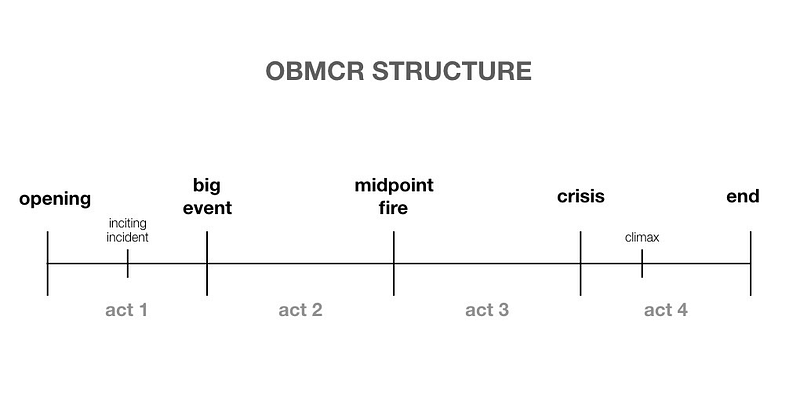
I consider this a fair compromise between the rigidity of Blake Snyder’s framework and the over-freedom of the 3-act framework. It can be considered as a 4-act structure that is created by adding an act break in the middle of the long second act, dividing the story into 4 equal parts. It essentially gives you one starting point (beginning of the story) and four endpoints that you can identify and work towards — 5 markers in total.
Opening — where the story begins (including setup and inciting incident). Who are the characters? What are their worlds/lives like? What’s the inciting incident?
Big Event — how does the protagonist go into the second act? What forces him to make the decision?
Midpoint Fire — what major event happens in the middle of the story that makes the crisis inevitable?
Crisis — what is the crisis event that leads us into the third act? What forces the protagonist to go and face-off against the evil forces one final time?
Resolution — how does the story end?
I refrain from adding specifics of what exactly is supposed to happen, rather, leaving it to your story to decide. What’s important is that the endpoints are known, and the reverse-engineering can happen using the work-from-end principle.
If you need more markers to make this framework more useful for you, then a good idea is to borrow some from Blake Snyder’s beat sheet — I know I do that from time to time.
Now you know the principles, tools, and frameworks to help you assemble your good stories. But you’re still not ready to plot a great story. The most effective plotting can be more easily achieved by a tested and repeatable process. That’s what the next section covers.
4 steps to great plotting — the CATT process
Before introducing you to the process, I’ll like to explain why it is guaranteed to work.
Taken together, the four steps below make you explore your story from many POVs before you write fade-in or prologue.
This is similar to the way an architect pores over a building design for months, checking to make sure that everything is right and that every component works together to make the building better.
By going through these steps, you create a future writing situation whereby you are like the construction worker who erects a spectacular building from the architect’s well-laid-out plan. Wouldn’t that be the dream writing scenario?
Without further ado, here are the steps.
Step 1 — Creating materials and finding direction (God’s view)
God’s View is a process of story-building that leverages the power of time and your two minds in creating the best story possible. In this step, you figure out what your story is by inventing characters, backstories, situations, etc.
This step is best carried out with notes, either written digitally or manually. The notes can be as many as you want. The key here is to let your subconscious mind run free and create the story. Each time a new idea hits, you take it down.
In summary, this is what you need to do in this step:
- Set a duration of every day and consciously think of your story for that period, trying to fix any issues you have or creating story materials.
- Take notes of any ideas you get using any medium that feels comfortable. Try to be as organized as you can be so you can always reference old material for new ideas.
- Keep learning about storytelling. I have found that whenever I am working on a story and I am reading a book on storytelling, I always filter every new knowledge through the lens of my current story. This always results in high-quality ideas that make the story that much better.
- Watch or read other good stories. When you experience quality stories while in God’s View, you will always find elements you can borrow from to make your story better. Sometimes you see something that sparks your imagination and gives you a solution to a plot hole you had.
- Relax and let the subconscious do the rest.
You do this until you realize what your story is. It could take weeks or months, depending on the complexity of the idea and how much you know. It helps to know your preferred structural framework so that the ideas coming to you are filtered through that framework.
Also, recall that part of your creation phase is also to find the anchors — opening, big event, midpoint fire, crisis, and resolution.
Before you leave this phase, you should ideally know what happens in your story at those points, particularly the ending (which could change later and that is fine). Once you have these, and you know your characters, their desires, and their motivations, you can proceed.
To learn more about this process, I recommend reading this article.
Below are screenshots from my iPhone notes app to give you an example of what it could look like.
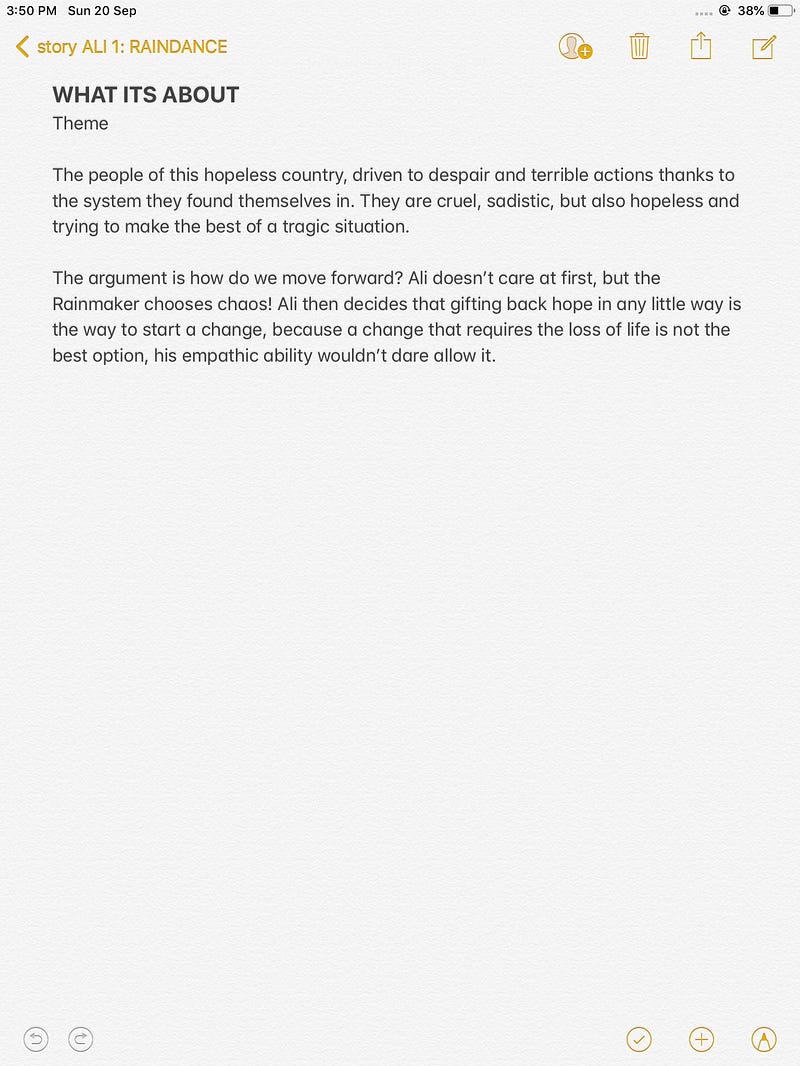
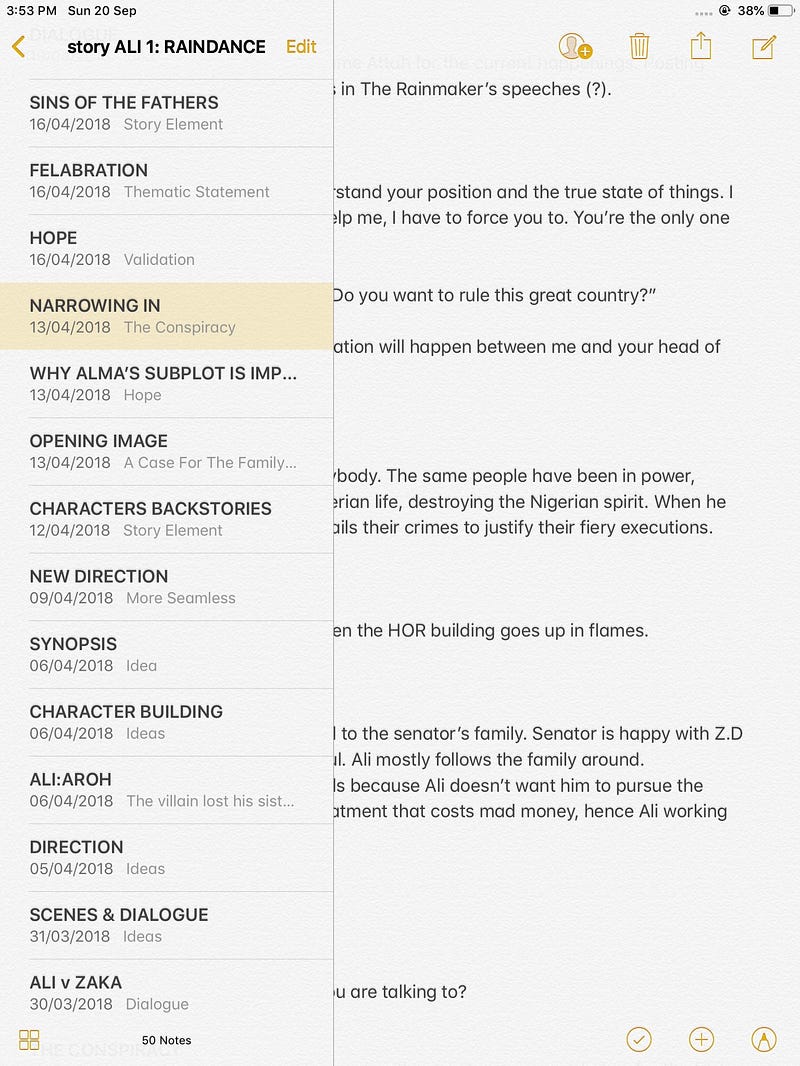
Step 2 — Arranging materials (outlining)
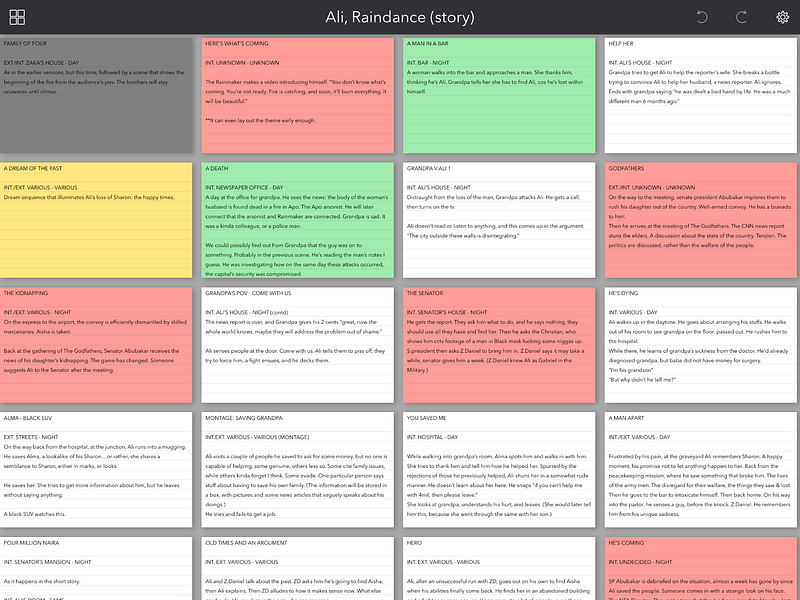
This is a simple process whereby you plot your story using index cards or any piece of paper you have — like my friend Tochukwu who cuts A4 papers into little squares. You could also use a computer or mobile device like an iPad.
One scene goes on one card and a simple summary of the scene is written — for novelists, one card can summarize one chapter, depending on chapter length.
This method is incredibly effective because it helps you see your story from beginning to end without the burden of writing a whole script or novel.
Further, because of their really small sizes, you can rearrange your scenes/chapters multiple times, finding the best arrangement. This rearrangement helps you test your causes and effects to see which deliver the most emotions.
How many cards make up a full story? Around 40–60 is a good range for screenplays. Any longer and you may be heading past a feature. For novels, whatever number of cards is necessary to tell your story.
When writing my stories (both novels and screenplays), I try to keep the cards to within 40–60. This is partly because I like my stories to be easily adapted across mediums (from book to screen and vice versa), and partly because I’m a lazy writer as far as novels are concerned — I like them short.
Step 3 — Testing the story
It is very tempting to want to begin writing your story once you have it laid out in index cards, but that is a mistake unless you’re hard-pressed for time. If the best plot is what you want, then you must test what you have on those it was created for — people. You do this by narrating your story verbally to friends and strangers. There are two main reasons that this step is invaluable.
The first is that it helps you quickly gauge just how good your story is. Think about it, it’s far easier to ask someone for 10 minutes of their time than it is to ask them to read a 120-page script or 80,000-word novel. In the second instance, you’re stressing yourself and the person, who will probably not read it.
The second reason is that it helps you identify and fix problems with your story (characters and plot). This is really what makes the step invaluable.
It happens like this: you’re telling your story to a friend and then you get to a scene, character action, or character motivation, and find that what you originally had doesn’t work. For a split second, you are lost for words, but then, like magic, a new and brilliant solution presents itself and makes the story better. That is evolution.
How many times should you do this? Think of it this way, if you do it nine times, you give your story nine opportunities for evolution. Like nature under the influence of evolution, the changes your story undergoes won’t be drastic, rather, they will mostly be small but significant, each building on the previous one until you have a spectacular piece of narrative magic.
Step 4 — Treating the story
Many writers absolutely hate this process because, on the surface, it seems like a serious waste of time. They think:
I already have the story, why waste my time doing a treatment when I could use that same time to write?
Well, for one thing, the treatment phase will help you realize just how much of your story you don’t know.
The treatment is done by taking the summaries from the outline and expanding them into more details. For example, if the summary in the outline says ‘boy meets girl at a restaurant.’ The treatment forces you to answer the questions of who, why, how, and when. As in, you now need to find or decide and detail who the boy and girl are, why the boy liked the girl, how they got talking, when it happened, and most importantly, how the scene ended.
The length of the treatment for one scene/chapter can range from half a page to two pages per card outline. You always want it to be as long as is necessary to answer the main questions posed by each scene/chapter.
While doing the treatment, you’ll find that you’re deleting and creating new scenes to suit the story as it shapes itself. Now think about it, isn’t it far better to identify and make these changes while not bothered with the stressful demands of writing quality prose and descriptions?
Oh! You didn’t know? Well, the treatment phase requires that you pay no mind to how you’re writing, just write it however it comes.
Once done with these four steps, you will find that your plot and story will be the strongest version of itself, far stronger than if you had gone straight to writing the story from the idea or outline you had.
One big thing to note — the inevitability of change
Whenever you take your story through this CATT process, you’ll find that most times the story changes. The range of change is different for each story. In my case, I find that the core story remains the same, it’s mostly a change in the arrangement of events or the content of the events themselves.
For example, the outline above was created for an unpublished novel. By the time I was writing the story, the beginning had changed quite a bit, with some earlier scenes moved down the line or scrapped, sometimes replaced by new scenes or scenes that were further down the line.
This may seem like a mark against the process because you’re wondering:
Why create an outline or write a treatment when it’s only going to change later?
Well, don’t you see that that’s all the proof you need that this CATT process works?
Stories evolve, and like nature, it does this by fixing past mistakes with every new iteration. The beauty of the CATT process is that every new iteration occurs in a different ‘phase’ so that you’re not rewriting the same story four times just to get the story right, or spending eternity in the outline phase because you want to get it right.
Fight against the resistance that urges you to skip the steps in the CATT process, it will save you a great deal of mental energy when it’s time to write.
How to plot towards a crescendo — Joker and the GOC PLC
What the hell is the GOC PLC, what has it got to do with Gotham’s Prince of Chaos, and how does it help you plot your story towards a crescendo? To answer these questions, we shall begin with the Joker.
Joker was one of my favorite film experiences of 2019, and it was because of the story and how expertly it was plotted. That said, huge credit is due to Todd Philips’ great cinematic direction.
What makes the story for Joker stand out is that it turns its protagonist into an antagonist. But what makes it shine is that when the protagonist becomes the antagonist, you still feel empathy for him. In my case, I couldn’t stop myself from mimicking his gait upon leaving the cinema. How was the story able to do this?
By creating believable, irreversible change using the GOC PLC.
G — goals
O — obstacles
C — conflict
P — pain
L — loss
C — change
First, we are given a character to care about, Arthur. Arthur’s goal is to make the world smile. His obstacles are himself (partly) and the society around him, including his mother.
Each of these obstacles creates a lot of conflict for him. He feels pain during each encounter, but come the third act, the pain becomes overwhelming. This happens when the truth of his birth is revealed to him.
Realizing that his mother, whom he has loved and dedicated his life to, is essentially the root cause of his problem, coupled with everything he’s been going through during the film, he snaps. At this moment, he loses the dream (goal) he once had, realizing that it is pointless, it’s not who he is, and in any case, the world isn’t worth his efforts.
It’s easy to think that what he loses is his mother, but no, he loses the hope of ever having a normal life. Once this loss occurs, Joker finally stops running from his true self. It’s at this point, having realized that the world itself is mad, that he decides he will be like the world, only he will do it better than they ever could.
It’s an expertly executed story because it inverts the normal hero journey and creates a third act that builds on everything that came before —a.k.a. save the best for last.
Thus, to plot a story to a crescendo, you need a character who has (or comes upon) a goal in act 1.
While working towards this goal, they face obstacles in the form of people and situations. These obstacles create conflict which cause pain to our character (act 2). The character tries constantly to overcome this pain until it is too much, leading to a great loss.
The impact of this loss, coupled with everything that happened during the story, forces the character to change and overcome the obstacles both within and without (act 3).
As you can see, the principles of plotting are all there: cause and effect, save the best for last, and change.
Bringing it all together
Plotting is akin to an arrangement of materials (scenes, story events). You need enough materials to begin arranging. If you go to plotting without adequate materials, you’ll be left with the burden of creating the materials and arranging them at the same time.
To find the materials you need to a few things:
- Know your characters — what they want, why they want, how they will get, and the obstacles (this holds for all characters). Stories are about characters. Here is an article to help you create great characters.
- Know your ending(s) — mustn’t be detailed, but enough to show where the story is going. Here is an article to help out with creating perfect endings.
- Know your theme — to understand more on this, read this article.
Once you follow the principles, methods, and tips outlined in this ultimate guide, you will be better equipped to plot a good story of your own. Like with everything, practice makes perfect. Go now and plot the next emotional masterpiece.
Got any questions or tips to add to this, or perhaps an argument to anything here, please drop it in the comments section let’s have a conversation about it.
Gilbert Bassey is a writer, filmmaker, and story consultant dedicated to telling great stories and helping other writers do the same. Subscribe to his Storycraft newsletter and get a free copy of the ‘how to fix a boring story’ checklist + a free in-depth email course on how to transform an idea into a good story.