
How to plan your week like Cal Newport — the plan.txt way
For people who can never seem to get their week figured out

It’s like sending a weekly newsletter to yourself.
I first came across this weekly planning strategy from Dr. Cal Newport while researching his idea of a shutdown ritual, and was quickly enamored by this simple but underused strategy of typing out a plan for the week.
Why use a planner when you can use a simple document saved to your desktop?
Newport has a law that he refers to as “The Law of Action Planning” which is a part of his larger philosophy of “freestyle productivity”. The idea here is that we get bored and tired of certain planning systems, and they begin to no longer work.
As a solution to this reality, he realized that he needed a system that could be ever adapting to his needs and life, every single week.
And so, he created his “plan.txt” document, which is a silly way of describing a document on his laptop where he describes what he’s going to do each week.
Here’s how to do it yourself:
(i.e. how I planned my week using his system)
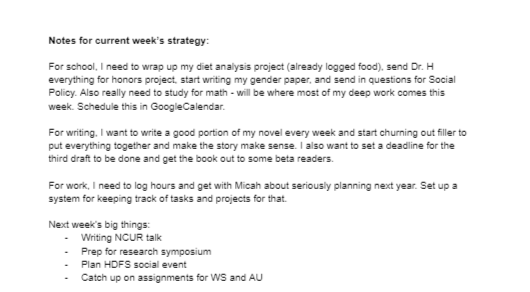
Just looking at the week and summarizing what needs to happen was immensely helpful. It also helped me to realize that certain things just won’t get done this week, that I can put on the agenda for next week.
“There’s too much to do, and there always will be”
In his book Four Thousand Weeks, Oliver Burkeman makes the great point that it doesn’t make sense to get onto yourself to not get to tasks that you never had time for in the first place.
“Once you stop believing that it might somehow be possible to avoid hard choices about time, it gets easier to make better ones. You begin to grasp that when there’s too much to do, and there always will be, the only route to psychological freedom is to let go of the limit-defying fantasy of getting it all done and instead to focus on doing a few things that count.” — OB
I think that looking at your week from a bird’s eye view like this helps you to see what’s realistic and when you’re putting way too much on yourself.
What next?
Based on my research (i.e. reading Cal’s blog) I’ve deduced that he also uses this space to hammer out what this specifically can look like. I’ve tried to mirror his strategy here.
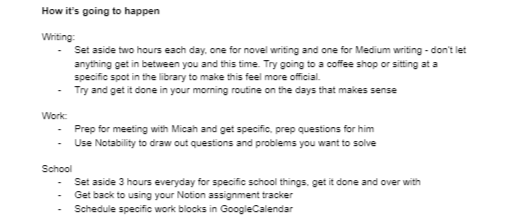
He also uses this space to put down any time-sensitive tasks, marking them in the document. His whole idea here is to really look at your week and go ahead and decide what it’s going to look like when it happens.
Cal’s day-to-day
Sometimes, Cal uses his plan.txt document to specifically look at what the days themselves will look like. He makes a point on his blog to clarify that every weekly plan looks different.
Sometimes it’s more general, other times he plans specific days and what they’ll look like.
On a more consistent front, he uses the strategy of time blocking.
He has a morning routine that lasts roughly from 5–7 am, and then his day is governed by some blocks of time that he lays out. However, he’s also a big proponent of flexible plans.
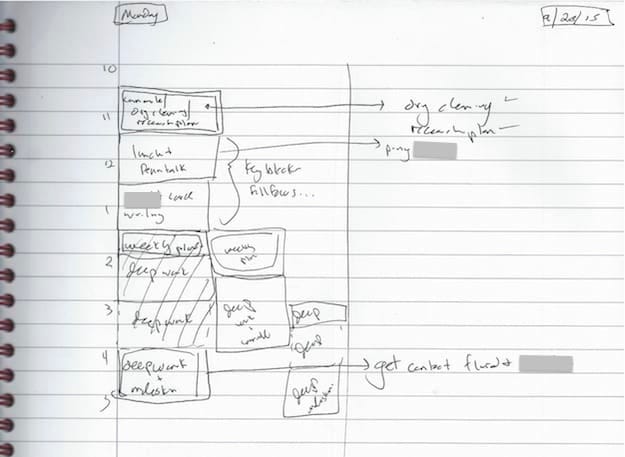
He’s not afraid to move things around, rearrange, or change plans entirely. I think that this is a really simple but powerful way to keep track of things and keep yourself on track while staying flexible.
I often do this in my pocket notebook that accompanies my more laid-out bullet journal. I can time track and time plan and note the adjustments I make throughout the day.
Cal is a great example of someone who’s using a top-to-bottom planning system. He starts with his long-term projects and objectives and then lays out how his weeks should look by those objectives, adjusting as needed to the specific weeks themselves.
Then, he’s able to plan his days based on those weekly plans he’s written out and can plan as needed based on how specific the weekly plan his.
Every week is different. But it doesn’t mean you can’t be organized, efficient, and successful in accomplishing the most important things each week.
Keys to this system:
1. It doesn’t have to be rigid
2. Link short-term goals to long-term projects
3. Change it up every week to make it work for you
Roxine Kee said it well in the following quote from her post on Cal Newport where she summarized some of his work and ideas:
“Cal’s detailed solutions are incredibly specific to his needs (best-selling author, academic, and blogger). While they do work for a wide variety of people, it’s impossible to replicate his results without self-awareness about your own situation.”
The whole idea here is to take some key ideas from someone very good at what they do and apply it to your own life and work.
I hope that my summaries and personal examples of Cal’s planning system have been helpful and inspiring to you and that you’re able to be productive, flexible, and focused on the things that matter most going forward.
Best of luck!


