
Leadership and Productivity
How to Pick the Right Priorities
If “every thing is important, then nothing is important” and you accomplish nothing.

There’s a false perception that defines a busy person as being highly proficient. Being busy is good if we pick the right priorities… AND leave room for the other important parts of life like interpersonal relationships, and mental and physical health.
When I think of this “busyness” in our lives, I’m reminded of the saying, “Like a chicken that’s lost its head.” While writing this, I wondered where this description originated from. According to Bloomsbury International’s website, “Idiom of the Week”, they say it originated in the 14th century and gave a definition of:
To be extremely busy doing more than one thing at a time, but in a disorganized or uncontrolled manner, or in a state of panic. ~ Bloomsbury International
Have you ever had an instance where someone asked you how you are and your response was telling of your busyness? Probably… I think we all have. Interestingly, we never really answered the question. They didn’t ask WHAT we were doing. They asked HOW we are doing. Yet, we explain our busyness whether it’s personal life, work or business because it’s our way of proclaiming our importance. I know that stings, but it’s true and we all do it.
Actually, I see “busy” as a good thing in business, or even at home. Yet, as I noted earlier, we need some balance with the other parts of our lives. Wherever we are, it’s important to pick the right priorities because if Everything is important, then nothing is important and you accomplish nothing.
Don’t allow yourself to get so busy that you get nothing done.
Being busy doesn’t mean we are effective at making the changes we want in our lives. In fact, it most often means the opposite — that we are wasting time on tasks that really aren’t that important. That leaves you drained of energy and wondering what it’s all for. If you watch others flying toward success, your own inaction can cause you to beat yourself up and create a false belief that you are flawed.
You are not flawed — you just need focus.
The Pareto Principle, better known as the 80/20 principle, is an effective time management and prioritization process to apply your time and focus toward the right activities. Basically, the Pareto Principle asserts that approximately 20% of your effort yields 80% of your results. When selecting non-priority tasks to accomplish, the inverse is true: Non-priority tasks that take 80% of your effort, only returns 20% of your results.
It’s important to decide which tasks are the most important and apply your efforts upon those. The fastest way to achieve your results and reach your potential is to pick the right priorities and then develop an action plan to accomplish them. I’m not talking about a comprehensive business plan; a simple list identifying steps to accomplish will do.
Some projects that don’t reach the threshold as a priority (80%) become secondary tasks for another time. If they are still important but not “As important” as the priority list consider outsourcing the job to someone that can accomplish it concurrently to your priority projects. Using that approach, you are then “Buying time” for yourself so you can manage other duties.
Look at Your Time Expense
When you start your week, keep a notepad with you and start tracking your time and efforts:
- Identify primary over-arching objectives and write them down.
- Categorize the objectives A, B, C, D, etc.
- List each project you work on throughout the day and capture the time spent.
- Total your time for the day.
- Identify the priority items.
- Remember: If everything is important, then nothing is important.
- Identify tasks to outsource or put aside until you accomplish priorities.
- Get off the treadmill of busyness and pick the right priorities.
Using the example spreadsheet (below), identify recurring or related tasks for each day.
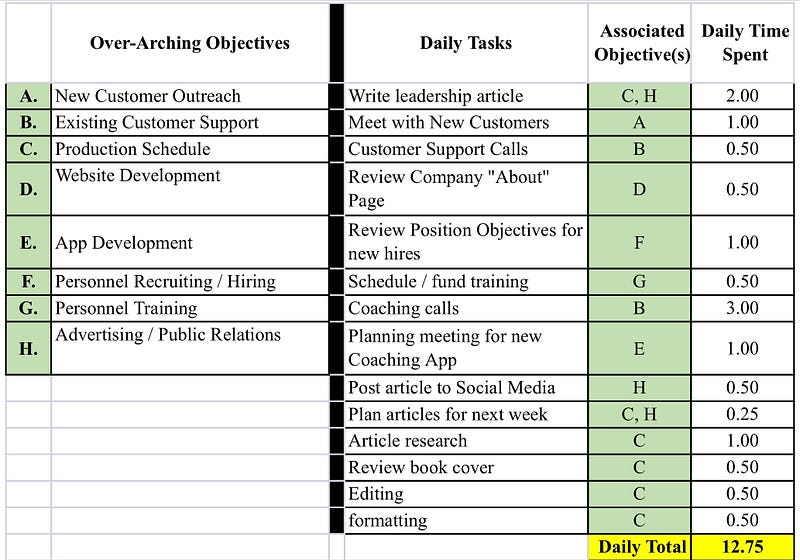
In this example, you’ve worked almost 13-hours while juggling 14 different tasks. While each of those different jobs addressed the over-arching objectives, which of those tasks are the most important? Each day and week brings unique challenges. You’re likely not going to be focusing on recruiting, hiring or training each week. Your book project will eventually get formatted, edited and published. Your website and new App may need ongoing maintenance but do YOU have to be the one doing that?
If you’re researching, writing and publishing one article a day, how much time could you gain if you hired a content writer to do that for you? Or a Virtual Assistant to post articles to social media for you?
The spreadsheet example is only one day’s effort. Multiply that by a five- or six-day schedule and it adds up. If we took some of these other things off your plate, you would have more time for coaching calls that equals money in the bank TODAY. Time you gain to work on the next book increases your potential residual income for the future. Looking at the example above, those are the 80% priority items along with new and ongoing customer support.
A Closer Look at Efforts
Not all efforts yield the same productive results. Given that, why would you want to spend 80% of your efforts on something with only a 20% payback? That approach starts you off with a loss.
I understand what it’s like to want to do it all myself. No one can do a project as good as me right? Not really. There have been many times when I hired a person who produced great effort and results. If we take personal leadership over our own time and communicate the goals effectively, we can gain important time to apply toward the priority tasks.
We are each given 24-hours in a day. Your life and over-arching objectives are likely different than mine. Take time now to track what you do during those hours. Are your efforts yielding tangible results that benefit you, or are you just keeping your head above water?
If you’re struggling and need a snorkel to keep from drowning from busyness, it’s time to make hard choices. Start applying your efforts now to those things that align with your goals and offer you the greatest reward.
Some More Popular Articles by Anthony M. Davis
⭐️ About Anthony M. Davis
Anthony M. Davis is a Leadership, Success & Stress Coach, Board Certified Therapist, and Top-100 International Travel Photographer. His free book, “Keys to Your Success” is available now.


