
The Three Biggest Questions to Ask About a Stock Before Investing
They’re the must-haves before putting any money on it.

Honestly, investing in the stock markets is scary. You never know what the companies are going to do next. They might try to pull off a PR stunt or they might just take the safe route. Who knows? And it is entirely up to them. You have no control over it whatsoever.
But that said, there are not many other places where you can really put your money to work except investing in assets such as the stock markets, real estate, and bonds. Saving your money in the bank is going to financially destroy your long-term wealth. On top of these, there are also considerations of how to diversify your investments.
There are many perspectives that you can take to invest in the stock markets. My way is to ask the question of whether the company can fail?
For instance:
- Where will the world be without Google and Apple?
- Who will be the first in trouble if Verizon goes out of business tomorrow?
- Can people really stop drinking Coke?
I ask these questions because they are the key to long-term investments. I am not looking for hype or speculation. I am looking to hold my stocks for over 50 years and have the interests compound themselves for me. And to do that, I have to look at the bigger picture as a whole and figure out what comes next for the world.
Nonetheless, hold that thought. If you’re asking what to actually look for before investing in a stock, you’ve come to the right place.
Disclaimer: I am not a licensed financial advisor. These are my way of researching the stocks to invest and it is by no means the best way. So take this piece as entertainment.
#1. Net income
All you need to know about the company is the net income that they’re making. Some analysts may argue about the little details in the balance sheet, but none of that will matter, in my opinion, because it will be reflected in the net income, anyway.
Net income (NI) is calculated as revenues minus expenses, interest, and taxes.
In essence, net income is whatever that is left after deducting every expense you have from your revenue. What you can put in your pocket.
This is the only figure that will matter because if a company does not have any net income and only has a net loss, it cannot really grow. The reason I say that is that companies need funding in order to grow, and there are only three viable ways to achieve that.
- Through using their own money. Can be investments from investors or profits.
- Shares offering
- Borrowing money
Therefore, if the company does have any surplus of cash in their bank account, their only choice left is to either offer shares or get a loan from the bank. Since offering shares has a longer process compared to getting loan approval from the bank, more companies would choose to go into debt in hopes that they will be able to pay it back in the future.
Debt
Surprisingly, this is quite a common practice as giant corporations like AT&T, Ford, Verizon, Comcast, Apple, and General Electric have all taken long-term debts worth over $100 billion. That’s not to say that these companies are in trouble because most of these companies have an even larger revenue figure.
- AT&T: $147.2 billion in debt vs $179.1 billion in revenue
- Ford: $114.4 billion in debt vs $149.9 billion in revenue
- Verizon: $106.5 billion in debt vs $131.4 billion in revenue
- Comcast: $105.7 billion in debt vs $108.7 billion in revenue
- Apple: $89.7 billion in debt vs $268 billion in revenue
- General Electric: $67 billion in debt vs $93.5 billion in revenue
My point is that these gargantuan corporations will have to take on some form of debt at some point due to the scale of their business. The difference lies with whether they are like Apple, who made good use of the debt and made nearly triple the amount of their debt, or Comcast, who barely broke even between their debt and revenue.
While you’re at it, take a look at their cash reserves as well. Because that is the determining factor of whether they will be able to weather macroeconomic factors such as a recession. Companies like Apple, who are smart enough to have this cash ready, indicate that the management is responsible enough and are well-prepared for whatever comes next.
Give them a bonus point for this.
Ergo, when you see a company whose revenues are lower than the debt, that is a sign of a company that does not have good management.
#2. Stock chart
The stock chart is one of those things that are more of a lagging indicator rather than a leading indicator. I look at the stock charts as a way to measure investor sentiment — whether more people are buying or selling.
I’m not going to talk about the boring candlesticks here, don’t worry.
But I am going to talk about how it looks.
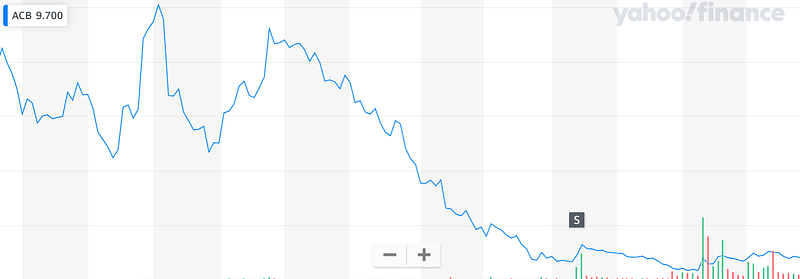
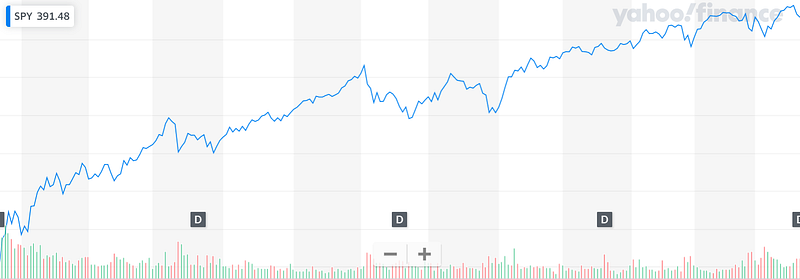
The entire stock market is essentially a supply and demand market. When there are people buying the stock, the prices will increase; when there aren’t enough people buying the stock, the prices will decrease. It is as simple as that.
Ergo, on the left, where the chart is significantly beaten down from its high signals to me that it is either the insiders or the investors are aggressively selling the stock. Whereas on the right, a steady price increase signals to me that more and more people want to get involved with the stock (in this case, ETF) as the price heads towards the top right corner.
That said, I also want to practice the devil’s advocate here and tell you that the charts don’t always reflect the true value of the stock. It is actually very rare that the stock chart does.
Why do people sell their stocks? Because the prices are going down.
Why does the stock price go down? Because people are selling it.
Why do people buy more stocks? Because the prices are going up.
Why does the stock price go up? Because people are buying it.
Humans are weird. And the stock markets are counter-intuitive. It is a self-fulfilling prophecy.
Take the stock chart with a grain of salt. It is by no means representative of the company itself or indicative of where the company might be in the future. The stock is not the company, just like the stock market is not the economy. But analysts do use technical analysis to gauge the sentiment of the stock. And it is your job to ensure that when you buy a cheap stock, you’re not buying a cheap company.
#3. Asking the right questions
- Where would the industry be in 30 years?
- Where will the world be without Google and Apple?
- Who will be the first in trouble if AT&T goes out of business tomorrow?
- Can people really stop drinking Coke?
- What does it take for Tesla to go bankrupt?
These are just some of the questions that will guide your long-term investments. I am a huge believer that the future will be technology, data, and sustainable energy. All the other traditional ways of doing things such as oil companies are slowly running obsolete. At some point, we will run out of oil or natural resources to harvest.
*Puts on tin foil hat
I am also a person who believes that the pillars of our societal system will one day collapse and a reformation will happen. There is a lifeline in every societal system, the economy, the banking, the politics, everything around us.
*Takes off tin foil hat

This is why I decided to pump a huge chunk of my money into robotics, technology, data, AI, and crypto-related companies. Before moving on, I want to mention that I don’t think this reformation is happening anytime soon. What do I know, right? It could be 3 years from now, it could be 10, it could even be 50 years from now.
To be frank, our journey to adopting cryptocurrencies as our way of transacting is still very, very far away when you consider the legalities and the technology we now have. We simply don’t have the ability for it yet.
Back to the topic. You need to first know the company from the top to the bottom. Ideally, every single product in their product line. You’d want to know if people will still be buying their products 50 years from now. You’d want to know if the industry will change. For the better or worse.
Of course, these items do not complete the equation at all. The other half is largely related to the management of the companies. If the management is shit, none of these would matter and the company would still go bankrupt. The good news is that you cannot control any part of the management. It is up to the voters to decide. So you don't have to worry about it.
If you’ve done your homework about the company and made sure that they have all they need in order to still be around for the next 50 years, stop there. Don’t fuss over the things that you can’t control.
Final thoughts
Picking a good stock to invest in is not a formula. Sure, you can learn about the CAPM model, which calculates the relationship between expected return and the risk of the investment or the Capital Market Line, which represents portfolios that optimally combines risk and return, but those are not going to give you the answer as to whether or not it is a good long-term investment.
A huge part of it comes down to sentiment, such as at what phase is the market, investors’ buying power, interest rates, just to name a few. Everything that’s going on in the world will affect your stock prices. The only question is how much.
Take into account:
- Net income
- Stock chart
And then ask the questions that might make the investment look like a bad one. Because a good investment is one that has a larger risk if you’re not investing. If you can’t find any reason to say no to that investment and you’re not biased, that’s a good investment.
Let me know if you find a stock like that, please.
Above all, think long-term and diversify. It doesn’t matter how great your investment is, it might still go wrong. That’s the nature of the market. Never be too convicted with an investment idea. Protect yourself first and never let one bad investment wipe away your entire portfolio’s gains.
Hey, since you’re here, why not join my mailing list for occasional cool stories in your inbox or consider becoming a member to read all my stories! ☺