
avatarChristopher Reno Budiman

Free AI web copilot to create summaries, insights and extended knowledge, download it at here

3085

Abstract

owed to open the exam paper, usually there will be 5 or 10 minutes of reading time. This is your golden minutes and uses this time wisely to take every single opportunity. (Not to cheat, okay). <b>Utilise every single inch of the scrap paper and take any necessary notes. Analyse the question and find the keywords of each question. </b>Most questions inside the exam paper have a hidden clue, especially the multiple-choice and true or false questions. You just need to be aware and conscientious in reading these questions.</p><p id="19ea">If you are doing a long answer question, take note of the keywords too. Your teachers and lecturers are not reading the whole answer, sometimes. They are just looking for the keywords and the main point of the answer.</p><h2 id="31d7">KEYWORDS EXERCISE</h2><blockquote id="b5e0"><p>Here is a question example is taken from a high school IT exam. Can you do it? The keywords are highlighted. You can write the answer in the response section.</p></blockquote><figure id="ff4c"><img src="https://cdn-images-1.readmedium.com/v2/resize:fit:800/1*ly1Sz42KLzjuhebubxaiVQ.png"><figcaption>Screen capture by the author. Source from <a href="https://www.cambridgeinternational.org/">IGCSE</a></figcaption></figure><h2 id="59e1">5. Answer the easiest questions</h2><p id="877e">In the exam paper, there’s a range of questions: from the easiest to the hardest. <b>If you didn’t study or prepare anything, always go for the easiest questions first.</b> When you have reading time, it’s best to identify which questions to answer first; therefore you don’t waste your time.</p><p id="7825">If your exam has different sections, try to answer the short answer questions first. Multiple choice, true or false, or fill in the blank questions for instance. Although these sections will not giving you as many points as the long answer questions, it guarantees you a point if you did it right. Don’t spend too much time here, as you need more time for the long answer questions.</p><p id="78f4">In long answer questions, you need to know that the secret is that <b>your teacher or lecturer has criteria to mark, based on how accurate your answer is. </b>If you don’t know how to answer the long answer question in detail, <i>just put the main point that you know. </i>You will still receive a mark for the right answer, although it’s not fully.</p><h2 id="0069">6. Use common sense</h2><p id="f19e">Using common sense, or known as <i>“The Art of Bulls****ing”</i>. Yes, this is the last resort technique if you don’t know the answer at all. Since most of the questions are applicable in real life, <b>you can think in a common-sense way what would the answer be.</b> Your teacher or lecturer will not expect you to write the exact same word like in the textbook, but they will mark it based on your understanding (Otherwise they will accuse you of cheating). Try to convince them by writing as many words as you can, but don’t confuse them by giving an unnecessary explanation.</p><p id="28a6">An example of how you can write an answer with common sense:</p><p id

Options

="3508" type="7">“Define Mitochondria”</p><blockquote id="2c70"><p>Expected answer: “The powerhouse of cells”</p></blockquote><blockquote id="ad9a"><p><b>Common sense answer: “The main thing inside the living organisms that controls everything to function properly”</b></p></blockquote><p id="2634">It’s longer, but you get the point, right?</p><p id="5ebb">These tips are impossible to do if you have no knowledge or foundation of the subject, so make sure that you pay attention in class. Nonetheless, if you want to maximise your exam result, study hard obviously! Make sure you are well prepared. And don’t forget: sleep well, eat breakfast and keep yourself hydrated to maintain your concentration.</p><p id="9d2f" type="7">GOOD LUCK!</p><figure id="2d32"><img src="https://cdn-images-1.readmedium.com/v2/resize:fit:800/0*iXn4D82Y8eA5QEwe"><figcaption>Photo by Sydney<a href="https://unsplash.com/@srz?utm_source=medium&amp;utm_medium=referral"> Rae</a> on <a href="https://unsplash.com?utm_source=medium&amp;utm_medium=referral">Unsplash</a></figcaption></figure><h1 id="8f9a">More from the author</h1><div id="4f78" class="link-block"> <a href="https://readmedium.com/i-love-being-a-deadline-fighter-edc5f9eed04d"> <div> <div> <h2>I Love Being a Deadline Fighter!</h2> <div><h3>And why you should consider it too!</h3></div> <div><p>medium.com</p></div> </div> <div> <div style="background-image: url(https://miro.readmedium.com/v2/resize:fit:320/0*KCVzxh5jC9SFs3pN)"></div> </div> </div> </a> </div><div id="e291" class="link-block"> <a href="https://readmedium.com/investing-in-technology-should-i-always-go-for-the-most-expensive-one-b1f863ba8e9c"> <div> <div> <h2>Investing In Technology: Should I Always Go For The Most Expensive One?</h2> <div><h3>Be thorough in deciding your next tech product.</h3></div> <div><p>medium.com</p></div> </div> <div> <div style="background-image: url(https://miro.readmedium.com/v2/resize:fit:320/0*Rlh_6fum8ar7z5hx)"></div> </div> </div> </a> </div><p id="6758"><b>Christopher Reno Budiman</b> is a writer, explorer and entrepreneur-minded person. He received Bachelor of Business (Hospitality Management) and Bachelor of International Hospitality Management with Swiss Hotel Association accreditation. He’s on <a href="https://www.facebook.com/chris.budiman97">Facebook</a>, <a href="https://www.instagram.com/christopherreno/?hl=en">Instagram</a> and <a href="https://www.google.com.au/url?sa=t&amp;rct=j&amp;q=&amp;esrc=s&amp;source=web&amp;cd=1&amp;ved=2ahUKEwjGxazLvLjpAhXK7HMBHVooDK4QFjAAegQIARAB&amp;url=https%3A%2F%2Fau.linkedin.com%2Fin%2Fchristopher-reno-budiman-239b05120&amp;usg=AOvVaw3wypG6ZPqqxqcC6lQ9mqnI">LinkedIn</a> if you would like to know more about him.</p></article></body>

Photo by Honey Yanibel Minaya Cruz on Unsplash

How To Pass Your Exam WITHOUT Studying

6 tips on how to become the class sensation.

It’s the time of the year again! Exam weeks are here. Most students took days and weeks to study before the exam, even some students took hours only to study. But what if you’re planning not to study at all? #TeamProcrastination

If you’re that one, here are some tips for you.

1. Master the topic

The key to mastering the exam is to understand the whole topic beforehand. Listen carefully to what your teacher or lecturers said in class. You can still take notes to review, but most importantly is to take out the main point. The more you prepare, the more confident you are on the subject.

The best way sometimes is to relate your exam topics into real life. Once during my hospitality college year, I had a wine tasting exam that requires me to describe the taste of different wine varieties. I didn’t study as most students did, instead, my friends and I organised a wine-drinking session, to familiarise our palette (Which end up as a drinking party, eventually). Anyway, my result wasn’t too bad and I didn’t regret doing it. #PassLikeABoss

Photo by Scott Warman on Unsplash

2. Be confident

Don’t be nervous! Bluffing is the key to failure! Just like a poker player, it can lead them to a wrong move. The same thing goes when you’re about to do your exam. You have to believe in yourself that you can do it. Do not overthink, as it can ruin your whole mood.

3. Be comfortable

When you are in the exam room, try to adapt yourself with the situation as much as possible. What does it mean? The exam room can be a little bit intimidating since it’s quiet and your invigilator is watching you. Don’t put too much pressure to yourself and don’t panic. Just take a deep breath and relax. When you are comfortable, you will be confident too.

I know some of you may have done an online exam, which is better since you do not need to worry about these things. Just relax at your home, be comfortable in your room. Make sure that you get rid of any distractions that cause you to lose concentration.

4. Analyse the questions

When you are allowed to open the exam paper, usually there will be 5 or 10 minutes of reading time. This is your golden minutes and uses this time wisely to take every single opportunity. (Not to cheat, okay). Utilise every single inch of the scrap paper and take any necessary notes. Analyse the question and find the keywords of each question. Most questions inside the exam paper have a hidden clue, especially the multiple-choice and true or false questions. You just need to be aware and conscientious in reading these questions.

If you are doing a long answer question, take note of the keywords too. Your teachers and lecturers are not reading the whole answer, sometimes. They are just looking for the keywords and the main point of the answer.

KEYWORDS EXERCISE

Here is a question example is taken from a high school IT exam. Can you do it? The keywords are highlighted. You can write the answer in the response section.
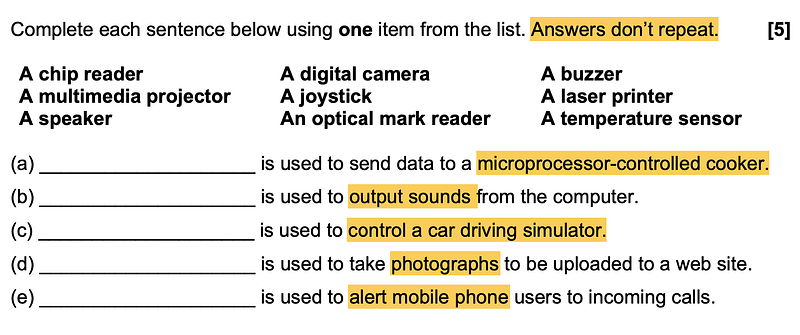
Screen capture by the author. Source from IGCSE

5. Answer the easiest questions

In the exam paper, there’s a range of questions: from the easiest to the hardest. If you didn’t study or prepare anything, always go for the easiest questions first. When you have reading time, it’s best to identify which questions to answer first; therefore you don’t waste your time.

If your exam has different sections, try to answer the short answer questions first. Multiple choice, true or false, or fill in the blank questions for instance. Although these sections will not giving you as many points as the long answer questions, it guarantees you a point if you did it right. Don’t spend too much time here, as you need more time for the long answer questions.

In long answer questions, you need to know that the secret is that your teacher or lecturer has criteria to mark, based on how accurate your answer is. If you don’t know how to answer the long answer question in detail, just put the main point that you know. You will still receive a mark for the right answer, although it’s not fully.

6. Use common sense

Using common sense, or known as “The Art of Bulls****ing”. Yes, this is the last resort technique if you don’t know the answer at all. Since most of the questions are applicable in real life, you can think in a common-sense way what would the answer be. Your teacher or lecturer will not expect you to write the exact same word like in the textbook, but they will mark it based on your understanding (Otherwise they will accuse you of cheating). Try to convince them by writing as many words as you can, but don’t confuse them by giving an unnecessary explanation.

An example of how you can write an answer with common sense:

“Define Mitochondria”

Expected answer: “The powerhouse of cells”

Common sense answer: “The main thing inside the living organisms that controls everything to function properly”

It’s longer, but you get the point, right?

These tips are impossible to do if you have no knowledge or foundation of the subject, so make sure that you pay attention in class. Nonetheless, if you want to maximise your exam result, study hard obviously! Make sure you are well prepared. And don’t forget: sleep well, eat breakfast and keep yourself hydrated to maintain your concentration.

GOOD LUCK!

Photo by Sydney Rae on Unsplash

More from the author

Christopher Reno Budiman is a writer, explorer and entrepreneur-minded person. He received Bachelor of Business (Hospitality Management) and Bachelor of International Hospitality Management with Swiss Hotel Association accreditation. He’s on Facebook, Instagram and LinkedIn if you would like to know more about him.

Motivation
Inspiration
Schools
Study
Exam
Recommended from ReadMedium