
How to Participate in Blockchain Governance in Good Faith (and with Good Manners)
Check out this table I made, I call it “Some Do’s and Dont’s of Participating in Blockchain Governance in Good Faith”:
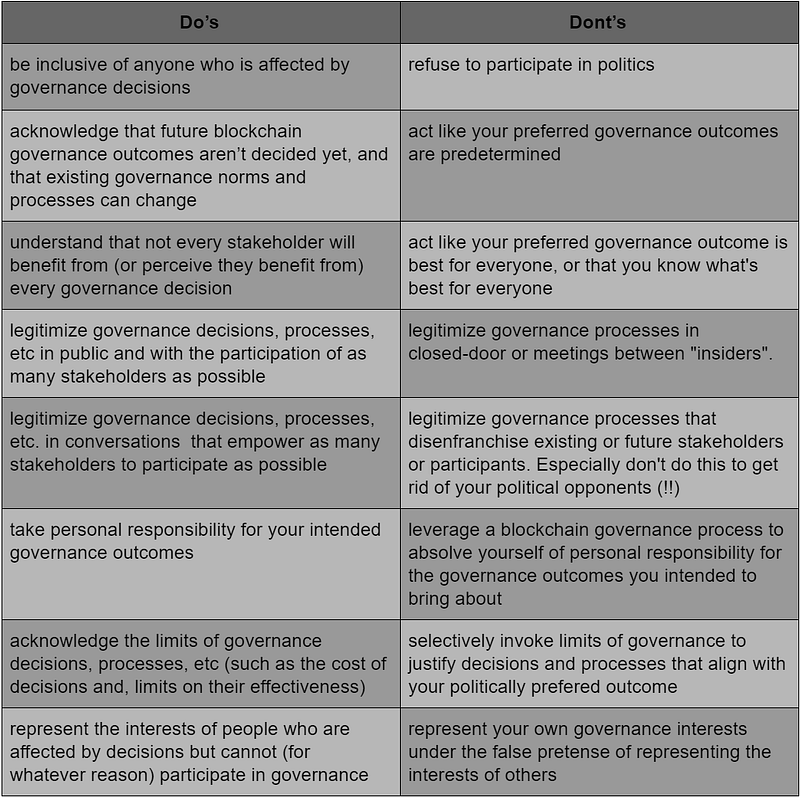
Don’t feel like if you’ve done any of the “dont’s” that you’ve necessarily acted in bad faith. Given the level of public understanding of governance (and especially blockchain governance), ignorance is normal, expected, and very excusable. Once you reach a certain level of awareness, however, the behaviors listed above become bad faith. But don’t unquestioningly accept anything I say or put in a table (I might be wrong), or assume that my table is complete (it isn’t).
I think most of these are self-explanatory, or have been explained better by others, but I want to say more about “don’t refuse to participate in politics”, because that bit is more controversial. In the next paragraph, by “you” I am addressing participants in blockchain governance who refuse to participate in politics, specifically those in positions of power to influence blockchain governance outcomes. And by “us” I mean all participants in blockchain governance:
By refusing to engage in politics you are refusing to coordinate with us in the act of driving for a blockchain governance outcomes that very possibly will have a large impact on our lives. By refusing to engage us in politics, you deny us participation in how you intend for us to collectively govern the blockchain. By refusing to engage in politics while driving governance outcomes, you’re attempting to put yourself/yourselves in a position of lord — one where you dictate the future of the plebs. I know that politics is hard, but I would much prefer it to your self-appointed lordship. I don’t think refusal to participate in politics can be good faith behavior (for anyone who is determined to determine governance outcome), any more than you can appoint yourself lord of the blockchain in good faith. Don’t hesitate to let me know if you disagree, or where I didn’t mention something I should have!
Edit: Clarification: I’m saying that refusing to participate in politics is bad faith if you are actively driving governance decisions, not if you are uninterested, apathetic, or disenfranchised. I’m calling out the people who are driving the car but refuse to talk to the passengers, not the passengers who don’t care where the drivers take them.
Now for some manners. These are things that aren’t really a matter of good/bad faith participation, since political opponents with bad manners can justify bad manners (in good faith).
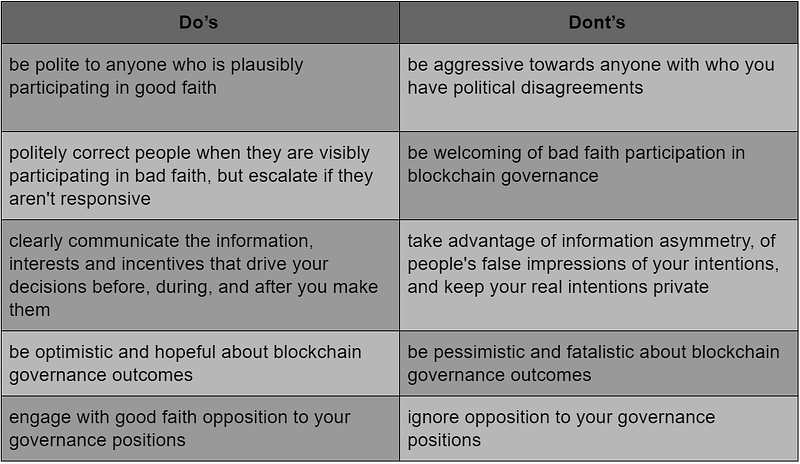
I know that I owe many of you responses to criticisms of my previous blog posts, and I’m not ignoring them! You can take this post as a checklist based on which I plan to (publicly (and privately)) criticize and praise your participation in blockchain governance. Pls hold on! :)


