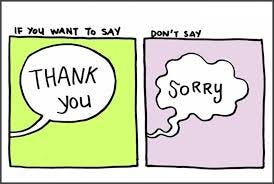
How to Not Say Sorry. Empower-filled alternatives.
If you’re confused, I’m sorry (oops).

Let’s unravel this.
An apology without attention is an empty promise — a dead caterpillar. An apology with intention transforms an awkward pause into a majestic butterfly flitting and alighting on the two of us.
Let’s expand on this idea.
You do the lead role in the following play.
DOES SAYING SORRY CHANGE ANYTHING?
ACT 1
Scene 1
Imagine you’re waiting for someone and they’re late.
What thoughts are skipping through your head as you glance at the clock for the umpteenth time?
Then I strut in disheveled, and gasp out, “Sorry I’m late”.
How does that sound? Are you willing to forgive my tardiness? My lack of respect? My total disregard for other people’s schedules? Who the hell do I think I am and why am I smiling? I’m not laughing.
You say “(fill in the blanks)”
Scene 2
I arrive at a competent pace, looking composed, amiable.
A slight pause on my part. “Thank you for waiting for me.”
How does that answer score? Are you validated? Acknowledged? Respected?
You say “(fill in here)”
(Curtain closes)
ACT 2
Scene 1
(You are a pillar of strength to someone close to you, spouse, sibling, or friend, who is going through an episode of depression.)
I’m the episode. (This is pretend — I’m fine at the moment.)
You play the part of the pillar.
I start with, “Sorry for being such a mess.”.
The jury’s out. But lots of judges banging their gavels in your head. Headache coming on — am I wasting my time trying to help? It’s draining.
You say “(aha, you’ve caught on now)”
Scene 2
I blurt out “Thank you for loving and supporting me as I am.”
Your reaction? Will you continue being that someone I turn to in need?
Odds are you will.
Why?
Because I acknowledged you; I came out of my swamp of despond and connected with you. I expressed gratitude to you. Therapeutic for me too.
I made the solution about you and not me. The key is to open doors, not slam them shut.
(We exit stage left, deep in conversation.)
INTERMISSION
Please go grab a beverage from your kitchen, stretch your legs. Yes, there’s plenty of time for a bathroom visit — I doubt there’s a queue.
(The curtain rises.)
ACT 3 (Final)
Scene 1
I’m working on a project with you. You tell me I have messed up.
You say “………”
My response. “I’m sorry.”
Do you accept that? Is this good enough?
Are you at a loss for words!
You’re ready to throttle me and I brush you off with that impoverished word. What does it mean?
What if I said, “Thanks for pointing that out,” instead?
Can you trust me? Did I take responsibility for my mistake? I kept your finger pointing right at me. I didn’t push you away or play the blame game. Does that sit well with you?
Phew! That’s a relief. It didn’t kill me. I accepted out loud I’m not perfect, and that’s okay.
We shake hands (or embrace if you prefer) as the curtain lowers.
THE END
CRITICAL REVIEW
In our Western fast-paced life, a quick word, a brush-off, so I can reach There — I’m too busy to be stuck Here.
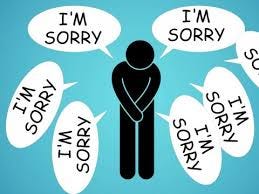
Over the next week, catch yourself using the S-word. We mean well when we say it, but does that connect or separate us? Is your choice of words meaning-full?
I’m as guilty as anyone. I caught myself yesterday. To be honest, my hubby was the catcher, not me — he knows the game. He’d asked me to fetch something from the workroom; I got distracted along the way and forgot. When he asked again, I threw the dreaded S-word at him and, he caught the ball and tossed it back.
Turn each sorry into thank you. Pay attention and practice. The outcome will astound you; will shift your perspective.
We communicate with words — we speak, we read, we write. Whoever we are, the words we choose change the world.
If we want to awaken ourselves, we should watch our words.
I’m not sorry and nor are you. Don’t say the S-word, ever again.
BMpowered. (Copyright 2018 C P Lucas de Braganza)