
How to Navigate Seasonal Energy Depletion
Transitioning from summer to fall
Are you feeling like a Mack truck ran over your head? Are your eyes itchy? Are you sneezing a lot? Are you exhausted?
Have you been wondering why all these things seem to be happening now?
It’s September and I have been experiencing this for the last few weeks. Allergens are high in Oklahoma, where I live.
Across the western United States, fires have been raging and smoke is infiltrating human’s homes and lungs. Not to mention the emotional toll the fires are causing.
Then, there’s that whole pandemic thing.
We are experiencing traumatic stress disorder and we know it. There’s no post about it. Not yet. We are smack dab in the TSD with a looming P sometime in the future.
And, we have no idea when we’ll be collectively coping with PTSD. Part of me thinks it’ll be easier for us when we can come together and acknowledge that our society is experiencing PTSD.
But, not yet.

We are tired. So, so tired. And, it’s understandable. I am fortunate to currently be a stay-at-home parent attempting to make a living with freelance writing (not there yet).
This means my schedule is fairly flexible. Our kids, aged 9 and 12, are satisfactorily self-sufficient. Dear Parents of Younger Children — there is hope. Our children can do so many things now: from making macaroni to doing chores to entertaining themselves.
Of course, bickering is still a family staple and sibling bickering…well, that’s a whole level-up of bickering that I never experienced as an only child.
Because my schedule is flexible and our kids are older I can rest and take breaks as needed. I know this is a luxury that many others do not have. I don’t take it for granted.
Many of us are feeling sheer exhaustion in 2020.
Last year, I wrote a book (publication forthcoming someday). This book is a memoir that addresses many facets of my life and invites readers to explore their own through the lens of nature.
Nature has always been a comfort to me. Especially when my mental health suffers. And, I believe our collective mental health has taken a big hit in 2020.
When I mentioned my sheer exhaustion day after day, one of my writing friends said she’d been feeling inordinately tired, too. She wondered if it could be the shift in seasons.
And, that was a big Aha! moment for me. Of course, I replied — how did I not think of that?
Here in the United States, in September, our daylight is transitioning. It’s darker later into the morning and dark descends earlier in the evening. The peaking days of summer’s strongest sunshine are in our rearview mirror.
And, this summer? Well, in many ways this summer is The Lost Summer. As I’m sure 2020 will in many ways come to be known as The Lost Year.
This summer we did not:
go putt-putting, go to birthday parties, host sleepovers, send the kids to grandparents for the week, go to the movie theatre, go swimming, go for a mini-vacation, go to the 4th of July fireworks display, or go camping.
The Lost Summer.
So, what I normally do when seasonal shifts arrive is to take the time to notice the changes. Simply observing the small changes of shifting seasons helps take away the surprise of Summer becoming Fall.
But, what do we do this year?
Well, we continue to notice the small changes.
And, we cut ourselves a helluva lot of slack. Because this year is HARD. This year has been A LOT. This year continues to be DIFFICULT.
For parents of school-aged children, the second year of virtual school has begun. And, as much as I hoped the online school would be easy-breezy, it’s not. Our children haven’t had in-person peer interaction for 6 months.
I’m not complaining about virtual school. In fact, I chose it. I don’t want our kids to put others at risk and vice versa. I don’t feel there’s enough precautions and information about COVID to deem a return to school safe.
So, I’m glad our kids are attending school virtually. But, I repeat, it’s not easy.
In order to care for ourselves during this shift of seasons from summer to fall, consider integrating the following into your day:
- Observe the shifting seasons and hours waning daylight.
- Shorter days mark a time of turning inward. They are a great time for reflection and introspection.
- Allow yourself to mourn what has been lost so far in 2020. It is healthy to experience grief and give yourself time to mourn. Just don’t get lost in that space.
- Shorter days often bring a need for people to rest. It is okay to need extra rest. Prioritize it. You are worth it.
- Notice the plants and wildlife shifting with the season. You are also wildlife. You can learn a lot from the creatures outside your backdoor.
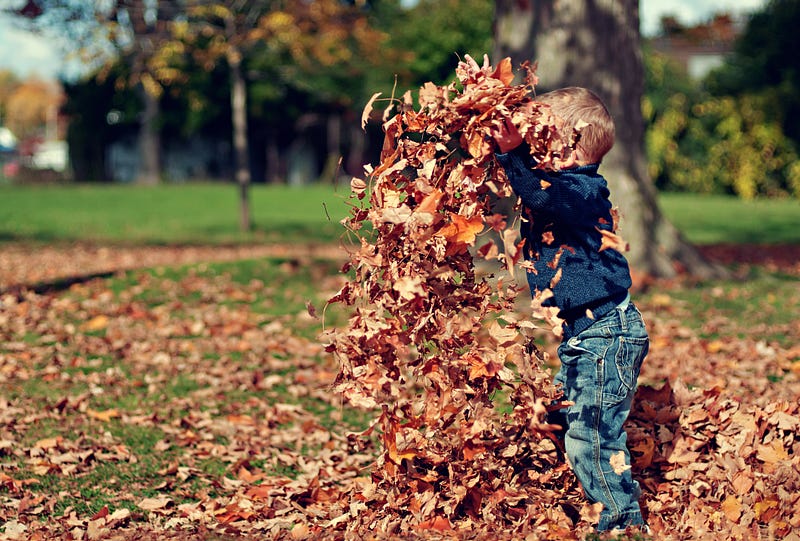
- Rake a pile of leaves and then jump in.
- Stretch. Moving our bodies is vital when we are inside more and can forget the importance of keeping our bodies flexible and limber.
- Engage in the traditions you love. I’m not generally great at decorating for the passing holidays of fall and winter, but I plan to put more oomph into it this year, as we’ll be spending the holidays at home.
When we all take a break from screen time — be that play or work — and go outside to jump in a pile of crisp autumn leaves our brains find comfort in something familiar and fun.
We giggle, laugh, and snap photographs. We remember the time Jaden ran through autumn leaves with a blue superhero cape around his neck and a winter hat on. David grumbles about the piles of leaves adding up to more yard work and I shrug off his complaint like I do every year. Ceci stays focused on raking the biggest pile to dive into face-first.
We live in the moment to the best of our ability and have fun.
The kids get along better when they are participating in an activity with a goal together. We move our bodies and feel better for it. The fresh air is invigorating.
For an activity that has more to do with processing the emotions of the year so far, try journaling. Make a list of what you are sad about. Then, make a list of what you are grateful for.
The gratitude part is important. It helps our brains find more happiness than we are keyed in to loss and sadness — however, it’s still important to process these emotions.
You can also verbally do this with a friend, your partner, and especially your children. This world flipped on a dime in a very concrete way in March of 2020. Our children need our guidance in navigating a completely different life. It’s normal for them to be grieving, too. And, it also helps for them to remember what they’re grateful for.
And, readers, while we’re on the subject, I want to let you know — I’m grateful for you.
Gentle Transitions
I’m a backyard gardener. The transition to fall in the garden brings some beautiful changes — green leaves turn vibrant red, orange, and yellow. Here in Tulsa, we see the migration of monarchs and other flying species.
Fall flowers bloom in all their glory. Autumn sunflowers sway their yellow blooms, red amaranth puts on its dangling red flowers, pineapple sage, and vining moonflowers finally begin to bloom.
Yet, we know the first freeze will soon arrive. It will soon be time to cut back, tidy up, and put to bed the garden for the winter.
For me, this brings feelings of both loss and relief. And the reminder:
Everything in life needs rest.
Aimée Gramblin writes across topics. Writing, Mental Health, Humor, and Memoir are a few favorite subject areas. Support Aimée’s writing by becoming a Medium member today.


