
How to Navigate Conflict and Disagreement With a Single Word
Withholding judgement with Montaigne.
It would seem people have never been so divided. It’s not hard to find arguments everywhere you turn. The media naturally plays it up since the drama improves their ratings and clicks. So, this leaves you surrounded by an unending flow of disagreement that clashes morning and night. How can one keep level-headed in this type of environment?
This is the general appraisal of our current age. But, step back a moment and think. Ask yourself these questions before you follow that narrative.
- Have people truly never been this divided?
- Was there a time when people argued and fought this much in the past?
- Is this the only time societal issues have caused divisions within families?
- If our age isn’t uncommon, what did people do to deal with these issues?
The times we live in aren’t unique. One philosopher lived through a time of great strife that caused families to come to blows and divided a land. Michel de Montaigne would live in the Bordeaux region of France during the Wars of Religion.
During the war Catholics and Protestants would battle violently in the streets. Montaigne’s own family was split between Protestant and Catholic. He’d find himself divided between his own family members, the local community, the church, and the monarchy. One wrong move might result in your death or banishment.
And you thought we lived in a difficult age?
Despite the climate, Montaigne wasn’t imprisoned. He wasn’t beaten by mobs in the streets. He seems, for the most part, to have gotten along with his family. He also appears to have been respected by both Catholics and Protestants— even acting as a moderator between the two.
His secret? He withheld judgement.
One Word To Guide You
“Skepticism guided him at work, in his home life, and in his writing. The Essays are suffused with it. He filled his pages with words such as ‘perhaps’, ‘to some extent’, ‘I think’, ‘it seems to me’…Words which as Montaigne said himself, ‘Soften and moderate the rashness of our propositions.’”
— Sarah Bakewell, “A Life Of Montaigne”
Montaigne would live a unique life. Born to a wealthy family, his father would send him away after his birth to live his first 3 years with local peasants. Upon Montaigne’s return, his father would hire a Latin tutor to teach his boy to speak. The tutor, the servants, and the family would only be allowed to talk to him in Latin. By the time he was 7, Montaigne was already fluent.
Latin would open many doors for the young nobleman. It would also give him the ability to read many classic pieces of literature in their original language. In his search of random classics, he’d find a book about Sextus Empiricus, a Pyrrhonian Skeptic.
Skepticism was a school of philosophy on par with Stoicism and Epicureanism in ancient Greece. According to Bakewell, Sextus would introduce Montaigne to one magic word, which would cure him of many of his troubles. It would also influence the way he’d see the world. This enchanting Greek word is Epoché, meaning to hold back or reserve judgement.
Montaigne had medals and measuring scales made to remind him of its meaning. The icons would remind him to weigh his judgement before taking a position. The concept would also remind him to look at himself with a skeptical eye, regarding his actions and thoughts.
He’d also hold judgement on his own view of the very world. Writing in the mid to late 1500s, Montaigne would imagine that humans and animals would see reality in vastly different ways. If so, what’s to say a human’s view is correct?
As Sarah Bakewell mentions in her book, Montaigne would strive to question everything. This curiosity made the world an interesting place and allowed him to fix and orient truth. It also made him tolerant of other points of view — allowing him to connect with those around him in a turbulent time.
While France fell into civil unrest around him, he simply replied, “Epoché”. The ancient Skeptics believed suspending judgement on all unprovable matters would bring about ataraxia — relief from anxiety or stress. It would certainly allow Montaigne to keep his even keel and navigate the treacherous waters between Protestants and Catholics.
A Historical Solution To Our “New” Problem
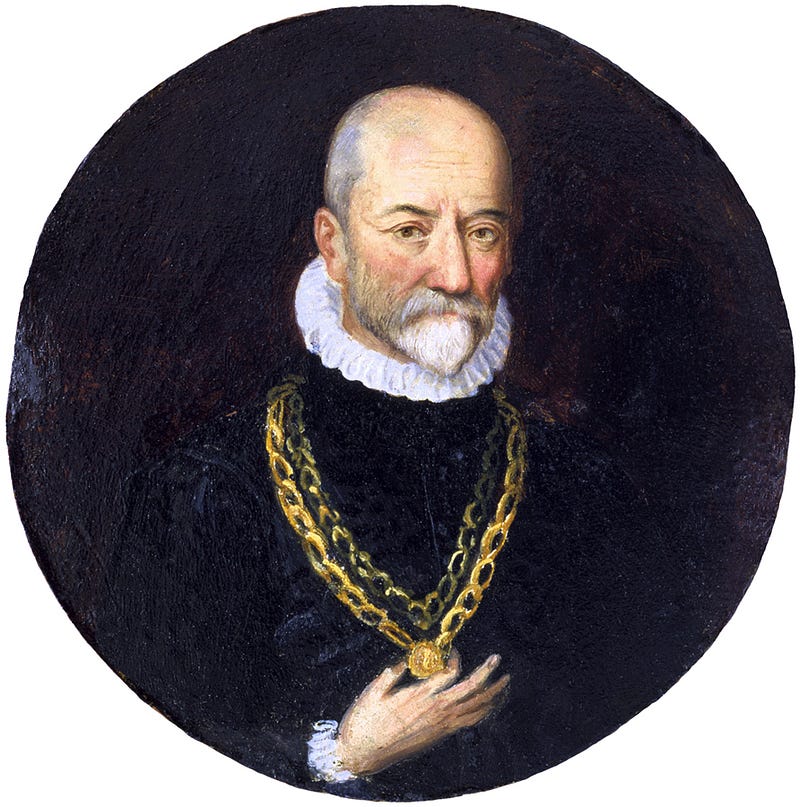

“There is no way so good that I should want to be fixed in it and unable to break loose. Life is an uneven, irregular, and multiform movement. We are not friends to ourselves…we are slaves, if we follow ourselves incessantly and are so caught in our inclinations that we cannot depart from them or twist them about.”
— Michel de Montaigne
We’re repeatedly told we’ve never been so divided. Things have never been so tense or combative. However, people have always been divided, fought, and argued — often violently. Maybe the topics have changed, but the fighting is far from unique.
Montaigne lived through an age of religious civil war. It wasn’t unusual for neighbor to fight neighbor and families to split. He rediscovered a solution found by the ancient Greeks — a simple word to remind him to withhold judgement on how you see the world.
Perhaps this might be a solution for our time as well. When opinions fly freely on social media, along with insults and raised voices, the best reply might be Epoché. We might be able to be mediators and bridges like Montaigne. Our time is not unique and the methods to solve our division are ones that have worked in the past.
Strive to withhold judgement. Strive to experience Epoché.
Mind Cafe’s Reset Your Mind: A Free 10-Day Email Course
We’re offering a free gift to all of our new subscribers as a thank you for your continued support. When you sign up using this link, we’ll send you tips on how to boost mental clarity and focus every two days.