

How to Name Your Bestseller (Hint, it involves “Girls”)
Despite the old adage, we all know that everyone judges a book by its cover. So why do some books sell while others languish on store shelves or in Amazon fulfilment centers? I submit to you that what moves those glossy tomes is as simple as the few words printed on them.
I’ve used the freely available New York Times Bestsellers API to study the titles of the most popular books of the last 5 years. Having carefully examined the data, I’m ready to share my results with the would-be authors of the world. Below I’ll show you how to title your future best-seller using just a few simple tricks.
Learn What Words Work
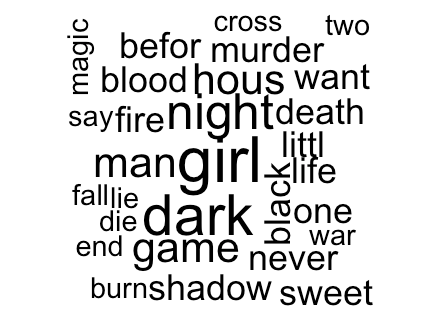
Does anyone know the name of the bestseller that has racked up over 100 weeks (over 2 years!) on the NYT fiction best-seller list? Chances are that you’ve seen the book at your local airport kiosk and felt it’s near-perfect title working subtly on your subconscious. I’m of course referring to Paula Hawkins’ “The Girl on the Train”. It turns out that this book uses one of the most powerful words in modern fiction, namely “Girl”. In fact, if we take a list of all the fiction bestsellers of the past year, we find that there is no more popular word. Below is a word cloud created by breaking down the titles of these books. As we can clearly see, some words seem to work like magic to attract potential readers.
Add Mystery
Looking at the most popular words in our list of bestsellers, we can see other tricks being utilized. Look closely. What patterns do you see?
It turns out that if we take the data from the past 5 years, we find many of the same popular words. We get things like “Dark” (31 titles), “Shadow” (16), “Night” (28), “Secret” (21), “Storm” (14), “Gone” (8), and “Game” (16).
What do these words have in common? Each of them implies a mystery. Perhaps we can read about things hidden behind ‘dark’ ‘shadows’, or maybe learn about a ‘game’ that we don’t know the rules to. Or maybe there is some important ‘secret’ we have to discover. As experts in persuasion will tell you, nothing captivates an audience quite like the unknown.
Make it about “You”
I have a confession to make, the word cloud I showed you above is slightly misleading. The unfiltered graphic of the most popular titles in fiction is cluttered with “the”s and “a”s — basic words that aren’t very interesting and so had to be removed. However, there is one word in this list which I think deserves attention. If we get rid of only the simplest words - “the”, “and” and “a” - but keep the others, we get this updated graphic.
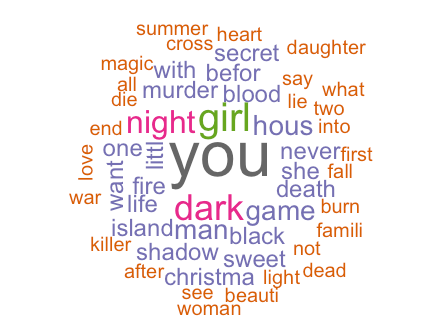
It turns out that the real, honest-to-goodness, most powerful word you can use to hook someone is “you”. Of course you already know this. After all you are Time magazines’ 2006 person of the year. You know that whenever you read the word “you” it hijacks some part of your brain, immediately putting you into the place of the sentence subject. ‘You’ are ultimately self-centered just like every other human. Use that to your advantage.
Make it Snappy
Besides the content, it turns out that the number of words in a book title is important. A quick histogram of the bestsellers illustrates this.
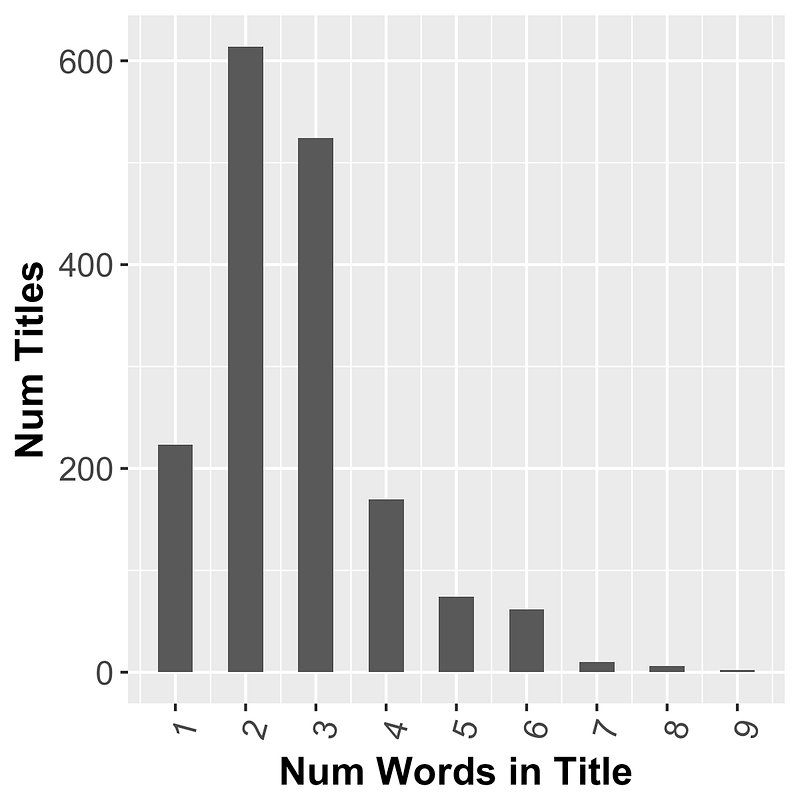
The message is clear. In general, shorter is better — two or three words in a title, tops.
Capture the Zeitgeist
As linguists know, the most popular words evolve with the times. This is illustrated nicely by comparing the bestsellers of the past year to those from up to 5 years ago. Notice any differences when we include the older data?
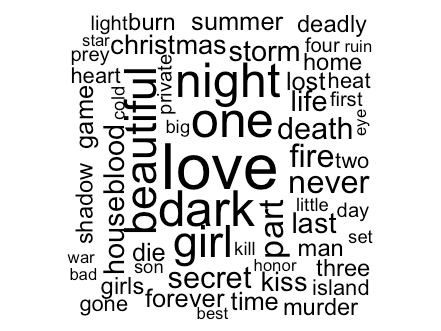
Whereas the books of the past year have been big on darkness and murder and death, the titles of the last 5 years are significantly more positive. On this list, both ‘Love’ and ‘Beautiful’ do a better job of capturing the mood of the nation. Interestingly, in the 5 year word cloud , “death” and “life” are now given equal weight (13 titles to 12)
Use Sex or Violence
Per the previous point, some of the most popular words depict the extremes of human experience. On one end, “beautiful”, “kiss”, “heart”, “heat” and “fire” show up repeatedly. On the other we find “death”, “kill”, “die”, and “murder”. By tapping into these exremes of the spectrum, you can more easily entice a reader.
Anchor your Story
Coming back to that masterstroke of a book title, “the Girl on the Train”, we may now focus on the second part, the train. A train is a great location for a story (as Agatha Christie well knows). More importantly, many bestsellers are bought in transit. Would-be buyers are already primed for travel stories as travelers themselves. After all, maybe you’ll meet an interesting girl on your train ride too.
Besides “Train” (2 bestsellers), popular settings for a book include, “House” (12 titles), “island” (8) and “Home” (9)
Times are good for anchoring a story as well. “Night” (28 novels), “Day” (12), “Hour” (5), “Summer” (11), and “Christmas” (11) are all well represented
Pick a Number
The human mind seems drawn to simple numbers and these seem to help ground a good title. “One” (23 books), “Two” (7), “Three” (8), “Four” (8) and “Fifty” (after the famous 50 shades series) are common in bestseller titles.
Use a “Man” if you Must
The genius of the word “Girl” as opposed to “boy” or “man” or “woman” is that it appeals to both male and female readers alike. Nevertheless, while there are fewer “Man” books among the bestsellers, the ones that make it do quite well. Taken together, they having a total of 73 collective weeks on the bestseller list in the past 5 years (eg “A Man Called Ove”).
NOW — Pick your Title
Finally. Here you are, armed with proven techniques for capturing a reader’s attention. Hopefully you’ll do some of the following with your book title:
- Used a word that works — eg “Girl”
- Add some mystery — eg “Shadows” and “Secrets”
- Write about “You”
- Capture the Spirit of the Times — “Dark” seems popular in the Trump era
- Lock down the setting— “Islands”, “Trains”, “Hours”, “Houses” etc.
- Use only a few words (2 or 3 major words is best)
and
- Add simple numbers, or else use sex and/or violence to help sell your story
See it’s easy.
As a bonus, here are a few sample titles to get you started. Surely no weary-eyed traveller could resist a novel named:
“Your Girl”, “Girl Island”, “Dark Shadows”, “One Night on a Train”, “Two Beautiful Girls”, “Secret Girl”, “the Girls of Fire”, “House of the Dark”, “Girl Games”, or “the Dark Girl”.
Who knows? Maybe you’ll even write one of these yourself.
Note: all code and data used to generate this post can be found on github at https://github.com/taubergm/NYT_fiction_bestsellers