How to motivate a fiercely independent society to shelter-in-place?
Control access to regulated healthcare pricing. Don’t envy China !
The United States is a society of fiercely independent residents, many of whom would rather choose to “die free” than “live bound”. The leaders of this great nation has created a framework for every individual to make their own choices and to live by the consequences of their choices, rather than be dependent on the choices of their neighbors. The spread of Coronavirus appears to challenge that framework.
Why is the government making decisions for me?
In a capitalist society, healthcare institutions are private enterprises that operate under the laws of supply and demand, and not necessarily a shared wealth for public good. As demand for healthcare services increase, prices must rise to align with limited supply of ICU beds and ventilators. Individuals turn to insurers to underwrite their risk of financial liability from infection.
A pandemic like COVID-19 poses extensive tail-end risk that is beyond what can be absorbed by private insurance. In a cost-efficient capitalist society, governments insure society against tail-end risks so that the cost of insuring against every catastrophe is not passed on to individuals or their private insurers. Governments pay out claims during a pandemic by regulating healthcare prices (free testing, no price gouging) and by picking up tabs on backend costs on N95 masks, PPE, and ventilators and medication research. When hospitals are full, valuable care is rationed, rather than auctioned for a premium.
In an unregulated free market environment, increased costs of hospitalization during a pandemic will influence the free choice of individuals and convince more to shelter in place. In a price regulated environment, the penalty for “bad behavior” is significantly reduced. As a result, less people will choose to shelter in place.
Many societies with limited social freedoms have chosen to limit this bad behavior through various means of physical and psychological assault on individual human rights, which cannot be replicated in the United States.
Is there a free-market solution?
Yes, just like any private insurer would deny claims for non-compliance with terms and conditions of coverage, an individual who voluntarily choose to increase risk of infection may be denied access to government regulated care costs for up to 28 days. If the person gets sick during this period, he/she may be charged market rates for hospital care. Any person or business who hosts the at-risk individual will also lose access to regulated pricing.
Even with the exposure to higher market prices in the event of an infection, the economic costs of sheltering-in-place may still be high for some individuals. Granting every individual the ability to make free choices and bear consequences for their own actions will balance the health and economic arguments.
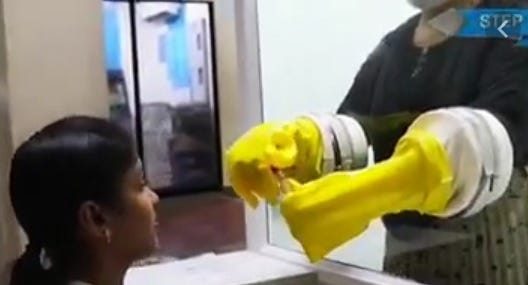
A hair stylist may now choose to offer her service despite being classified a non-essential business. She may pass on her risk of having to pay market price for her healthcare to her customers by charging a hazard fee to her customers. She is likely highly motivated to innovate on ways to offer her service with limited risk, perhaps by staying behind a Kiosk or glass barrier, when offering service.
Her customer, who can’t put off grooming will pay the hazard fee, and may derive economic or social benefit by other means, say, by avoiding a costly divorce.
As time passes and herd immunity grows, more previously infected and now immune small business owners will be willing to make their non-essential business services available to claim an economic premium from customers willing to bear the risk of being infected. This will hasten economic recovery, as the pandemic subsides.