
How to Meditate by Using a Singular Raisin
When was the last time you used your senses to connect with the world?
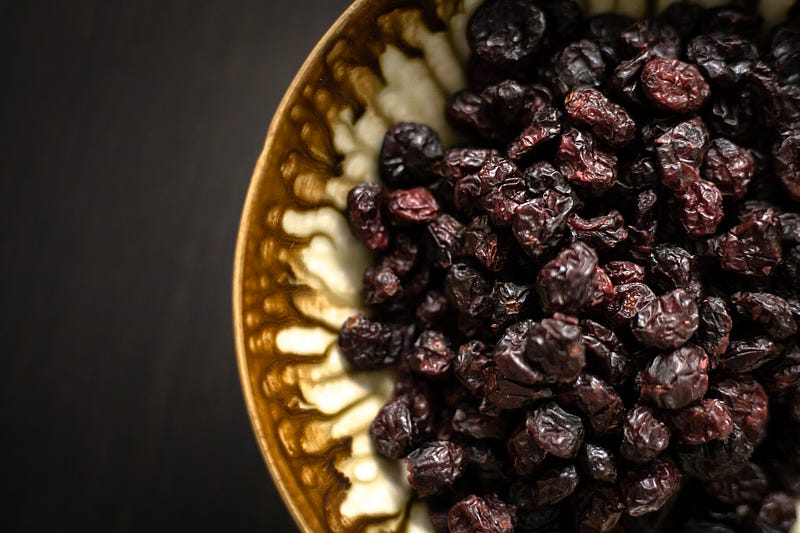
Most of us have probably eaten a raisin at some point in our life, whether it is part of your packed lunch, encased in your scone or what you thought were chocolate chips in your cookies. But have you ever eaten a singular raisin?
Raisin Meditation is a way of making us solely focus on the present by becoming more aware of the senses that were given to us. When was the last time that you could say you have used your senses to connect with the world? With anything or anyone around you? By placing all of our energy into the present experience, it should allow us to enjoy and value things more. So how do we do it?
Before you start, find a quiet place where you can relax and not worry about any unexpected noise. And — you guessed it — grab a raisin. In all fairness, it doesn’t have to be a raisin. As long as it’s something you can eat or even drink, it should do the trick. When my therapist first introduced me to this new way of mindfulness, I was surprised how you would be able to meditate by using such a little thing. But let me show you how…
Concentrating
Firstly, place the raisin in front of you and for the time being, leave it alone. Examine it and then close your eyes. Focus on your breathing movements — the breathing in and breathing out.
Think about what you can hear in the background, how do you feel? Do you feel relaxed or agitated? This should clear your mind as you allow yourself to be in the present and only focusing on that.
Holding
With your eyes still closed, pick up the raisin. By not being able to visualise it (even though we know what the raisin looks like), we restrict ourselves to using our other senses. It should allow you to explore your other senses and sharpen them.
Ask yourself, how does it feel?
Use your feeling of touch to explore the texture of the raisin. The sense will kick in with the answer — whether it is heavy or light; hard or soft; big or small. You probably already knew the answers to all of these, but have you ever stopped to confirm it by touch?
Smelling
It is time for our nose to be tested. Hold the raisin up to your nose and inhale its aroma.
What does it smell like?
This one, I feel is a harder question to answer. The obvious answer is that a raisin smells like a raisin, right? But try harder. Does it smell sweet? Does it make you want to eat it or is there no smell at all? All answers are important, and none of them are wrong.
Placing, Chewing and Swallowing
Now place the raisin in your mouth and without chewing, use your tongue to explore the texture of the raisin, as you did with your fingers. You only have to do this for about 30 seconds.
After this, you can now knowingly take a bite into the raisin. You will be trying to concentrate on the tastes as well as the textures. Usually, when we are eating, we don’t fully focus on how it feels when we are chewing because we do this subconsciously. With this exercise, you will be purposefully doing the movements and actively feeling it too. I now ask you, what does it taste like? What does it feel like? What does it sound like?
You have probably never thought these questions before because you have most likely never pointed the answers out. Do you like the taste? Is it sweet, bitter? Does the texture feel strange in your mouth? Is it hard or soft? Are the rigged edges that you are used to seeing as rigid now? When you are chewing the raisin, is that the only thing you can hear?
Finally, swallow the raisin, but notice how you are consciously preparing to swallow it and acknowledge how it feels. Can you feel it move through your throat and into your stomach?
After you have eaten the full raisin, what does it feel like to no longer have the raisin to concentrate on? Do you want another one? Is there an after taste now that it’s gone?
You can now open your eyes. The exercise is complete. How do you feel?
The whole point of this meditation exercise is to make you more aware of your surroundings by making you focus on one sense at a time. Not just the smells that come through your nose, the feelings in your touch, the sounds you hear. Not what you can see or taste but recognising what is right in front of you — the present. You place all your energy into seeing what’s already there. And maybe now, you won’t take it for granted.