
How To Manage Stressful Situations
A beginner’s guide to stress cycles

The word ‘stress’ has an average of 135,000 monthly searches per month. Along with this comes ‘stress management’, ‘stress relief’, ‘stress symptoms’ which all have well over 18,000 monthly searches per month.
We can see that dealing with stress is a very common issue and we are always looking for ways to reduce the stress that we experience in our lives.
As the demands of life are only increasing, we are facing more stressful situations. This could be from work, family, relationships, friends, and right now this whole pandemic situation that is going on.
In my work, I come across very stressed family members of people who are dealing with psychosis. Stress management is a massive area that we work through together and one of the ways that we look at how to manage stress is through ‘stress cycles’.
This is a very simple and effective tool that psychologists use and we can all create one for ourselves very easily.
Let’s take a look at what a stress cycle is and how you can create your own to manage the stressors in your life!
What Is A Stress Cycle?
A stress cycle allows us to identify a stressor or ‘trigger’ and encourages people to think about how this has an impact on them physically, emotionally, behaviourally and cognitively (thinking).
The idea behind it is that once we become aware of how different stressors affect us within those 4 areas listed above, we can look at ‘exit strategies’ for each area. This can provide us with different strategies that we can utilise to help manage stress.
Let’s take a look at an example of a stress cycle:
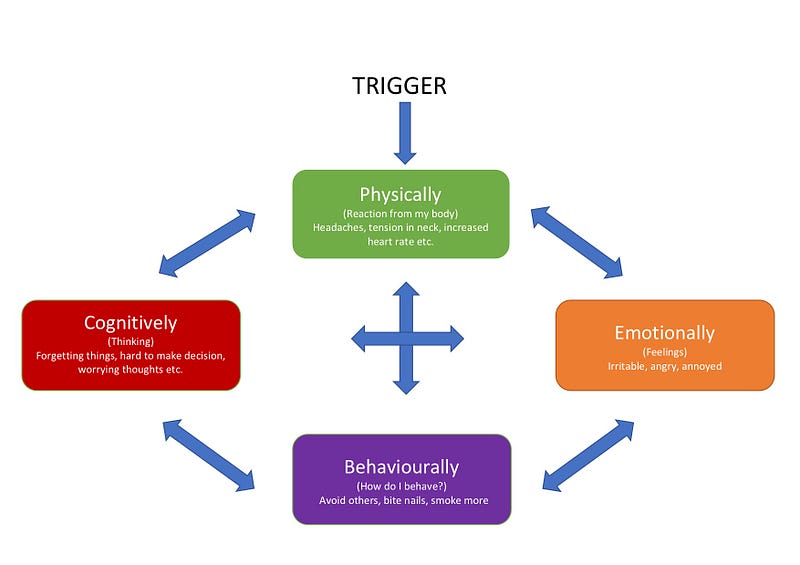
In this example, the trigger can result in headaches and an increased heart rate (physical reaction). This can create feelings of anger (emotional reaction) which can result in behaviours such as biting nails (behavioural reaction). This can lead to worrying thoughts (cognitive reaction).
As you can see (with all the confusing arrows) our reactions can interact with each other which can increase these thoughts, behaviours, feelings etc.
Essentially, we are looking at different ways our body and mind can react to a stressful situation. We can then look at how we can intervene to break this cycle and manage the stress we are experiencing.
How To Create Your Stress Cycle
Let’s get into creating our own. This is a step by step process that I go through with the people I work with to help manage stressful situations.
1. Identify A Trigger
The first part of any stress cycle is to think about a particular situation that can cause stress. It can be within any scenario but I always encourage taking a specific example.
I am going to use stress within the workplace, as this is a topic that is becoming increasingly evident with greater working demands.
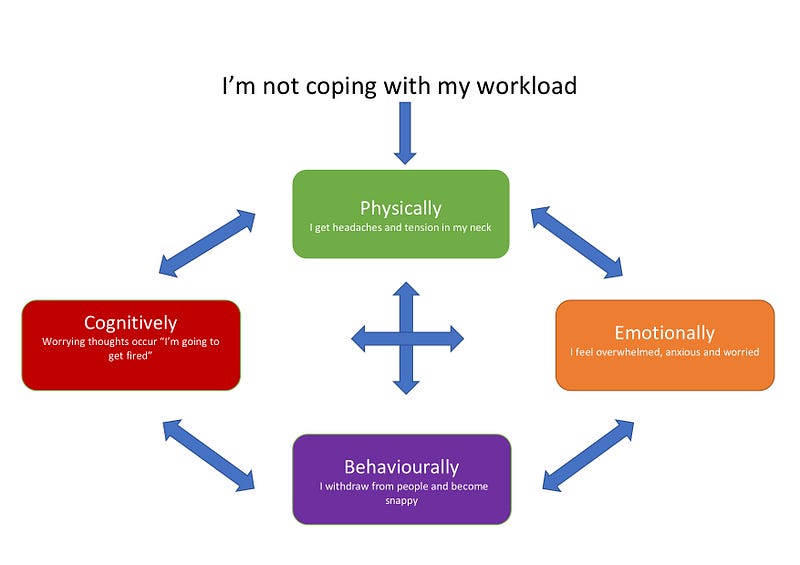
To be more specific I am going to say that the trigger is ‘difficulties in coping with my workload’ — this would be the trigger that affects me physically, emotionally, behaviourally and cognitively.
One step further would be — what specific difficulties am I having? Is it the number of tasks, not understanding what I have to do or feeling isolated with all the work.
2. Physical Changes
What happens, physically, to your body when you encounter this stressful situation?
Do you get headaches, tension in neck or shoulders, increased heart rate, change in appetite, difficulty sleeping, clenched fists or do you grind your teeth? The list is endless.
TIP: If you’re finding it difficult thinking about what is happening physically to your body, the next time this situation occurs or any other stressful situation happens, take note of what is happening physically. Sometimes it can be difficult to think about these changes now.
In this example, headaches and tension in shoulders will occur if there are difficulties in coping with the workload — specifically the number of tasks.

3. Emotional Reactions
How do you feel when a stressful situation occurs? What emotions do you notice?
It could be anger, irritation, frustration, feeling overwhelmed, anxious, worry, fear, shame, guilt, frightened feeling etc.
Make a note of all the emotions that can occur. Back to our example, the emotions felt when having too many tasks to do are — feeling overwhelmed, anxious and worrying.
4. Behavioural Reactions
What changes in behaviours do you notice within yourself and towards others when this situation occurs?
Examples include avoiding others, snapping at others, biting nails, eating more or less, withdrawing from people, being careless, drinking more, smoking more etc.
In this example, the changes in behaviours are withdrawing from people and becoming snappy with friends and family.
5. Cognitive Reactions
What thoughts develop when this situation occurs? How does your thinking change?
Do you start to get worrying thoughts, multiple thoughts racing through your head, difficulty concentrating, memory lapses, difficulty in thinking clearly or do you find it hard to make a decision?
In our example, worrying thoughts start to occur such as “I’m going to get fired” and difficulties in thinking occur, making it harder to do all those tasks.
Make a note of changes you see in your thinking when this stressful situation arises.
Exit Strategies
Once you have pieced together the stress cycle you can now see how your mind and body react to a stressful situation.
The last part of any stress cycle is figuring out ‘exit strategies’. These are things that could be done to help break this cycle.
Exit strategies could include — going for a walk, getting a massage, talking to or seeing friends and family, deep breathing exercises, positive self-talk, positive thinking and lots more.
I’ve included an example of different exit strategies for each reaction below:
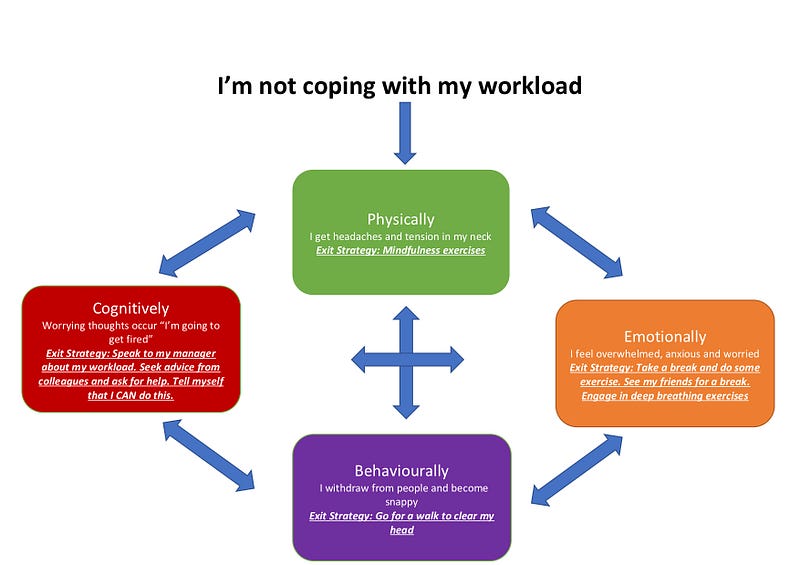
It’s important to note that the stress cycle is automatic. It can happen very quickly once the trigger is presented — which is completely fine and something that is beyond our control. The exit points allow us to have strategies in place to help manage the cycle and stop the cycle from repeating.
Make a note of the things that help you relax, the things that you enjoy, the things that make you happy. They can all help with breaking down your stress cycle.
Just like that, you have yourself your own stress cycle that you can refer to!
Final Comments
Creating a stress cycle is simple, easy and a productive way to help manage stressful situations.
It can increase awareness of how our mind and body are reacting to stress.
We don’t tend to realise what is going on when we are stressed. We just know that we feel tense or worried. By highlighting how we react, we can improve our wellbeing by taking action and knowing how to take action.
The exit strategies that you identify can be used in multiple situations. This can help because we are all going to go through stressful periods at different points.
Feel free to leave a response if you have tried creating your own, want some help with creating one or have any questions. I would love to hear from you!


