
How to Make Your Content Go Viral
A Beginner’s SEO Guide. Learn Why, When, and How.

Search Engine Optimization (SEO) is what search pages use to rank your content. In other words, the process used to get free, organic/natural traffic to your website, blog, or article and position your content at the top of the search results pages.
Google rates content based on the authority and usefulness of the information for the end-user.
Of the 206 factors, only seven account for almost 95% of Google’s algorithm ranking parameters to rank your content on the result search page.
There are only two ways to get to the top of any search page: mastering SEO or paying to put your content at the top; because no one scrolls beyond the first or second result page unless they’re searching for work, looking for someone, or googling themselves.
Using SEO is easy. This is a beginner’s guide on why, when, and how to use SEO, plus the 7 factors which account for almost 90% of Google’s ranking.
As always, I suggest you bookmark this article for future reference after you read it.
Table of Contents
· Why to use SEO
· When to use SEO
· How to use SEO. The 7 points of a viral blog post
  ∘ 1. Consistent Publication of Engaging Content
  ∘ 2. Use Keywords
  ∘ 3. Backlinks
  ∘ 4. Niche Expertise
  ∘ 5. User Engagement
  ∘ 6. Internal Links
  ∘ 7. Mobile-Friendly / Mobile-First Website
· Take away
  ∘ Disclosure
Why use SEO
You are a writer who likes to share your knowledge, advice, humor, and learned how to survive rejection letters.
Furthermore, you want an audience. In other words, people who see your articles read them, or buy your products. Strictly speaking, you want followers/customers and make money.
Otherwise, you would journal every night in your diary, sketch on paper, or film home movies instead of writing on a paying platform, Tweeting, posting memes, or uploading a ridiculous dance or funny cat content on TikTok.
When to use SEO
As I explained before, SEO is a simple set of instructions to tell the fast but dumb Google algorithm that your content is relevant to what its users are looking for.
Therefore, your work should be at the top of the first search result page. And you want this without expending an obscene amount of money.
The only way you will achieve it is to learn how to speak in a language their algorithm understands. For example, let’s say you write an article about where to get baby formula.
Since thousands of new parents are looking to buy baby formula for their children, you know this is a current concern affecting many families in the United States.
In a stroke of luck, your baby supplies company received a lot of cans before stores ran out. Now you want to sell all your inventory before your competition has a chance to re-stock their shelves.
You have several options to promote your baby formula, either placing a big sign on top of your warehouse, buying an ad in some newspaper, or investing a tremendous amount of money to buy TV or radio time.
Another option is the traditional door-to-door product sales, and the last is to sell it in your online store, but for this, you need to be at the top of the search.
To achieve it, you must convince the Google algorithm that your baby formula is what the people are searching for. Also, to get you to the top place on the first page ASAP.
How to use SEO. The 7 points of a viral blog post
Ok, now let’s roll up our sleeves and get to work. According to Michigan Technological University, SemRush, and other SEO authorities, various factors influence your content’s ranking.
How important is each one?
First Page Sage, the largest SEO firm in the US, presented its 13 years of study of Google’s algorithm. The result shows that only seven factors account for 95% of the parameters that affect Google’s search algorithm.
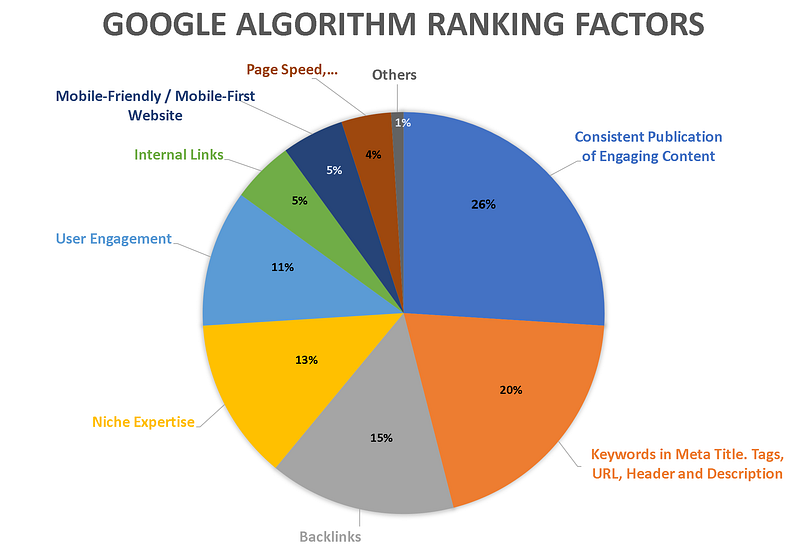
Nevertheless, what are they, and how can rank your content at the top?
1. Consistent Publication of Engaging Content
You’ve heard this before from many top writers. There is no substitute for quality and authoritative writing to show the Google algorithm your content is worthy of reading.
Content specifically created for your intended user increases site traffic and improves your site’s authority and relevance. Be sure to fine-tune your web writing skills and let your readers know you are an authority on the topic.
Make your content clear, non-threatening, conversational, engaging, and easy to understand for most audiences.
Google tests new content to see how well it responds to the search and if people are satisfied with it. When users stop scrolling, and stay at the selected page, means they found what they wanted.
2. Use Keywords
Another secret for improving SEO to get to the top, is to find the key to unlocking the algorithm. Find a specific keyword phrase describing your content.
What are your readers, or future clients, searching for?
For example, if “baby formula” is your keyword phrase, your content will be relevant for those searching for “where to buy baby formula?” or “where can I find baby formula?” on the search page. Be sure to include it in:
- - As part of the SEO title and SEO description.
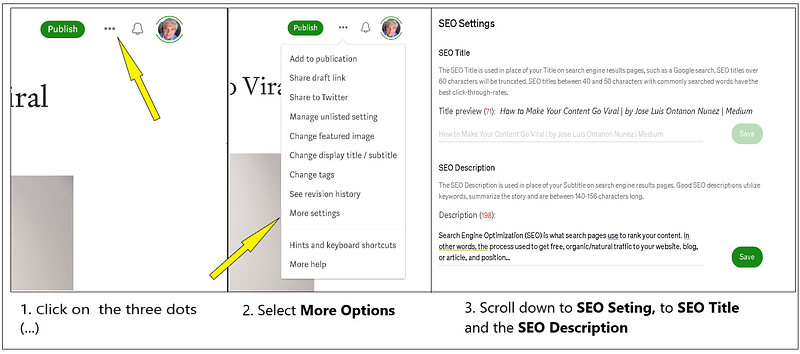
2.- Include your keyword phrase in the article Title and Subtitle. This will also help you with your Niche Expertise, as I’ll explain below on point 4.
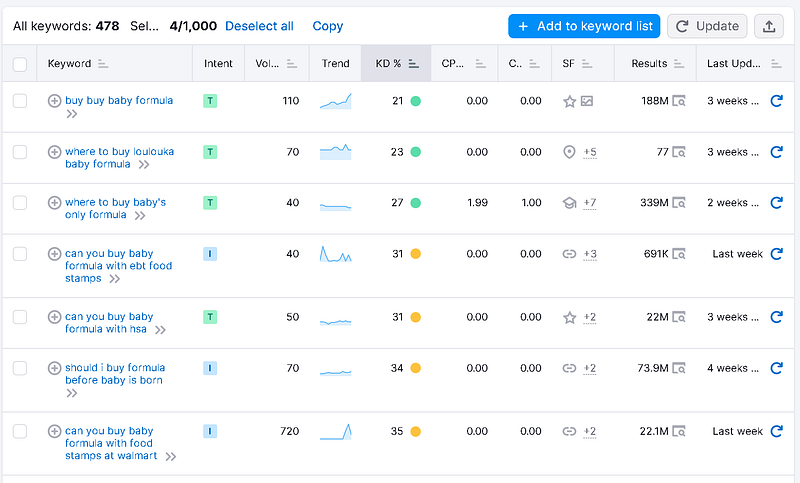
Use SEMrush Keyword Magic Tool to search for the best combination. A free option allows you ten searches per day; create a free account and make your searches work.
After logging in, select “Keyword Magic Tool” from the left menu, and type your keyword. You will find now many people searched for the keyword, how it is trending, and the “Keyword Difficulty” (KD) with a color dot beside it.
This dot represents how difficult it is for your keyword to get to the top 10 results on Google. It goes from 0 to 100%, from easy to hard. Red means the hardest, then orange, yellow, and green. Double-click on the KD % column to show low to high results, and look for other variants.
3.- If the text allows it, use your keyword phrase on the page headings and subheadings?
4.- Your article’s content is the most important thing to influence the search engine rankings. Repeat your keyword phrase in your document once or twice in the introduction, the closing section, and several times throughout the content. Some experts say about 1% times your article’s word count (e.g., if your article is 1,000 words, about 10 times).
5.- Don’t forget to use it in bold, italics, TITLE, and Subtitles, but don’t overdo it. Remember to keep your writing casual and easy to read for your audience. Don’t sacrifice the quality of your article trying to fool SEO.
3. Backlinks
To improve your credibility and let your readers know you are an expert, follow these rules about using links to increase your SEO.
1.- A well-written article is unbiased, easy to read, helps readers learn more about what they are interested in, attracts links from other websites, and improves SEO.
2.- Remember, no one likes copycats. Don’t steal other people’s work. Credit the author and add a link to the source if you use information from other sites.
Google algorithm will punish SEO if your article has a high piracy grade. Avoid this by using a free plagiarism checker.
3.- Add relevant links to your work. Using “click here” links won’t increase SEO. Instead, a text-rich link helps the algorithm value your article’s relevance to the readers. For more information about links, check “Using the story editor.”
4.- Include links to other articles you’ve published, your referral link, or add a table of contents.
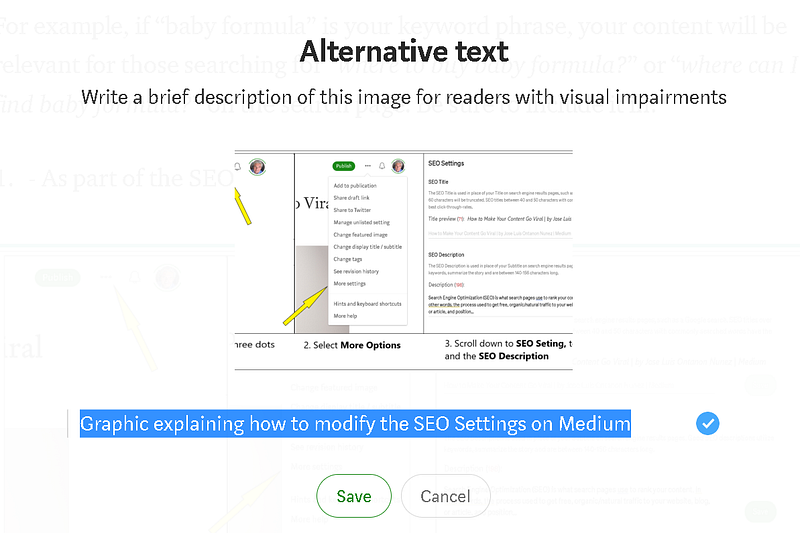
5.- Add picture captions to prove you have the copyright or a license and avoid copyright infringement disputes. Moreover, Google cannot read images to rank your work and values this in your ranking.
6.- Always use descriptive links by linking keywords. It helps your reader find more information. It helps people with disabilities using screen readers and makes Google’s SEO algorithm rank your work higher.
Check “Using Images Page” for more information on captions and descriptive links.
4. Niche Expertise
Google favors websites that perceive as niche experts. This means having a cluster of 10+ authoritative pages revolving around the same keyword.
For example, the keyword “baby formula” could be the hub keyword for your company which has “baby formula to sell,” “the best baby formula,” and “an easy method to pay for baby formula.”
Consistency in the use of the keyword across the page creates a kind of magnetism and will attract traffic from any Google search containing your keyword.
5. User Engagement
It is how individuals respond to your content, product, or website, and it is vital because highly engaged users will read, buy, or share feedback about your information.
Google measures User Engagement by tracking how users bounce between pages and time spent. The number of pages they open each session is a good indicator of the content’s quality.
Your reader’s time is a finite resource, and you have to make sure they spend it on your work, and they will connect, return, and share your article or writer’s profile with their friends.
So, write engaging material, deliver what you promise in the title, and write thinking on WIIFT (What’s In It For Them)
6. Internal Links
People with disabilities will thank you for having an alternate text describing your image and video media using alt tags or alternative text descriptions. Remember that Google cannot read images to rank your work and will value this in your ranking.
Try to be clear in your description. Avoid phrases like “image of” or “graphic of” to describe an image. Always use a clear description of the picture.
Instead of “image of a girl with a cat,” write “young smiling girl in a red dress, carrying a light-brown Siamese cat.” Check the “Using Images Page” for more information.
Using alt tags allows search engines to locate your page through the image, which is crucial for people using text-only browsers or screen readers and increases SEO.
7. Mobile-Friendly / Mobile-First Website
Google shifted to a mobile-first world, giving more value to content design for its smartphone visitors as the primary target.
So think outside the desktop version of your content and consider how to make it look better on mobile phones. Both sites should look the same on cellular and desktops. It means a simple and optimized mobile user experience.
Edit your work using small paragraphs, white spaces, separators, and images with links on image captions.
Take away
There you have it. This is one of the most straightforward SEO courses you can find. If you follow the instructions, your article will rank higher on the search page and help you sell more baby formula than your competition.
No one can tell you if it’s right or wrong to use SEO techniques in your articles. In the end, only you can decide on what to do.
However, at least now you know why, when, and how to include SEO instructions in your future work.
In a nutshell, these are the lessons I learned. I hope they help you.
Before using SEO, consider why and when to use it if you want to go viral and promote your business, blog, or brand. If you follow the instructions, you will have an excellent chance to do it and be at the top of the list.
If, on the other hand, you want to reach an enormous number of readers on this platform, first be sure to do the following:
- Expand your writing skills by reading books like Stephen King’s “On Writing: A Memoir of the Craft,” Ray Bradbury’s “Zen in the Art of Writing,” Ernest Hemingway’s “On Writing,” or “Bird by Bird” by Anne Lamott.
- You can also subscribe to a writing course specialized in this platform. There are lots of them. In my case, Zulie Rane and Sinem Günel’s advice helped me.
- You will have a greater chance of a better-performing article if you read almost every publication’s guidelines. They have links to help you with your titles, images, tags, and format, e.g., “Illumination Submission Guide.”
- And last but not least, the only proven method to go viral here is to write and publish in a major publication a high quality captivating, easy-to-read, reader-oriented material with a great title and an intriguing picture.
I hope this article helps you master SEO and gain views, reads, claps, and followers.
“Being a writer is a very peculiar sort of job: It’s always you versus a blank sheet of paper (or a blank screen) and quite often the blank piece of paper wins.”
— Neil Gaiman
Disclosure
I want to explain that last month I published an article titled “What is The Best-kept Secret About SEO Google Doesn’t Want You to Know?”
Many readers told me that though it had great ideas, it was too much information and that I should divide it into four parts.
This article is part one; the others are “Why Does Google Lies About SEO’s Ranking,” “Why using SEO made my stories go viral but not as I expected,” and “The Big SEO Mistake You Absolutely Don’t Want to Make.”
© Copyright Jose Luis Ontanon, 2022