
How to Make Time Management Your Secret Weapon
Time is a double-edged sword. Wield it like a pro.

Whether it’s submitting a draft, meeting with clients, or rushing out the door, being late sucks.
It’s stressful and nobody likes it.
As entrepreneurs, time management is our currency. Many of us balance life commitments with multiple side hustles, and more commonly than we let on, day jobs. Just like real currency, how we manage time has the ability to help or hurt us.
Here’s why deadlines are tricky and how to make them simple.
Why we feel perpetually rushed
Setting your own schedule means the freedom to sleep in or take a few hours of “you time” in the middle of the day. It also means waking up in a panic because you didn’t do that thing you were supposed to. “Shoot!”
The ability to set and meet deadlines is imperative to our success. So, why are so many of us perpetually behind schedule?
There is an old adage that explains how our actions naturally expand to fill the time we allot them. This layered truism is known as Parkinson’s Law. It is responsible for marathon study sessions, low Uber ratings, and the bold-faced lie of “I’ll just be five more minutes”.
What is Parkinson’s Law?
In short, Parkinson’s Law states that,
“Work expands so as to fill the time available for its completion” — C. Northcote Parkinson
Although not a scientific law, Parkinson’s Law, made popular by the book “Parkison’s Law” by C. Northcote Parkison is widely accepted as truth. It has been studied and most notably applied to the world of business.
Think of a time you’ve procrastinated. I’ll use the example of this very article. It is currently Wednesday. I’ve set a deadline for myself to have it completed and submitted to “Start it up” by Sunday at 10:00 AM.
Knowing how long it takes me to write an article I can safely say that I’m ahead of schedule.
But, Parkinson’s Law states that because I have until Sunday, it will take me until Sunday, no sooner.
Knowing that I have until Sunday to complete my article I may push my first draft to Friday. Or, being that I have already begun, I may begin to expand my research and make the article unnecessarily complex. Regardless of the path, it is safe to say that I will have this article ready for submission Sunday morning, minutes before my deadline.
Parkinson’s Law is layered, like an onion
Time management is nuanced, having many layers. If handled correctly, it can add robust flavour to your life. If not, it will make you cry.
Time management described through Parkinson’s Law is comprised of three fundamental truths of human behaviour: to do our best, be happy, and to act only when motivated.
1. Doing our best
Kant’s Moral Theory is a philosophical theory that deems a person’s greatest value is that of their morality. Being that our experiences and creations are an extension of how we are perceived, we want them to be as close to perfect as possible. This sense of perfectionism causes us to procrastinate, overthink, and ultimately spend more time than is necessary.
2. Being happy
We all strive to be happy. Once happy, happier. According to The Law of Expectations, happiness is equal to reality minus our expectations.

Expectations lead to stress, making us less happy. But, although low expectations may leave us contented, they are of no help when scaling a business or writing an article. We need to feel the squeeze of a deadline in order to act.
3. Acting only when motivated
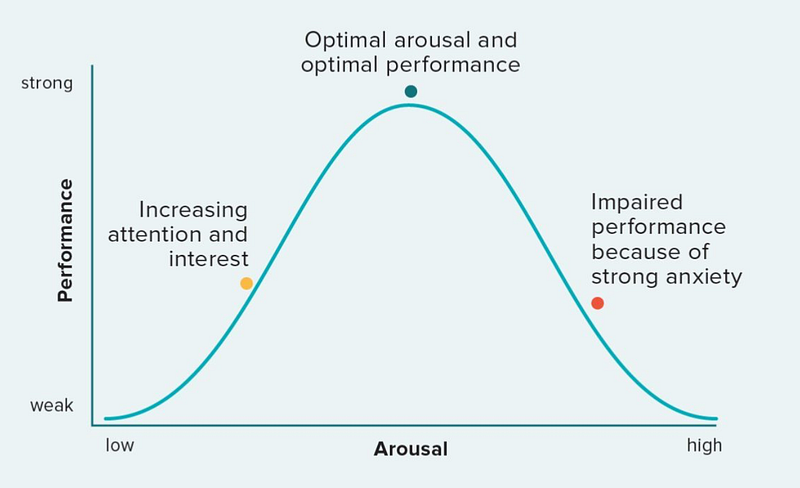
Yerkes-Dodson Law tells us that levels of performance peak somewhere in between low and high levels of stress (arousal). Too little and we feel unmotivated to act, too much and we crumble under the pressure. Yerkes Law is a bell curve that peaks somewhere near the middle of a deadline. As we know, pressure makes diamonds.
Bonus: positive reinforcement works
Deadlines should be challenging yet achievable. If unachievable it is in our nature to give up. The Super Mario effect is an experiment conducted by famous Youtuber, Mark Rober. The results showed that the more encouraged participants felt to complete a certain task, the more times they tried, and ultimately the more successful they were.
How to use Parkinson’s Law (with examples)
Knowing about the double-edged sword that is Parkinson's Law is only half the battle. The other half is learning how to wield it.
So, here’s how to use Parkinson’s Law to meet deadlines like a pro…
First, set your end range…
No weapon can be wielded without understanding its capabilities. Estimate a range of how long your task or project may take. Be specific as to set a visible finish line.
Example: I want this article to be completed by Sunday at 10:00 AM at the very latest.
Second, list all the steps to get there…
Anyone can pick their sword up and swing but what details are needed to carry out a lethal blow? What could go wrong and how will you course correct? Jot down anything and everything.
Example: First draft, break, re-visit, walk away, re-visit, fine-tune, shop for publication, find image, adjust SEO, obsess over headline, etc.
Third, cut the deadline into 3–5 mini deadlines…
Remember the Super Mario Effect and Yerkes-Dodson’s Law. Mini deadlines give us consistent motivation without feeling defeated. Exaggerate the time each deadline will take.
**If you’re enjoying the sword metaphor, you can think of it as forging a weapon…
Example:
- First draft (1–2 hours) — Collect your materials and melt your steel
- Take a break (1 hour) — Pour molten steel into forge and let it cool
- Revisit #1 (1.5 hours) — Remove from forge and hammer
- Take a break (1 hour) — Cool in cold water
- Revisit #2 (1 hour) — Hammer and shape
- Fine-tune (1 hour) — Finish shaping
- Headline (1 hour) — Polish and grind
- Pub shop, image, and SEO (1 hour) — Sharpen and engrave
Fourth, finalize your nuanced deadline…
Set in stone the steps to achieve your final deadline. If you believe you can finish it sooner and would like to, record the adjusted time. Remember that the time you allot yourself is likely how long it will take.
Example:
Wednesday: Begin article and finish first draft
Thursday: Re-visit and shape
Friday: Re-visit again and finish final draft
Saturday: Shape, fine-tune, begin headline
Sunday: Finish headline, pub shop, and submit by 10:00 AM!
Key takeaways:
When building a business, brand, or running a side-hustle, time management is imperative for success.
Entrepreneurship allows us freedom but can act as a double-edged sword. Wield it like a pro by:
- Understanding Parkinson’s law (things take as long as you give them)
- We naturally procrastinate and won’t act until we have to
- Pressure makes diamonds but too much will crush them
- Break down deadlines into mini deadlines
- Be thorough in your planning
- Stick to your plan
- Own your freedom


