
How to Make the Unconscious Mind Conscious Again
Using psychoanalysis (without the Freudian babble)
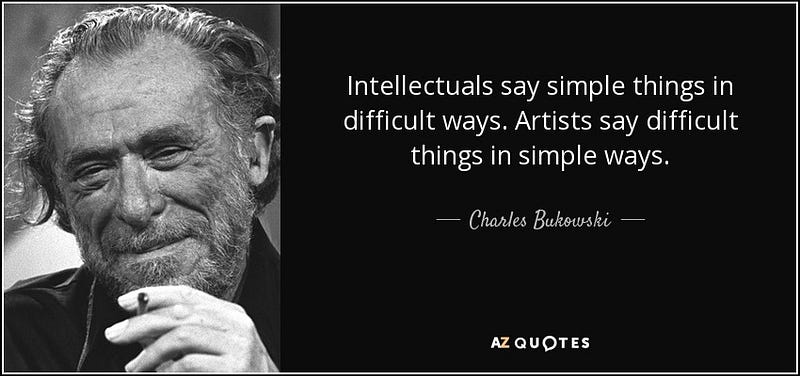
I am a great fan of poet Charles Bukowski. He is a sufferer and survivor who is more believable than any psychologist in my books.
I am especially fond of the quote in the image above.
That’s why I never expected Freud would be the one to help me understand the conscious and subconscious mind in an easy and creative way. But luckily I have a mind of my own which also means I am open-minded at the same time.
To heal from trauma or a depressed mind, you must be open-minded. Don’t just listen to me or psychologists, or poets or family, or Freud — listen to all of us. I can’t stress this enough.
If you want to achieve success, listen to everyone but no one
This way, if you are stubborn like me, you will feel like you have developed your own school of thought and are more likely to be a top student.
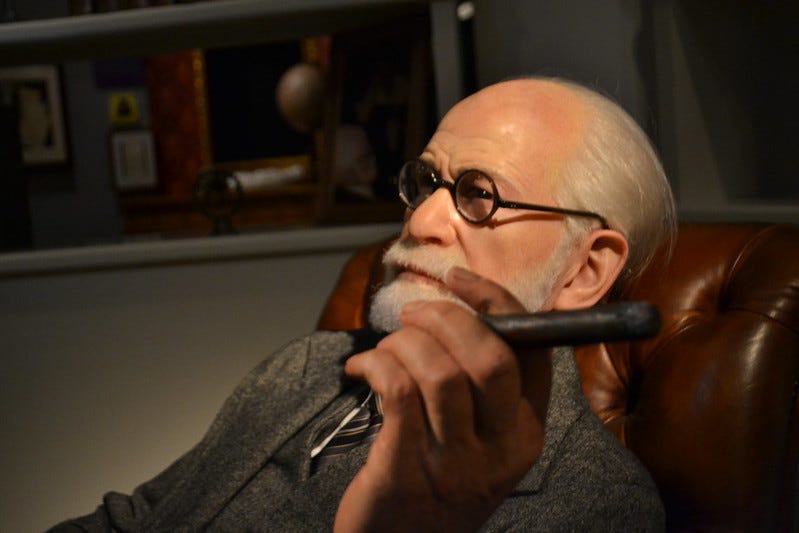
Sigmund Freud
I quite like Freud. He could very well have been a creative type because he made the idea of the conscious mind versus the unconscious mind a popular notion for all to understand.
Considering the fact his grandson Lucian Freud was a famous painter who spared no flaw in his portraits, uncovering the darkness of the human psyche seems to be inherent.
Sigmund Freud emphasized the importance of the unconscious mind, and a primary assumption of Freudian theory is that the unconscious mind governs behavior to a greater degree than people suspect. Indeed, the goal of psychoanalysis is to make the unconscious conscious.
_ Saul Mcleod, PHD
In order to understand the unconscious mind, we must first understand the conscious and subconscious minds.
The Conscious Mind
The easiest mind to understand is the conscious mind, which Freud explained is the tip of the iceberg that is visible. This is your thinking mind and holds no memory at all.
It is the one we access more readily and consists of all the mental processes of awareness. For example, you are conscious of the information you are reading now, or the sound of your stomach grumbling and that you should have something to eat.
When we receive information from our senses, analyze it, and then make decisions based on that information, we are utilizing our conscious mind.
The conscious mind is always observing and categorizing the world around us and includes everything we are thinking about right now.
The Subconscious Mind
The middle layer of the mind, the subconscious, is the layer of the iceberg underneath the surface. This layer stores information just beneath the level of conscious awareness.
It contains every experience, thought, and impression we have ever had. We can retrieve this information easily, for example, if someone asked you what was the last movie you saw or your mother’s maiden name, you would recall this information easily.
It is a memory bank for everything which is not in our conscious mind. It stores our beliefs, previous experiences, memories, and skills. Whenever we have an idea, emotion, memory, or a past image, this is our subconscious communicating to our conscious mind.
The same piece of art is interpreted differently by different personality types because we relate to that piece of art according to what our subconscious stores.
The subconscious mind runs everything in our lives and is also our guide, looking out for danger and opportunities.
The Unconscious Mind
Freud likened the unconscious mind to the huge bulk of an iceberg hidden under the sea. The primary source of human behavior and much like an iceberg, the most important part is the part you cannot see.
Even though some psychologists (or contrarians) still consider the unconscious mind a shadow of a “real” conscious mind, Freud believed the greatest part of the mind to be the unconscious which has a strong impact on personality and could potentially lead to psychological distress.
Memories and emotions that are too painful or embarrassing to consciously face are stored in the unconscious mind. When we feel fear or discomfort it means our unconscious mind has been triggered.
If the unconscious mind is too powerful or dominant in our lives, it means our level of consciousness is too low and therefore our suffering is high.
The communication between the unconscious and conscious minds is like one-way traffic. We have no conscious control over the communication that is fed to us by our unconscious minds.
Both subconscious and unconscious minds communicate with our conscious minds.

Don’t Fear the Unconscious Mind
If you are a creative type then you probably need more creative examples to understand the unconscious mind so I came up with a few of my own.
I really think creativity should be a major part of therapy but no psychotherapist I have seen ever mentioned healing by creativity. I am convinced it is because it would benefit us too much and they are afraid to lose us.
I have also come to my own conclusion about where creativity and depression come from.
I believe that depression and great works of fiction have come from a place where the subconscious and unconscious minds collide.
Here is an example using my favorite author Mary Shelley:
To produce a masterpiece like Mary Shelley’s Frankenstein, you must, first of all, have suffered a major disturbance in your life.
I personally don’t believe there will ever be greater works of fiction than those written by authors who have experienced great trauma. Frankenstein exists because Mary Shelley lost her daughter who died only a few days after birth.
It was Shelley’s living nightmare that resulted in her unconscious dreaming up a way to dig up her daughter and bring her back to life. The idea of the book arose from these nightmares.
The conscious mind of most people works hard to forget their dreams in the morning to protect them from disturbing images the unconscious holds.
The afflicted writer has little fear over their unconscious, and that is their biggest asset. They don’t want to forget, they demand to know why; why things happen the way they do.
So don’t fear what lies in the unconscious mind. Get creative and produce something that brings it out to the surface for all to see.
“Beware, for I am fearless, and therefore powerful.” — Mary Shelley, Frankenstein.


Repression and the Unconscious Mind
Repression is the Freudian concept he developed as he worked to help patients uncover their unconscious feelings. It is the first defense mechanism he identified.
He believed there was some mechanism at work that actively blocked unpleasant emotions, impulses, memories, and thoughts from the conscious mind.
The entire Freudian psychoanalysis focused on bringing these unconscious feelings into awareness so they could be dealt with consciously.
Not to be confused with suppression which is the conscious blocking, repression might initially help by calming these difficult emotions but Freud believed this defense mechanism could lead to psychological distress such as depression and anxiety later on.
The psychoanalytic theory also suggests that repression plays a role in distorting a person’s reality, which may then lead to neurosis and dysfunction.
For a creative writer, this often results in an inability to distinguish between fiction and reality. Considering Mary Shelley’s Frankenstein, I don’t think this is a bad thing.
I suffered depression from traumatic happenings in my life and definitely benefited from seeing a few psychologists but adding writing to conventional therapy healed me faster than any therapy would have alone.
Make the Unconscious Mind Conscious Again? MUMCA!
I have already established that each time we have an idea, an emotion, a memory, or an image from the past, it is our subconscious mind communicating to our conscious mind.
However, communication from the conscious mind to the subconscious mind is not so easy. Learning how to communicate between the conscious and the subconscious mind is key to success, health, wealth, and happiness.
You need to consciously create good thoughts, build good habits and filter out the bad so they don’t infiltrate your subconscious and therefore making the unconscious mind less dominant.
The subconscious mind works on the principle of morality. The subconscious mind rewards us with joy and happiness if we take moral action. Or, it punishes us with guilt and grief for not taking the right moral path.
If we are not morally and ethically strong, the conscious mind busies itself with the management of the unconscious mind. It acts like a mother negotiating with a disobedient child to behave.
The subconscious mind punishes us for our immoral behavior because it is a form of self-betrayal. That’s why people say we are our own worst enemy.
The replaying stress caused by the resulting guilt and grief eventually causes us to suffer from a variety of mental and emotional health issues.
Our current mental health crisis is at new heights, therefore it is crucial for us to restore and strengthen our moral values so as to release us from the control of our unconscious thoughts, feelings, and desires.
The anything-goes attitude that many people have adopted has to go. Set limits and boundaries for yourself and your network in the form of morals and ethics. Surround yourself only with people that comply.
Freeing our conscious minds from the constant assault of uncontrolled thoughts and mental chatter will put our minds at ease, allowing us to feel genuine satisfaction, inner peace, and happiness.
But to free our minds, the key is to not only establish your set of morals but make a promise to yourself that they will never be broken.
People fall back into depression when they have lost moral ground.
To achieve MUMCA we first need to understand what morals and values are.
Merriam-Webster’s dictionary defines a moral as: conforming to a standard of what is right and good.
Merriam-Webster’s dictionary defines ethic as the principles of conduct governing an individual or a group.
The difference is that morals often describe one’s particular values concerning what is right and what is wrong,
and ethics tends to suggest aspects of universal fairness and the question of whether or not an action is responsible.
Finding your own set of morals is important but also having an opinion on the ethics governing different groups without being too judgemental is equally important in healing trauma.
They can beat the crap out of you but nobody can take away your morals and opinions. They can only strengthen them.
People with strong morals and codes of ethics are less likely to be depressed long-term.
If you don’t have a strong set of morals and ethics that you live by, create a list or borrow someone else’s and promise yourself you will stick by them. I guarantee you it will work. This is the best way I have found to MUMCA (make the unconscious mind conscious again) and to get in the good books with your subconscious.
If you enjoyed reading this article give it a clap or two so other people can find it.