
How to Make the Turn
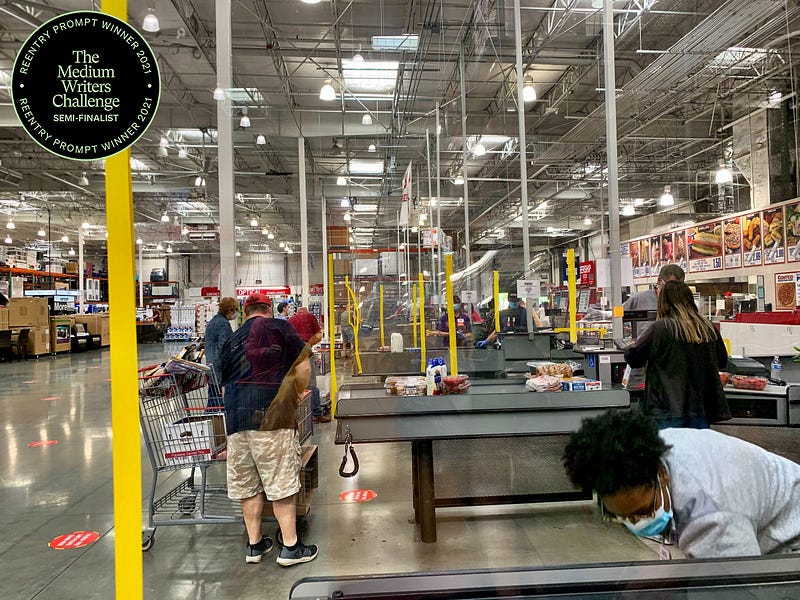
I lost my husband one morning in Costco as we were about to check out. I texted him, then called, then saw him looking for me. We had one of those, “I see you now; you’re walking toward me” conversations. I lost him again that evening when he had the stroke. And again, five weeks later, when his organs checked out one by one and he drifted away from us.
He stayed with me in the car for several months. I could feel his shoulder in the empty passenger seat.
It took me almost a year to build Costco back into my routine and when I did, I remembered to go wide on the turn off Memorial Parkway, as Jim had always instructed, hassling me about how I changed lanes too late.
“Will you just let me explain?” Jim said the day of his stroke. And so we sat in the car before going in and I let him break it down. “The only person who could hit you if you go wide early,” he said, “is some impatient bastard behind you, like me, who passes you on the right.”
He needed to get it out of his system, to leave me with a single paragraph in the unwritten instruction manual for a life without him. That and a bookmarked link for a piece in The Toast about how to buy a car without ever having to speak with a human, which I found after I totaled mine at a different intersection the following summer.
Who was I anyway? Had my husband been the interesting, attractive, funny one? Without him, would I still fall asleep listening to podcasts or would I rather routinely stay up until midnight? Would I really be happy eating salad for dinner as he always suspected I would if left to my own devices? “Big salad,” he would say, doing jazz hands, imitating how I might try to sell such a meal. “We’re just going to have a big salad!”
But after we had eaten the last of the food people brought us and were running out of paper products, there was no avoiding going back. Making the turn was hard. Going wide early as he instructed was the last thing he ever taught me. I’ve been figuring out the rest as best I can ever since.
Do we really need to keep buying chicken? What will two people do with a bag of avocados? I filled my cart, arms, house with multiples that would exceed my appetite.
In the months that followed his death, Costco’s abundance was a reminder of all we were not, did not do, or need. I no longer needed the gigantic box of oats to make the granola he liked, but I stopped buying coffee from the downtown roaster and bought beans in bulk. I cancelled the cable and let them play baseball without us.
We had been a family of four. Soon our younger daughter would leave for college and the older daughter, because of her disability, would be with me forever. She was eager for me to find a replacement husband as soon as possible. “I don’t want it to be just the two of us,” she said. She offered me up to visitors, cousins who came to the memorial service. “My mom really needs a new husband,” she said.
“I don’t,” I said.
That summer, I met someone. Our daughters had become friends at school and introduced us. We went to Costco together the way a young couple might dog-sit, a trial run for marriage or parenthood. We divvied up the avocados, a two-pack of fancy maple syrup. We cooked more and more meals together. We made plans, big salads. A year later we were married, a family of seven.
At the intersection where you make the wide turn for Costco, there is a Spy Store. Divorce Specialists. Designer concealed carry purses. Bedazzled stun guns. If I had some of their ghost-hunting gear, I could say to him now, You see what I have done? I came back to Costco to resume my life. Do you understand?


