
Worries Act Every Bit Like Ill-Mannered Guests! Show Them the Door with This
Using this simple automated framework, I murder most of my worries!

I had not uttered a single word in three days. There was a gigantic storm brewing, and it was raining incessantly. I was sitting with my eyes closed, seeking refuge under the shade of a big tree.
I had been lost for quite a while, trying to find my way out. All I could hear was the pitter-patter of rain both inside and out.
The weather was a perfect metaphor for my headspace. Worries swirled and raged inside my mind like a fierce thunderstorm.
I had come to a vipassana meditation retreat to find answers, to find my way back to peace. And on the third day, while I was meditating in the rain, something changed.
Read on to find out how I found peace.
The Nature of Worries
Vipassana means to see things as they are, and I did precisely that. I saw worries for what they actually are — a signal.
Humans are well-evolved machines; there aren’t many superfluous things in our construction. Every feeling, every emotion is there for a reason.
Good feelings are a way to reinforce useful behavior. Bad feelings signal that something is wrong and needs to be changed.
For example, pain is a signal to protect our bodies from damage. But what do worries tell us?
Underneath our worries lies a lack of clarity which may be dangerous.
When our ancestors realized their food supplies were running low, the resulting emotion was worry. This prompted them to search for food, even if they weren’t hungry yet. Great leaps in civilizational development (tool use, agriculture) were helped by humanity’s justified worries about what the future would bring.
Worries tell us to plan and take action. When we’re confident about our ability to deal with the situations ahead, they evaporate. This way, having worries is actually good and healthy.
What is unhealthy is when worries completely consume our attention. They cloud our vision and strangle the enthusiasm we need to excel. It’s tough to motivate a mind stuck in fretting.
I have developed a framework to deal with worries. I used it myself, when I took a giant leap of faith: I left behind my job and followed my dream to become a writer.
The framework is based on two simple ideas:
1. The Concept of Ill-Mannered Guests
Worries drop in unannounced and are inconsiderate of our time and plans. They wreak havoc on our property. And, more often than not, they overstay their welcome. They act every bit like ill-mannered guests.
According to the book Getting Things Done, we need to develop a proper system to guide our worries.
We can take back control by promptly writing down our worries as they appear. Then, we must shelf them. We can revisit them later when we have more time and energy to think about them.
Worries drop in unannounced and are inconsiderate of our time and plans. They act every bit like ill-mannered guests.
2. The Concept of Signal vs. Noise
Steven Covey talks about the circle of concern and circle of influence in his book 7 Habits of Highly Effective People.
The Circle of Concern encompasses all the worries and concerns in life. Things like the weather, this pandemic, or the economy are outside of our direct control. There’s nothing we can do to make the situation better.
Other things — such as our response to these situations, our work performance, our choice of diet, etc. — are well within our control. They constitute the Circle of Influence.
We need to work on the worries that lie in the Circle of Influence and not dwell on things outside.
Worries are signals when we can act upon them, the unactionable ones polluting our minds are noise.
Now let’s delve deeper into this framework you can use to quiet your mind and make the most of your worries.
The Worries Be Gone Framework
Prerequisites
- A pen and paper, or a notetaking app like Notion.
- Twenty mins of time each day — this is your Reflection time.
- A calendar or reminder app.
Place your notebook in an easily accessible place. Set a daily meeting with yourself for 20 minutes where you do nothing except deal with your worries.
Phase 1: Collection
- Go about your day as usual, but keep your notebook or notes app at hand.
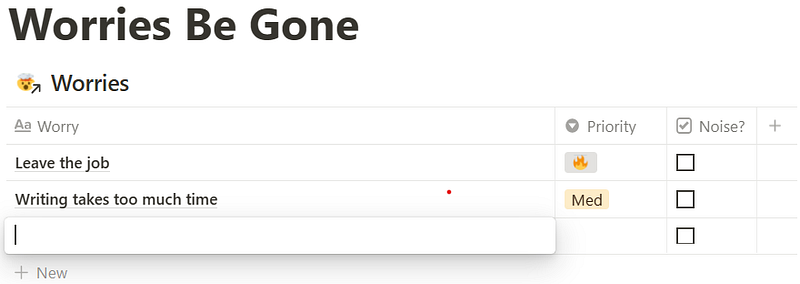
- When worries come knocking at your door, add them to your list.
- Assure yourself that you will get to them later.
- Just giving space to your worries could be all it takes for you to relax. It allows you to look at worries rationally and makes it easier to let go.
Phase 2: Reflection
- For 20 minutes a day, ignore all distractions and give your worries the attention they deserve. In descending order of importance, go over everything you wrote down.
- For each worry, spend some time describing it in as much detail as possible. This will give you a basic level of clarity and concretize your worry. Sometimes the fear of the dark is greater than the darkness itself.
- Spend some time deciding if the worry lies in your Circle of Influence. Consider if this is the right time to tackle it.
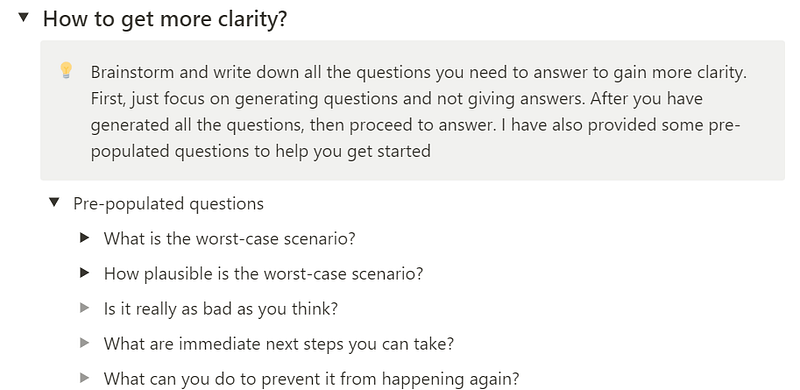
- Brainstorm and write down all the questions you need to answer to gain more clarity. In this step, just focus on generating questions and not giving answers. I have also made a sizeable list of pre-populated questions to help you get started, look at the end of article for more on this
Phase 3: Action
- Once you have come up with as many questions as you can, proceed to answer them.
- Based on your answers, formulate the next course of action. Write down what you can do to make the situation better. If applicable, write down the things you can do to prevent the problem from happening again.
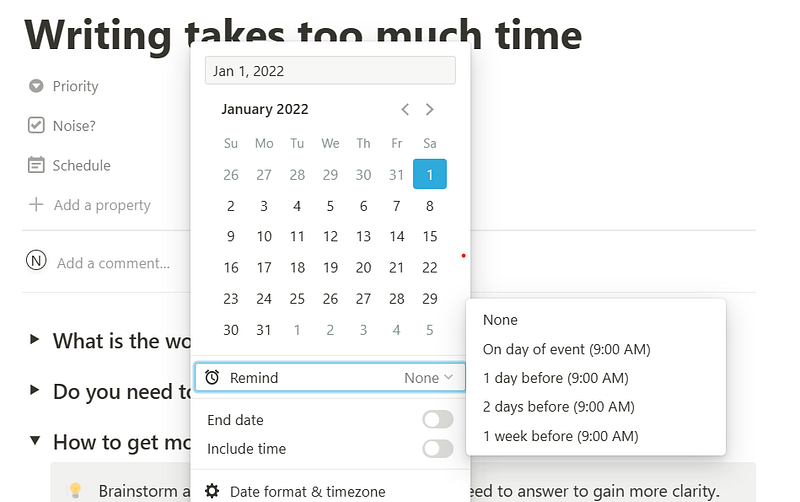
- As soon as you figure out the next step, add it to your calendar. This will help you avoid procrastination, and you won’t overthink your solutions if you have a clear timetable.
I Hope This Framework Helps You Find Your Way
I’ve compiled the above information in a Notion template that you can start using directly. You can also download a printout if pen and paper work better for you. You can find it here — Worries Be Gone.
I’d like to conclude with one of my favorite poems:
O Lord, grant me The Serenity, To accept things I cannot change; The Courage, To change the things I can; And Wisdom, To know the difference.
Related Reading
Showing Support
If you enjoyed my work and found it useful, you can help fuel my writing by buying me a coffee. This will help me sustain longer without a job :)
Alternatively, if you enjoy reading stories like this and want to develop a healthy reading habit, consider signing up to become a Medium member. It is $5 a month and gives you unlimited access to all the amazing content on Medium. I’ll receive a small commission if you do.


