
Personal Essay
How to Make Peace With the Ghosts of the Past: I Played My Cello Again
And I did it great by debuting in an orchestra
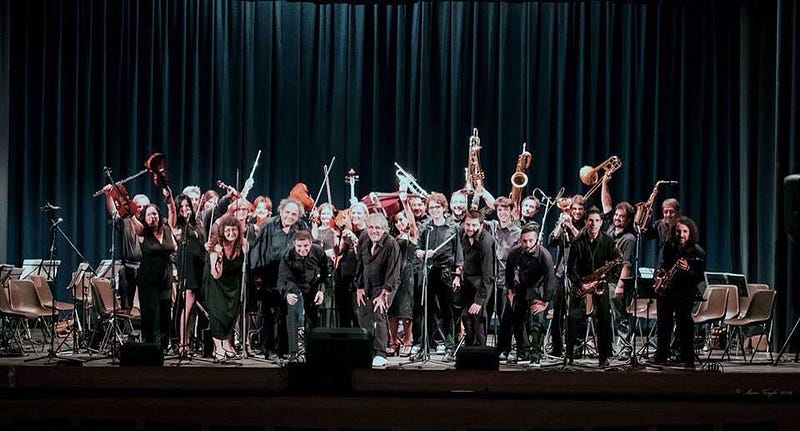
I made an impossible reentry as a cellist thirty years after I gave up playing and studying music. But first, I had to restore my cello after a disastrous accident that occurred twenty years ago. The story is long, but it’s worth reading. I hope you find it inspiring, entertaining, touching.
Ready? Engage!
Prologue:
This day of late spring is clear, and the sun is now high in the sky. The facade of the large yellow building bears the Roman year: ANNO MDCCCLXXXXI, which is 1891. But we are in 1985. And we are sitting outside, under the stern gaze of the statue of Dante, who lends his name to this small square in Mantua, a small city known as Virgil’s birthplace between Milan and Venice.
Low box hedges surround this tiny garden and white gravel cover the short paths. There are no trees, but four green wooden benches around the statue, which the other students and I have occupied. There is still half an hour left until the boring afternoon theory and solfeggio lesson starts at 3:00 pm.
“Move that cello from here, I can’t pass!… Thanks!”
Eh, yes… My cello has always been bulky, and also heavy to carry by hand throughout the town, from home to the conservatory. While walking, I regularly pass it from hand to hand so as not to tire my arms. On one shoulder, I also carry the bag with the books, the pencil case, and the sandwich that my mother handed me at the door, on my return from school at 1:05 p.m. And I eat it on my way. I never have time for lunch at home.
Loaded with everything, I walk at a brisk pace, so fast that I get there in just 20 minutes.
Often, my brother’s friend, Marcello, who also comes to the conservatory and plays the horn, joins me halfway through. As we stride swiftly, he does nothing but talk, and while laughing, I keep saying to him, “Yes, yes!”, “Sure!” — “Yeah, yeah!”, “Right!”… It’s like a cadence marked by the frequency of our hurried pace. We can’t be late for class. We need to be able to have fun without having time for it. Discipline is important at the conservatory. Music has its time. Our life has its time, and time flows.
1985 lies now in the depth and far, covered by the layers of the following decades. They are measures of life at the rate of ten years at a time. In succession, they form my existence score, in treble clefs and bass clefs. Joyful moments harmonized with moments to bury.
And the worst of such moments was when we buried my mother on a snowy Valentine’s Day, February 14, 1986. Why am I talking about it? Because she’s part of this story, and I, in fact, got mad at her.
She was sick for four years, but I felt she didn’t fight enough to live, and instead, she preferred to go to her beloved God rather than stay with us; with me. Incredulous and annoyed that she was no longer at home, I felt overwhelmed by an immense suffocating grief. Between one panic attack and the next, I left the conservatory and the cello. I could no longer bear to study music. And I barely made it to graduate from high school four months later.
And Here This Story Begins…
My mother supported me, encouraged me, and even enrolled me in the conservatory admission tests. Now and then, she invited Don Luigi, the priest of our parish, to our home to listen to my musical progress. Her pride was me playing, and since I entered the cello class, she eagerly jumped through hoops to buy me a cello.
In those days, there were no cheap Chinese-made ones. Today, students can purchase those factory-made instruments to exercise, paying just a small amount. And even Amazon and eBay weren’t around. So, my mother searched well, among the lutherie workshops in the province to find a suitable instrument at an affordable price. And, if nowadays no one does that any longer, she did it by driving with no global position system on unknown roads.
Finally, her research proved fruitful.
She found an old cello at the luthier Gadda’s, which an orchestra musician had given him as part of the payment for one of his expensive new instruments. Gadda had no interest in that cello, so he sold it to my mother for a paltry price of around current $1000. Anyway, he fixed it with silver strings and renewed the bow with the hair of Asian horse, of which I was very proud because it sounded so precious. I loved telling my mates that my bow hair ribbon was made of Asian horse hair.
This was the role my mother played in this beginning part of my story.
I was in love with my cello and proud of having it. I knew that it was very old because there was a yellowed label inside its body written in Latin, and it said, “… fecit in 1907”. It was not a cherry color, nor that dark brown common to so many string instruments; it was quite a nice warm, honeyed color. Not only! It had the perfect curl; the most graceful I’ve ever seen in a cello. And its mellow potent voice could speak to me. It had a powerful, deep sound that vibrated within me.
The day came when I realized that I no longer considered it an object. That instrument had become my faithful friend who followed me everywhere and with whom I had a constant dialogue. And I was even jealous when, in class, before starting my lesson, my maestro would play it for a few minutes, showing off everything that I still couldn’t do. Probably, thinking about it now, my maestro must have deplored that such a fascinating instrument was in the hands of an incapable and insecure novice as I. It was humiliating to hear my cello expanding his voice in all his might and then, in my hands — his caring owner —, expressing it insecurely in a croaking voice crrrrrr-crrrr, crrrrrr-crrrr…
But those were the Eighties, the years of my puberty, which is always a difficult period for any teenager. So, everything was normal… Except that my mother passed away; I abandoned my cello; and after four hard years, I left home, moving to Verona.
3 is a perfect, sacred, religious, philosophical number. Maybe it’s not just a concept. Maybe quantum physics will one day explain this. Meanwhile, however, my life continued at the harmonic rate of ten-year measures at a time. And we quickly arrive at three decades later; it is already 2016. On the threshold of my first fifty years.
In my life, encounters, events, and coincidences have followed one another interruptedly and inexplicably everywhere I was in the world. For these contingencies, I am always well disposed with everyone and open to every new experience.
At that time, my fourteen-year-old daughter was attending a ballet school in a neighboring village. I knew all the other parents, but in that year, I forged a closer friendship with a tall and blonde mother, who had a very sunny disposition and was gifted with a sonorous, crystal-clear laugh for every time something amused her. Chatting with Donatella, we discovered we shared many interests, and we both attended the conservatory in Mantua in the 1980s.
A chat leading to another, and there we are. She asks me: “And where’s your cello now?”
“My father has it.” I reply. “I left it with him when I moved. I asked him to keep it well because one day I would’ve come back to take it with me. But then, I never did it… Actually, now, I’m not planning to move anymore, so I might as well take it back!”
And she’s quick to reply: “Of course! Why are you waiting? It’s yours, and your mom bought it for you. It’s her gift!”
“Yes, but now I can’t even play it anymore! Too many years have passed by and I don’t know anymore how to do it. Beyond that, years ago, my father called me to tell me that, stupidly, his mother-in-law had attached her dressing gown to the curl of my cello, which protruded from the top of the wardrobe. She actually used it as if it were a coat hanger. So it happened that my younger brothers, who were just toddlers, had hung up on the robe for fun and made the cello fall to the ground. At everyone’s dismay, my cello had two long cracks running through its harmonic case; the fretboard was all detached and cracked as well. You can’t imagine how bad I felt to hear about that mess! I mourned as an old friend had really died, and I also thought about how my mother would’ve been enraged to hear this story. So I asked my father not to throw it away, but to keep it, closed in its protective case, where no one could touch it anymore. And luckily, he did it, even if now, I don’t really know what I could do about it!”
But Donatella, who has listened attentively, answers me slyly: “And who says you can’t do anything? Did you ask a luthier?”
“No, to tell the truth, no. But even if I found one, with what money could I ever pay them? Do you have an idea of how much it costs to restore such an old cello? Is it really worth it? There are now Chinese cellos that play great for a few hundreds euros.”
She did not answer me and remained silent in thought.
Two days later, Donatella telephones me and announces, “Raffa, I found a luthier here in Mantua, a very good one and they also tell me he’s very humble and honest… I give you now the number and you call… Asking costs you nothing!”
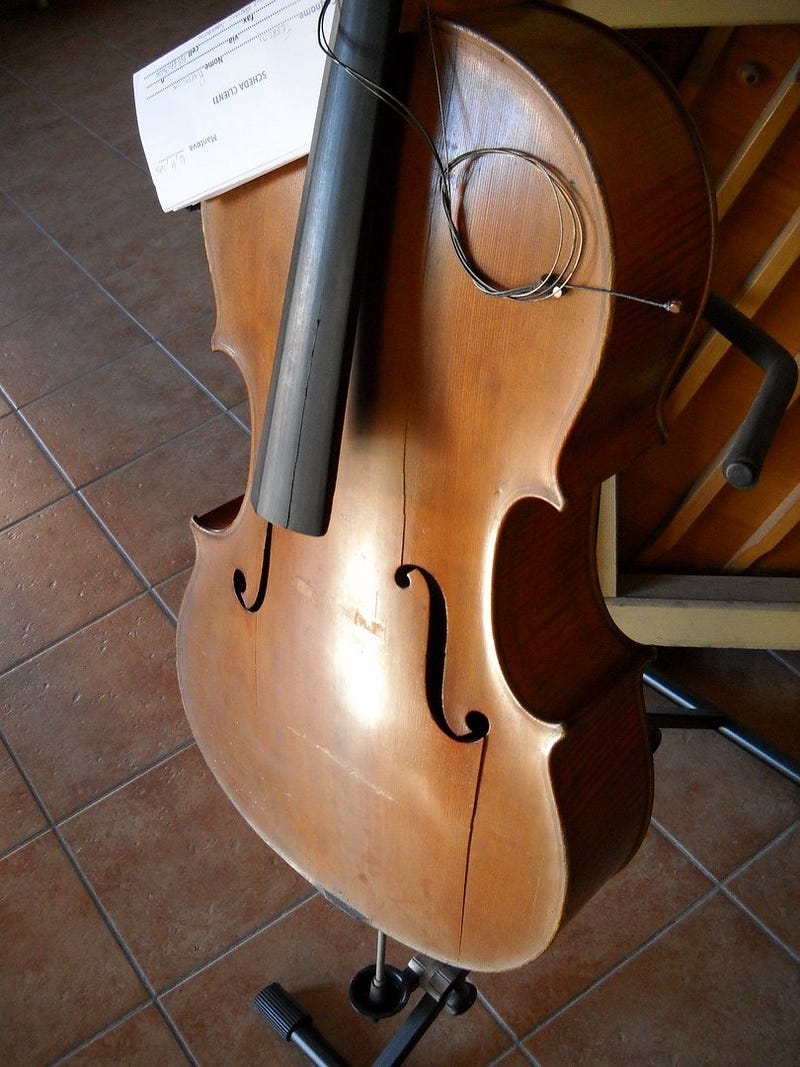
A few days later, here I am with my crashed cello in the workshop of the luthier, maestro Gianni Mariotto. I feel bad to show it to him. I’m ashamed. I feel like a mother who has abandoned her child, who has ended badly. But I also tell him and his son Guido the whole story and add that, “Beyond any economic value, there is the emotional one, superior to all the money in the world because that cello is not just an instrument, but my mother’s gift.” I also tell them that, unfortunately, I can only afford to pay 3000 euros, but if it will cost more, I could pay in instalments. They listen to me smiling, and then Guido proposes, “First, let’s look at how it is!” Finally, I decide to hand my cello to the luthier.
With great care and delicacy, he places it on the large, solid oak table and turns on the bright light above my injured cello. Now, even the thinnest cracks are clearly visible. I feel overwhelmed with guilt for having left him over twenty years in those conditions… I don’t deserve him. Maybe it was better to have left him where he was. I am silently holding my breath… A difficult wait. I feel like I am in an operating theater with the surgeon bent over the dying patient. Guido is dusting and observing him with the greatest tenderness and admiration.
Suddenly, he stands up and says to me: “So: it’s indeed in a very bad shape, but it’s a very well seasoned wood and should keep the repairs because it doesn’t move anymore. I believe that in a few weeks, I could return it to you ready to play.”
At that point, I feel elated, but I hold back and ask him, “So, can you really fix him? How much do you think I will owe you? Shoot me the figure immediately, so I know what a death I must die!”
“Well, I don’t think I’ll ask you for more than 2000 euros; on the contrary, I think even less… Let’s say I’ll do it for 1700 euros, if it suits you!”
“Nooo!!! But thank you!” I cry, “You are our savior! Thank you, thank you!!!” — I’m too happy.
Then the luthier smiles at me, amused but cryptic, as someone who knows a lot more, but doesn’t know whether to talk or keep silent. Thus, I ask him if there is anything else he needs to tell me.
“Well, yes…” he says, addressing both me and his father, “to tell the truth, your cello is not just any cello… It is an original Sgarabotto senior, which in recent years, has increased its value, which is quite a sum of money.”
I am stunned. I ask him, “Really? But then my mom really gave me a super gift! Then, even more so, I certainly want him to be restored because I want to play him again… It’s the best I can do for my cello’s and my mother’s sake.” I say, pointing to my instrument still lying on the table. “Precisely for this reason, I will never sell him, and I don’t even want to know how much he’s really worth because his true value is my mother’s love for me. This cello is the concrete expression of her love. She bought him sacrificing her few savings, just to give him to me… I will never get rid of him just for money!”
Eight weeks later, my cello comes out of the capable hands of the two luthiers as new and even a little modernized. Now he’s back as polished and brilliant as a real star, with a new titanium endpin, new strings, new fine tuners, new bridge, new pegs, and a new blue case. They also renewed the bow with new hair, though no longer of an Asian horse. I confess that seeing him as if those thirty years never passed makes me very merry. The emotional bond I feel has suddenly rekindled. I promise I won’t ever abandon him again and I will relearn to play him to bring his voice back.
Finally, I thank them and say goodbye. But Guido and his father, maestro Gianni, follow me to my car and they inform me they will be available should any problem arises. They also suggest I come back every six months to do a check-up of my cello. At last, maestro Gianni even inspires me with these words: “Remember that a cello like yours cannot be just an ornament, it requires playing. The more you’ll play it, the more it will thank you by enhancing its voice. But first, you must please it and play it!”
Now that I have restored my cello, Donatella invites me to her house for a slice of cake and a chat… “So, Raffa, you see?… Your cello has been repaired! Are you happy?”
“Of course!” I exclaim.
“Well then! Now, you can play in the orchestra with me!”
“Are you kidding me?” I blurt out, “I haven’t touched it for thirty years, and I can’t even remember how to read a music score! Besides, not even in those five years of conservatory I ever played in an orchestra!”
“You don’t want to disappoint your mother now, right?” she starts, “Your cello is recovering, so playing in the orchestra will be a cure-all for it. You will see how it will harmonize better. Its voice will adjust to follow the other instruments!”
“Ah, ah!” I laugh, “He’s not alive! It’s not like it plays alone!” But the luthier’s words echoes in my mind.
She insists, “But Raffa, string instruments relate and adjust with one another, you’ll see… Come and try, if you don’t believe it!”
“Donatella, do you realize what are you telling me to do? Thirty years! I haven’t read a note and touched a bow in thirty years! Yes and no, I’ve only seen cellos in concerts on TV. Absolutely impossible! Among all of you music professors, who have never stopped playing and teaching… Please, tell me how could I even dare to think it! Let’s stop it here… This is just insane! I appreciate you want to involve me, but really, Donatella, this is completely unlikely!… No, no, thanks!”
“Come on,” she’s a true pitbull and doesn’t let me go, “let’s have fun together! At least, come and meet who is there and see what music we play!”
“Ok, alright!” I finally give in, “I come to see and say hello… Just a visit!”
The following week, on a Thursday night, we’re going together to the orchestral rehearsal in Mantua.
I feel tense and uneasy, also because I know what Italians are up to: when they have an idea they like, they just don’t let go. So, with Donatella, I am on the alert. She seems just too happy and smiling… She really worries me!
We climb the stairs to the second floor of the music school where the rehearsals take place. Donatella with her viola by hand and I’m dragging myself behind her. I don’t know how to behave; what to think; what to say; what to do. I’m just being out of breath for climbing the high and worn marble stairs of this old building, where two steps equal four! I really feel like a fish out of the water, in the true sense of the word.
And finally, we enter the large room. On the right, the grand piano takes up a lot of space and the chairs and lecterns are spread out in a semicircle, like the rays of a fan. The maestro immediately catches my attention, apparently very relaxed while chatting with a musician. He’s certainly a sociable person. Incredibly, he wears Havaianas flip-flops on his feet, and has a white short-sleeved shirt open on his chest, where a gold necklace peeps out. Surely he’s still in his fifties, with thick and fairly long hair, disheveled and graying. He really seems like a friendly person. Certainly, he’s taken me off guard because I didn’t expect to see an orchestra maestro like him… Like a beach guy, let’s say.
“Ohè!” He’s waving his hand at us; and now he’s walking and smiling toward us… Gosh, he’s here! “Hi, are you the new cellist?” He asks me bluntly. “Donatella has already told me everything!… But didn’t you bring your instrument?” I’m stunned and dumb, looking for the eyes of my friend who, in the meantime, chuckles. I feel myself sinking and the floor’s engulfing me. My breathing is short and shallow. I try to say something, but I’m gasping: “But actually,…”
“Hi, Massimo!” Donatella is finally coming to my rescue, “tonight, my friend is here just to meet you and listen to what we play. She wants to think a bit about joining us since she claims she hasn’t played for thirty years… And it seems impossible for her to start directly in an orchestra!”
She’s still smiling and also very amused by the situation. I can see it… In my heart, I’m roaring at her. So, I speak up now: “Yes, indeed…”
Maestro Massimo Piccoli interrupts me and continues, “Don’t worry… Once you hold your cello, everything comes back natural to you… It’s like riding a bicycle! You never forget how to do it once you’ve learned! I’ll give you two weeks to practice; come back and tell me what you think! Now we are preparing the concert for the birth-centenary of Frank Sinatra and, since Mantua is the capital of culture this year, we will perform several concerts in the town and province, sponsored by the Municipality.”
He’s like a running river of words and he keeps talking, “I united the ElasticOrchestra, where Donatella plays and the Marmirolo’s winds band. The concerts will also include singers and dancers, as well as a narrator who will comment on Sinatra’s life with anecdotes between songs.”
I’m speechless. This maestro is telling me it is normal not to play for years and to return after only two weeks of practicing to be part of a super concert that joins two orchestras in a tour of already organized events. What do I tell him now? Donatella’s having the time of her life without even the decency of hiding it. And the maestro seems to egg her on in league with her. I do not know anymore what to say… Maybe they’re just pulling my leg…
“Listen, guys! This is Raffaella, the new cellist! Starts in two weeks with us!” He’s introducing me to the orchestra and I stagger. The floor is a chasm that opens under me.
“How nice, welcome!” “Oh, finally an extra cello! We really needed it!” And then here they go… all the greetings and exclamations of welcome. So, I’m compelled to clarify; maybe they didn’t get it yet: “Hi everyone! Lovely to be here with you, but I’m not so sure to really join since I haven’t played for thirty years… I don’t think I can really be able to play with you so soon.”
I realize I’m already making excuses to justify my incompetence. If I really have to come back next time with my cello, at least I did my duty to warn them.
“Do not worry!” They all assure “We’re here to have fun!” Yes, but I know what I mean. They think that I’ve done something over the years, anyway. They don’t even believe one iota of what I’m telling them.
The first violin, Mirella, is now introducing herself, shaking my hand with so much warmth and vigor. All her face is an open smile, already welcoming me as if we’re old friends. In fact, I remember her at the conservatory, and if I’m correct, at the time, they regarded her as a talented young violinist. “Well, hi! Splendid, we were just looking for a new cello because the bass group isn’t consistent enough, yet. Donatella had informed me she’d bring a new musician. I am delighted that you joined us! Welcome! If you need anything, just ask me and don’t worry.”
What can I do but thank her? Now it seems I no longer have a say. Instead, it appears I have to take care not to make Donatella look bad, as evidently she spoke highly of me to everyone. Somehow, however, I really have to make it clear, at least to Mirella, that I’m not quite up to it.
“Thanks, Mirella! You are really kind.” I start, “But what I just said before is really true! I haven’t touched my cello for all those years, and I’ve never played anything since; not even the piano, the guitar, or the recorder. My cello has been semi-destroyed for over twenty years, and I’ve just had it restored by the luthiers to play it just for my personal leisure at home. Just that. I absolutely don’t think I can live up to all of you, and I don’t want you to rely on flimsy illusions. You know… I have to start from the basics again.”
Mirella and Donatella are finally listening to me. Well, maybe now they get it. They are nodding, but still smiling… Eesh! But did they understand what I just said, or not?
“Alright… That’s ok… Don’t worry so much!” Mirella begins again, “You’ll see! In these two weeks, if you play two hours a day, you will make it easily… Did you learn at the conservatory at least the first four positions? And the bow techniques? If you’ve studied it for five years, you must have the sufficient skills you need. It’s just a matter of re-training a bit your hands and feeling more relaxed. You’ll see, while you’ll play, everything you’ve learned will come back to you. It’s only a matter of practice, and if you need any explanation on the scores, everyone here, including the maestro, will gladly help you. Agreed!” She concludes, “But now we have to begin. Take a sit wherever you like and enjoy. See you in two weeks then. Ok?”
What can I say now? “Ok, thanks Mirella! I really feel very well-liked. Thanks for this warm welcome. See you in two weeks, alright!” I shake her hand and before going to sit, I meet Donatella’s eyes, which reveal the most absolute celestial bliss; mine are certainly throwing hellish fire and brimstone at her.
It’s already been two weeks and tonight I’m going with Donatella to the fateful rehearsal. This time, I have my cello on my shoulders. My friend chats amiably and gossips a little about my cellist colleagues.
In the previous days, I studied a lot, even so, I lacked faith. But after three or four days of studying the music scores, I realized I was still able to read them, even in the bass clef.
How did I get started? I sat on the edge of the chair and held the bow. I started playing the open strings, experiencing its pressure and speed, playing it at the tip and at the end near the frog. Then, I practised in the middle and in the various bow positions; slow at first, then faster and faster. My satisfaction and confidence grew by the day. I was beginning to believe it.
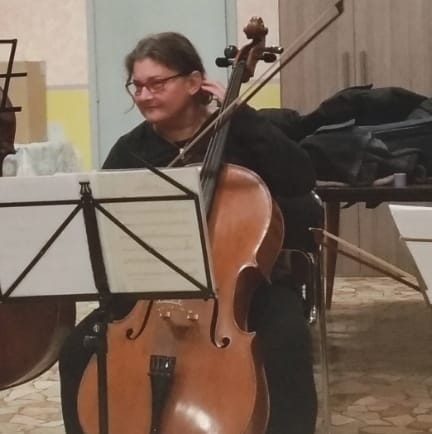
Strange to say, my biggest effort was in the physical practice. I didn’t expect it, but it takes muscle to play the cello. The upright posture, sitting on the edge of the chair, killed my back… When writing, I am always bent forward, but to play, I have to sit upright. And my right hand has to hold the bow perpetually in suspension, especially when I play on its tip, keeping my arm outstretched. To do it, I had to maintain my poor shoulder low and relaxed, but it stiffened after a short while, so I had to stop and massage it and stretch for a while. My right hand, at first, clung tightly to the bow, but feeling more relaxed, I was surprised to move forward and to progress quickly. Then I could maneuver the bow with more agility.
Cellists’ hands that seem so light and fast while shifting between positions on the fingerboard are the result of a lot of practice. But my fingers were slow and unsure on the strings. And worse, my left hand’s soft fingertips were mangled, reddened, and bled because I had no calluses. In that first week, cold water was my cure-all.
What about vibrato? I avoided it at first because, besides being stiff with my hand, the sore fingertips could not swing on the strings. But at the end of the two weeks, my left hand moved with some agility; though, I had to improve a lot more… This arrival was just the starting point.
I don’t remember having all these pains in the 1980s, but at fifty, I’m certainly not as athletic as I was back then.
Donatella, at first, was the preferential target of all my curses, but once I felt calmer and determined, I kept asking her for explanations on some scores and related theory. I complained, and she encouraged me; the cello was out of tune, and she helped me to tune it; I whined “this is difficult!”, and she replied “Then don’t play it! It’s just a rehearsal now. You have plenty of time to learn it from here to the concert!”
She was always seraphic, with her everlasting good mood. I entirely owe my music reentry’s success to her, who was indeed my coach. Without her and her positivity, I don’t think I would’ve ever made it!
Conclusion!
It is June now, and we are in the municipal theater of Marmirolo. From here, we begin our concert tour.
Outside and in the foyer, many people are already in line for tickets; some are sipping an apéritif at the buffet before the concert begins. Most theatergoers know and greet one another cheerfully.
Excitement is in the air, outside and especially in the backstage, where we are tuning our instruments and exchanging last-minute wishes and advice. Not only that, we are all armed with telephones and cameras to take shots for tangible memories of the evening. It’s an excited confusion. Everything is hectic, but selfies and greetings don’t cease. Young beautiful dancers flutter around, trying steps and spins here and there with their partners. The singers are closed in their dressing rooms to rehearse the most difficult English passages of the songs. The tuxedo-clad narrator is going around greeting all acquaintances. He’s a well-known tenor of the area. He’ll only sing My Way, but his beautiful, warm and vibrant voice will recite short anecdotes connected to Sinatra’s life, introducing song after song.
Mirella is checking the attacks for our string orchestra with maestro Piccoli, who’s very elegant in a tuxedo. Now he rightfully looks like a real maestro, and also a handsome and charming one… I was actually wondering how he would show up tonight. Mirella and all musicians are also in black, and we’re comparing and showing new shoes and clothes, exchanging smiles and compliments.
For my first concert, I bought as well an elegant outfit to wear and, as last-minute silliness, I dyed my hair the same color as my cello to match it and as a reciprocal wish of good luck.
My children, Femke and Luca, are sitting in the second row and with them, there are also two old friends, whom I invited at the last moment because, by chance, I entered their shop to buy this black outfit, and so I asked them.
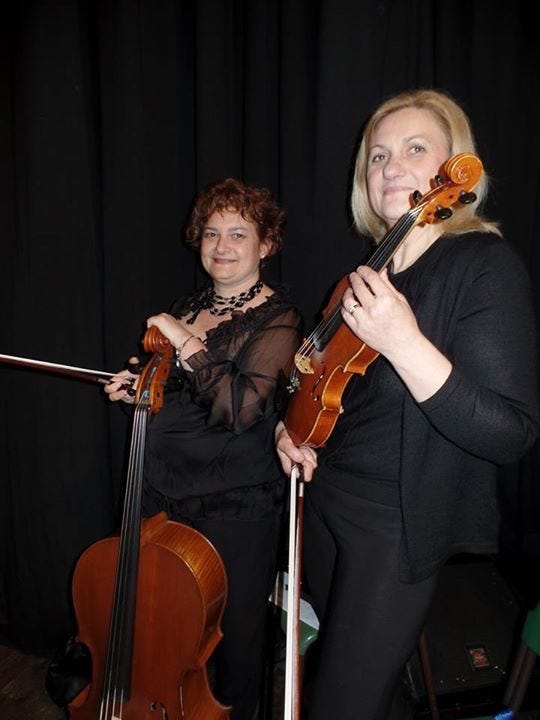
And now, I finally hug with Donatella and I whisper a quick “Thank you!” to her ear. I sit next to the other three cellists, who are waiting to ask me if it’s okay where they’ve placed me. Of course it’s okay, after three decades, even just being here is a privilege and a superhuman achievement I’ll remember for life!
After thirty years of abandonment and two months of rehearsals, my debut as an orchestral cellist is happening! Incredible but true. Tonight, I’m playing in a real orchestra and in a real theater with a large audience. And I’m not anxious, just excited!
Tonight, my motto is: “For my mother’s bliss: my cello and I as one!”
The curtain goes up and the maestro winks at me.
Thanks, Mom, I am at peace with you now.