
Combine Meditation With Productivity For A Great Morning Routine
Sitting still and clearing your mind isn’t just for zen masters — ambitious, alpha go-getters can benefit from a mindfulness practice too

Headspace, Calm, Gaba — you name a Meditation app and I’ve tried it. Mainly because I love self-improvement and technology, and the promise of betterment and becoming super zen sounds, well, promising.
However, there are two key things about my personality (and maybe yours too, if you’re reading this) that previously prevented me from sticking to any kind of mindfulness practice until I developed my own system:
- I am a notoriously ambitious, action-driven person. My frankly impossible 30 before 30 ‘to-do’ list was a source of humour and bafflement amongst my friends.
- I’m pretty ‘heady’ as a person. That is to say, that I tend to ruminate, intellectualise and look for structure in my thoughts, often to the point of spiralling. Thinking and cognitive thought are my go-to in any situation.
Therefore, sitting still (i.e not taking any action) and clearing my mind (i.e not chasing down my thoughts and coming up with new ones) didn’t sound like the ultimate use of 10 mins of my time daily.
This meant that I ended up dabbling temporarily with mindfulness & meditation apps, seeing some benefits but then ultimately putting the apps aside and thinking “God, meditation kinda sucks. I can’t do this.”
That changed when I developed a new system and approach to meditation and mindfulness that has fundamentally transformed how I start my day.
In concrete terms, it’s brought me:
- Distance from thoughts and feelings so that I can process them better
- Literal ‘head-space’ for better ideas to be generated
- Tangible actions and outputs that I can use for my life
Don’t just take my word for it: research backs up the theory that mindfulness boosts productivity. There’s numerous studies to choose from, but one that stands out is a Detroit study which saw productivity in the workplace rise by 120% after implementing mindfulness as an employee program.
Enough of the spiel. Here’s how I developed a mindfulness routine which works for my impatient, action-driven nature:
1. ‘Treat’ yourself to productivity after meditation
Meditating on its own, while nice (and something I do on occasion) went against my personality. Without connecting it to ‘actions’ or ‘output’ (i.e my comfort zone in life), meditation practice just seemed to be all too wishy-washy and intangible for it to stick as a habit.
So by ‘treating myself’ afterwards to action-based habits which produce ‘output’— e.g. writing, sorting, planning — I can force myself to do 10 minutes of not doing any of those things and clearing my mind first.
Here’s my quick 20-minute morning routine, into which I’ll go into in depth here in this article:
- 10 minute guided meditation (no thinking, no action)
- 5 minute brain dump onto paper (thinking + action)
- 5 minutes of reflecting and planning (thinking + action)
For guided meditation, I use Headspace, which has lots of great beginner 10-minute meditations. And while I’m meditating, I am doing what lovely Andy Puddecombe asks me to do — i.e nothing.
So I’m focusing on my breathing and body. ‘Noting’ my thoughts or feelings for what they are, but then immediately returning to the breath once I notice my mind drifting. No chasing down thoughts. No actions. Just chill.
For those out there who are ambitious, action-driven people, you’ll probably hate this at first, but I guarantee this 10 minutes will start to make a big difference in your life (you might even get a bit hooked on it).
Just give those 10 mins a try, safe in the knowledge that you get to do some nice ‘productivity-driven’ thinking & actions afterwards. Yay!
Note: it’s still really important to do the ‘chill bit’ and not just skip to the ‘action bit’. That’s cheating.
2. Time for some ‘action’, baby: get it all down on paper

Phew, meditation’s done. Maybe you feel a bit sleepy or just annoyed at yourself for not ‘doing it right’. Maybe you loved it and feel great. Well, it’s done now — next onto the output.
I started doing ‘Morning Pages’ independently of meditation a little while ago after revisiting the all-famous ‘Miracle Morning’ framework.
However, I found it really came into its own when writing after meditation.
Essentially all this is is writing down your thoughts as they come up — a.k.a ‘The Brain Dump’:
- Start with setting a timer for 10 minutes and writing down everything that comes into your head either during meditation or as soon as your pen hit the paper.
- This can be anything from “I don’t know what to write” to “I hate my ex boyfriend” to “I feel worried about my job” to “I should make fajitas later, I love fajitas”. Again, no judgement here. Just keep writing.
- One technique I use is to just keep asking myself : ‘What else’? Eventually after 10 or so minutes of doing this, the brain tends to repeat itself. If “I need to do laundry” comes up again for the second time, then I know I’m done.
3. Make connections & organise
Once you’ve been doing steps 1 and 2 for a while, you will probably start to see patterns in your thoughts and feelings that come up time and again.
For me, this led me to adapt my morning pages to structure the patterns I was seeing in my meditation practice and I was able to bucket my brain dump ‘musings’ into a few different categories.
Basically, before I start writing, I split my page into boxes with the category headers. Then as a thought comes into my head that I want to write down, I mentally categorise it and start writing in that box that matches the category.
You could start with just two high level categories:
- Feelings — i.e “I’m feeling a bit angry today”
- Thoughts — i.e “I don’t like the way S spoke to me yesterday”
Then go to the next level down:
- Fears — i.e “I’m worried I won’t be able to finish the presentation today and that my boss will be angry”
- Gratitudes — “I’m grateful my partner remembered our anniversary”
- Ideas — i.e “That could be a new blog post”
- To Dos — “I need to clean the bathroom”
Mine looks a bit like this (example brain dump):
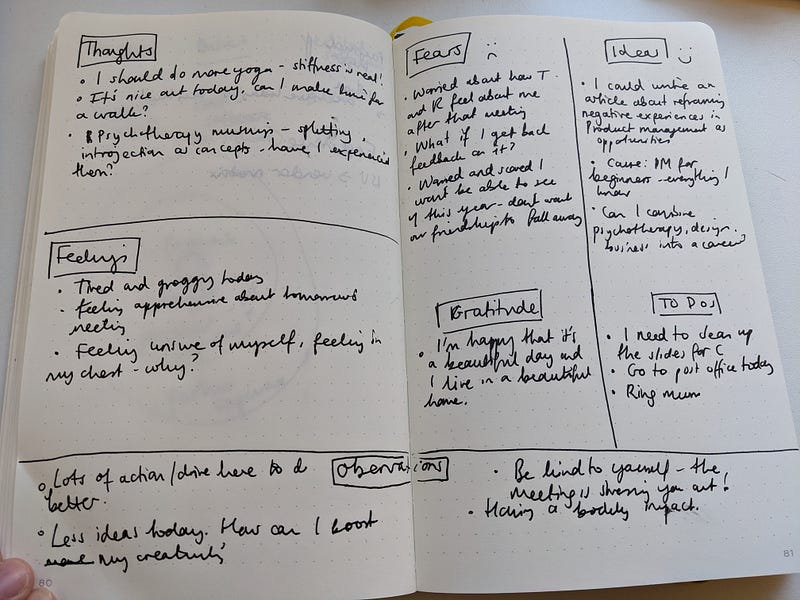
Why does this help? Well, bucketing your thoughts into these categories will make you feel like an absolute brain wizard. To be able to not only note your thoughts and feelings, but sort them into different areas, giving you both understanding and distance from them — truly is a superpower.
4. Observe yourself like you’re David Attenborough

Once you’ve written down and categorised your thoughts, it’s time to take a big old step back and look at what you’ve written down.
I like to think of myself as a David Attenborough type explorer who is observing a strange creature from the depths of the jungle.
Some observational prompts to get you started:
- What are the dominant themes or patterns in what I’ve written down?
- What’s my overriding emotion or state of mind today?
- What might my state of mind tell me about how I should treat myself today? i.e ‘Maybe I should be compassionate towards myself today, as I can see I’m a little anxious’
- Is there anything surprising that cropped up today?
- What are my best ideas today?
- Why might I be thinking or feeling this way?
Observing your thoughts and feelings without judgement is the cornerstone of meditation.
I actually would go one stop further: I think it’s important to have a healthy dose of compassion towards yourself, not just neutral interest.
Why is observation important for productivity lovers? Well, observing and getting distance from your thoughts will not only bring a sense of peace, but will also give you hugely valuable insights which can lead to concrete actions to guide your day.
And that’s what we wanted, right? Output. Hurrah!
5. Mix it up to match your mood, personality and day ahead
Finally, it’s been really beneficial for me to continue to tweak and iterate on my routine based on how I feel and what the day looks like. Personalising your routine to you and keeping it flexible will help make it stick:
Match your mood
Before even hitting the ‘play’ button on your meditation, I try and do quick body / brain scan to sense how I’m feeling generally — then I choose a guided meditations which matches my mood.
In practice:
- Feeling a bit hard on yourself? Try a ‘self acceptance’ meditation
- Feeling nervous about a big presentation? Try a ‘confidence’ meditation
- Lacking the creative spark? Try a ‘creativity’ meditation
I have to admit, it’s kind of fun to have a ‘choose your own adventure’ approach to starting your day.
Use the right medium for your brain dump
I like writing things down, but you might prefer a different method to get your thoughts out of your brain and into the world. Think in visual pictures or soundbites rather than written words? Draw your thoughts, or record your voice speaking aloud.
Adapt your routine to match the structure of your day
I do my 20 minute meditation & morning pages practice — you guessed it — in the morning. However, you might prefer a lunchtime break, or before you go to bed to dump out all the ideas and feelings that have been floating around that lovely brain of yours all day.
Closing thoughts
- If you ain’t zen, you ain’t zen, so don’t try and fight it. You’re not going to suddenly become some chiller than chill overnight, but that doesn’t mean meditation isn’t for you— quite the opposite actually.
- Mindfulness, meditation and journaling are excellent techniques to get the most out of your brain and to function better as a person — ideal for those who love productivity.
- Seeing those 20 minutes of your day as an investment which will pay you back in great output and clarity is a way of reframing your meditation & journaling practice as beneficial, rather than a hindrance to productivity.
I really hope this has helped you alpha folks to think about meditation, mindfulness and journaling a little differently. Let me know in the comments if you have any other techniques for ‘hacking’ your practice! (Also claps are lovely too!) Thanks :)


