
How to Make Better Decisions: Are You a Satisficer or a Maximizer?
Why your decision-making style can make or break your happiness

How do you feel when making a major life decision, like buying a house or changing jobs? Are you able to choose quickly and feel happy about what you picked? Or did you labor over every detail, examine every option, before finally settling on something?
I remember the process of choosing a major in college — it was painful. There were so many options, and I had a ton of interests. I looked at majors by starting salary out of school, how happy the students seemed to be, even which professors seemed the coolest.
In the end, I chose a double major in English Literature and Musicology. In theory, I should have been happy with my choice — it took me so long to make it that I declared my majors on the last hour of the last day before the deadline. I took all the time I needed to make an educated decision.
But instead of feeling happy with my decision, I was miserable. Why?
I’d spent lots of time trying to make the perfect decision, but I still felt there might be something better out there. And as it turns out, I was showing the classic traits of what’s called a “Maximizer.”

What are Satisficers and Maximizers?
Researcher and economist Herman Simon theorized that there are two types of decision-making styles, the Satisficer and the Maximizer.
You might be a Satisficer if…
Satisficers are people who are happier making a fast but imperfect decision. They’ve spent a little time thinking about their choice but haven’t considered every possible option. Satisficers settle for an option that’s “good enough” and move on. Gretchen Rubin, author of The Happiness Project, described them this way:
“Satisficers make a decision once their criteria are met; when they find the hotel or the pasta sauce that has the qualities they want, they’re satisfied.”
You might be a Maximizer if…
Maximizers are people who want to make the best possible decision. They can’t choose until they’ve deeply examined every option. That’s what I was doing when I spent nearly six weeks researching majors. I was trying to find major that was “the one” instead of choosing one that was good enough.
Research from Swarthmore College found that Maximizers reported significantly less life satisfaction, happiness, optimism, and self-esteem. They also experienced much higher levels of regret and depression than Satisficers. Although both make good decisions, they feel very differently about the decisions they make. As Professor Schwartz put it:
“Maximizers make good decisions and end up feeling bad about them. Satisficers make good decisions and end up feeling good.”
In one study, Dr. Schwartz followed job-seeking college seniors. They found that while Maximizers got better job offers. Their starting salaries were 20% higher than Satisficers, on average. But the Maximizers felt worse about the jobs they ultimately chose — they were obsessed with what might’ve been..
The Problem With Too Much Choice
“Learning to choose is hard.
Learning to choose well is harder.
And learning to choose well in a world of unlimited possibilities is …perhaps too hard.”
— Prof. Barry Schwartz
The world has evolved from a relatively simple place to one overflowing with choices. The average American grocery store now has between 40,000 and 50,000 options. Netflix now has upwards of 50,000 titles to choose from. Even the average American’s wardrobe has grown 400% since the 1950s.
Research says that the more options people have, the more likely they are to be disappointed by their final choice. Having infinite options means Maximizer behavior could become more common. As Barry Schwartz put it in The Paradox of Choice:
“A greater variety of choices actually makes us feel worse.”
So if we know that Maximizing behavior is so damaging, how do we avoid it? In other words, can a Maximizer learn to Satisfice?
How to Satisfice
When it comes to reducing Maximizing behavior, there are a few possible approaches. We can make fewer choices, whittle down our choice sets with the Chunking Strategy, or delegate our decision-making.
1. Narrow Down Choice Sets With the Chunking Strategy
Routine, day-to-day decisions can eat away at our limited mental resources. Questions like “What should we watch on Netflix tonight?” can kick off an hours-long search for the “best” movie or show. To reduce this Maximizing behavior, try narrowing down your choices to a smaller subset with Chunking.
What is Chunking?
Chunking is a process by which big groups of information are broken down into smaller parts. Then these parts are grouped by common elements. The Chunking strategy can help you tackle a big decision by turning it into a series of smaller, low-risk choices.
The Chunking strategy can help you tackle a big decision by turning it into a series of smaller, low-risk choices.
For example, instead of considering all of your Netflix options at once, chunk the titles down by genre. Ask yourself if you’d like to watch a Comedy or a Drama. Once that’s settled, move to the next section by asking yourself if you’d like to watch a new release or a classic movie. Repeat this process until you’ve made your final decision.
2. Make Fewer Choices
The average person makes thousands of decisions a day. And every decision consumes a lot of mental energy, especially if you’re trying to maximize each one.
But not all of these decisions are equally important. If we eliminate non-critical choices, you can save mental resources for the toughest decisions and reduce the amount of Maximizing you do each day.
For example, Apple founder Steve Jobs famously wore the same clothes every day. He was able to eliminate a low-value decision and save his mental resources for critical issues.
How to Decide What to Delete: The Eisenhower Matrix
How do you know what’s a low or high-value decision? The Eisenhower Matrix, a tool developed by President Dwight D. Eisenhower and refined by author Stephen Covey, can help you figure that out.
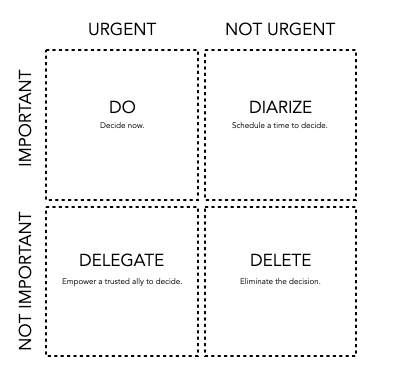
In this model, decisions are divided into four subcategories, depending on how urgent and important they are:
- Urgent and Important = Do these decisions now. They can’t wait.
- Urgent but not Important = Delegate these tasks to someone you trust.
- Not Urgent but Important = Diarize the decision. In other words, put it in your calendar to tackle later.
- Not Urgent and Not Important = Delete these decisions. They don’t matter.
3. Delegate Decision-Making
The Eisenhower Matrix can also help us discover which are the best choices to delegate to the trusted Satisficer in our lives.
For example, if you’re in the market for a new car and your spouse is a Satisficer, have them pick it out and sign the lease. You can’t be unhappy about a decision you didn’t make, as long as you trust your spouse, parent, or friend to make the right decision.
The Bottom Line
Most people fall somewhere in the middle of the Maximizing and Satisficing spectrum. But the younger you are, the more likely you are to be a Maximizer. And the older you get, the more of a Satisficer you become. It turns out that even the most hardened Maximizer eventually learns to let go of finding the perfect solution for every challenge. As author and psychologist William James put it:
“The art of being wise is the art of knowing what to overlook.”


