

How To Make Better Decisions
The Lost Art Of Context
In 1970, economist George Akerlof published a paper called The Market for Lemons: Quality Uncertainty and the Market Mechanism, in which he described an idea that would keep researchers busy for decades: adverse selection.
The concept describes a type of market inefficiency. When buyers and sellers have different information about the goods or services being sold, whichever party knows more can dictate the outcome of the transaction.
For example, sellers of used cars know whether their vehicle is of good quality or breaks down every ten miles, (a so-called ‘lemon’) but potential buyers don’t. As a result, sellers overcharge. Akerlof dubbed this phenomenon ‘asymmetric information’ and predicted a market death spiral, in which, theoretically, no one would want to buy a car.
Of course the real used car market is very much alive, however inefficient. While measures to mitigate information asymmetry have been introduced, such as extended guarantees, inspections, and certifications, people still get ripped off every day.
But why? Akerlof received the Nobel prize in economics for his discovery and today, almost 50 years later, every US state has its own variant of the ‘Lemon law’ to protect consumers. Yet, we still make bad decisions, not just in purchasing goods, but everywhere.
And we really have no excuse to.
Avoidance Is Expensive
There are two types of capitalism: the kind that solves real problems and the kind that peddles placebos. The latter thrives on information asymmetry. In fact, it’s the only reason it works.
While con artists and scammers have been around for millennia, they’ve had to be a lot more creative since the rise of the internet. The wide dissemination of information at no cost has shrunk the gap a lot. Or rather, it’s increased how much we can shrink it ourselves. What used to be mostly a game of luck has now become a game of effort, but we avoid it just the same.
Take this picture of a turtle, for example.

It’s beautiful, isn’t it? While it’s a fantastic way to elicit emotions and get you to daydream about your next vacation, you don’t know where I took it from. But you could find out, thanks to Google Image Search.
With some more effort, you could even determine what kind of camera was used, where it was taken, who the photographer was, and ask them for more details. The question is, if I used this picture to try and sell you an all-inclusive trip to the Bahamas, would you?
Most of us don’t. We’re happy to comply when others prompt us to make decisions with as little context as possible. We form opinions based on headlines, pass judgements after reading tweets, and glance at pictures without demanding the frame they came in.
That’s what information asymmetry is at its core. A lack of context. It’s baffling how often we choose to decide under its influence, despite having all the tools we need to fight it.
Here are three that help you define, set, and leverage context to improve every single one of your decisions.
1. Knowing What You Know
One of Warren Buffett’s most popular mental models is the circle of competence. In a 2017 documentary, he describes it as follows:
“I can look at a thousand different companies and I don’t have to be right on every one of them, or even 50 of them. So I can pick the ball I want to hit. The trick in investing is just to sit there and watch pitch after pitch go by and wait for the one right in your sweet spot. And the people who are yelling ‘swing, you bum,’ ignore them.”
Knowing what you know increases the probability of your assumptions being right and thus helps you decide with confidence. Whatever lies outside of that circle is nothing but smoke and mirrors, but you can afford to ignore it, because you’re not going to take shots in the dark.
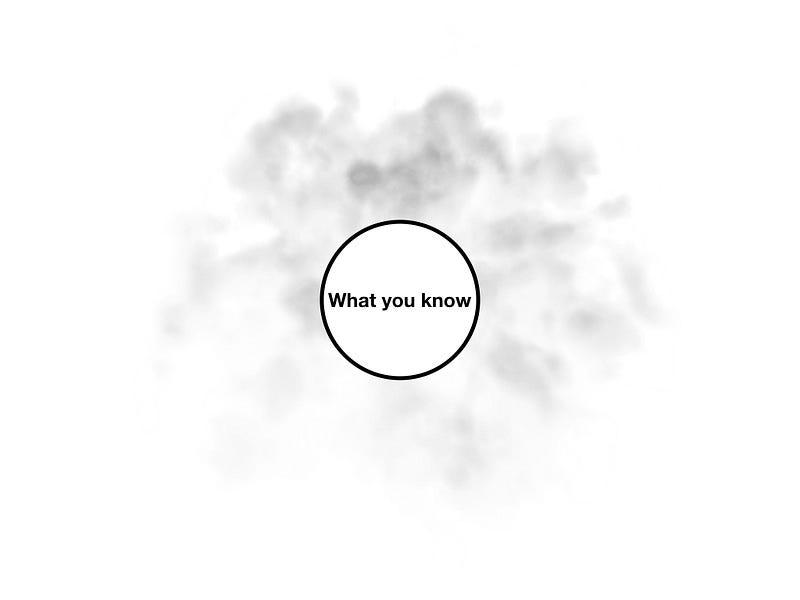
What’s remarkable is how small a circle we can get away with, yet still be successful. You could specialize in producing, selling, or investing only in tetracycline antibiotics, and that’d be more than enough to keep you busy for a lifetime.
To find the border of that circle early, we must walk to the edge, peer over, and maybe run a few low-risk experiments. But once we’ve set the perimeter, we can build a huge web of context inside it, while ignoring all the noise on the outside.
2. Knowing What You Don’t Know
In video games, it’s very common for the map of the terrain to be unknown when you start playing. Only as you move around do you uncover patches of the area, which slowly begin to form a complete picture.
No matter how many black spots are left, keeping track of where they are allows you to shine your proverbial flashlight on them later, but not go there before you’re ready. There’s lots of smoke outside your circle, but that too is finite, at least for any particular decision. Knowing that boundary has value.
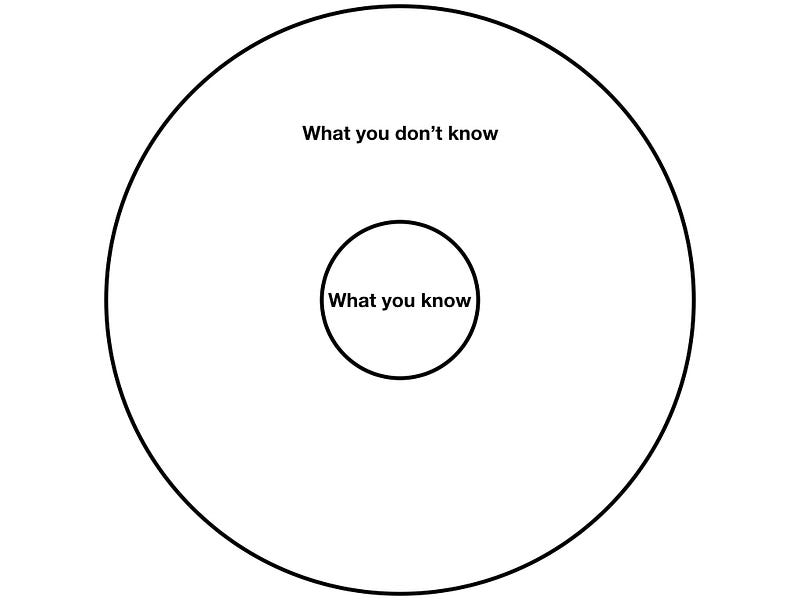
The more you optimize your life, the less you’ll have to step outside your circle of competence, but sometimes, life forces you to. It’s impossible to pick the perfect job when completely switching career fields, but being aware of how little you know, you can consult with experts, steer clear of big responsibilities at first, and prioritize what you’ll learn.
Even saying “I don’t know” out loud provides relief, makes it easier for others to empathize, and is more often seen as a sign of professionalism, rather than weakness.
3. Knowing How Much You Need To Know
Once you’ve determined where your wisdom ends and how much there is to attain for your specific decision altogether, another question presents itself, and it makes all the difference: how big is the gap between the two?
Former Secretary of State Colin Powell placed the ideal amount of information needed to make an educated decision between 40% and 70% of the total that’s available. Ideally, he says, you’d always keep waiting for more context at less than 40%, but never procrastinate after you’ve got 70% of the data.
No two situations are alike and this isn’t a hard rule, but thinking about whether you can push the edges of your circle of competence, and how far you’d have to drive them to avoid complete failure, is worth your while.
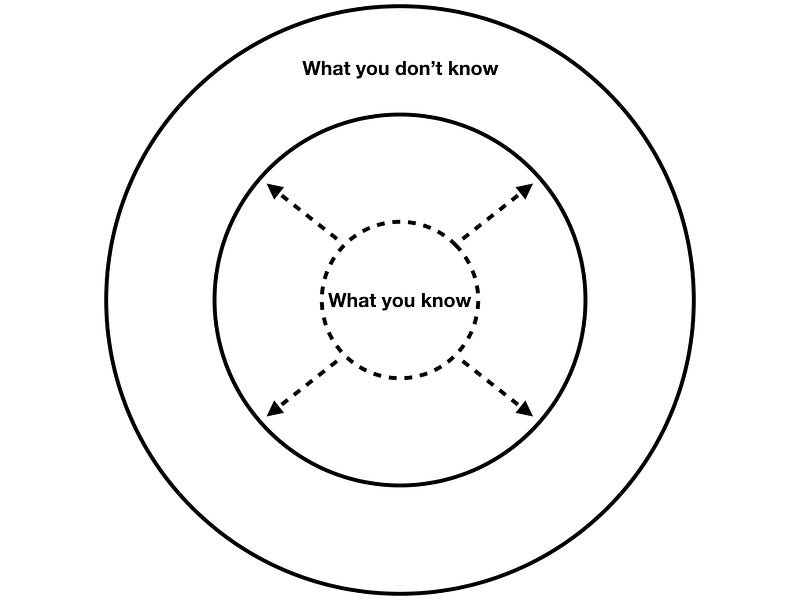
For example, if a stranger passes you in the street and doesn’t return your smile, your gut might tell you “this person’s arrogant.” However, armed with nothing but their appearance, you clearly have less information than you need to make that call.
Similarly, spending two whole afternoons to decide which out of three $50 backpacks you buy might be overdoing it, especially if you make $50/hr or more.
These are oversimplified, but the principle stands. Don’t let perceived urgency pressure you into sub-par decisions. Ask, search, and wait for what you need to pick not just an option that will do, but the option that’ll do best in your circumstances.
The Diet Of The Wise
When Warren Buffett first took an interest in financial markets, there was no internet, yet he chose to fight information asymmetry regardless. It surely must have been an uphill battle, reading all those books, complicated financial reports, and whatever else he could get his hands on.
Yet here we are, history’s entire knowledge at our fingertips, often failing to google, go beyond the headline, or read the blurb of a book, let alone the whole thing. We’re too lazy to read and too busy to think, when that’s the diet of the wise. Better yet, it’s close to free.
In a fully connected world, information is only as asymmetric as you allow it to be. You have all the tools you need. Use them to build context. Avoid environments that force your hand. Know what you don’t know. Resist the temptation to move too quickly.
If your good decisions compound, maybe we’ll read about you someday.


