
The Reflective Eclectic
How to Look at Everything Differently
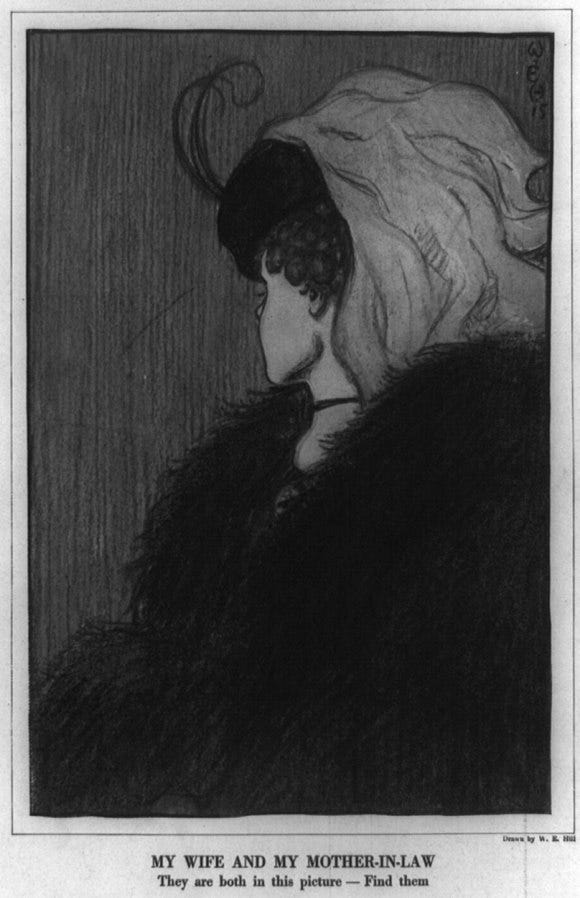
I keep this picture in my psychotherapy office. It’s on the bookcase facing the couch.
If you look at it one way, you see a young woman with a big hat, turned away from the viewer. If you look at it another, there’s an old woman in profile, said to be the artist’s mother-in-law. It’s impossible to see both at the same time. If you’re seeing the young woman and want to see the old, you have to locate a prominent feature and redefine it. Find the young woman’s necklace and think of it as a mouth. The rest of the image of the old woman will fall into place. Then, once you see the old woman and want to see the young, go back to that feature and call it a necklace. The young woman will return.
The reason I have this image in my office is because it illustrates a problem many people have when they come to therapy. Their thinking is stuck. Often, it’s negative thinking they’re stuck in. Things are actually better than they think they are. They’ll admit they don’t really have anything to complain about, but they complain anyway; they are unable to do anything but complain. They are like the viewer stuck on seeing only the old woman (or, if that sounds too ageist for you, the young woman). How can they switch?
The image offers a solution. Find a prominent positive feature of your life: your dog, say, the way he’s happy to see you when you come home. Continue in this manner, identifying positive things until the contours of a positive life snap into place.
What I like about this is that you don’t have to deny that there are problems in your life. Your dog may be the best part, but your boss is killing you. Just as you can easily go back and see the old woman, your problems are still there for you to look at and try to solve. You also don’t have to make anything up. The vision of the young woman is really there, and the dog is really there, you don’t fantasize them. They were there, all along. The very moment your boss was yelling at you, your dog was anxiously waiting for you to return home.
All this is pretty cool, but I think you can take looking at the picture to another level, one that takes you to deeper truths.
The picture does not have to be anything. It doesn’t have to be either a young woman or an old one. It can simply be some marks on paper. To tell you the truth, that’s all it is and all it ever has been. The picture has never been a young woman or an old one. It’s always been a picture. If you made it more than that, it was all in your mind.
The tendency to organize marks on a page is so strong that it can be hard to not see anything; but when you are able to do so, you break free of all the concepts, presuppositions, and prejudices that confine you.
The same thing happens when you look at your life. Rather than sorting out all the features of your life into good and bad, how about just saying they are what they are: stuff happening. Your boss is a person, your dog is a dog. Your boss is not the devil, direct from hell to torment you; he’s just doing his thing, trying to do his job. Similarly, your dog is not living proof that you’re the greatest human on earth. If he had a different owner, he’d be happy to see her, too.
When you restrain yourself from cataloging everything into good and bad, it becomes easier to accept life on life’s terms. You don’t have to resist every apparently negative thing that comes along. You don’t feel so sad when the positive goes away. You might even be able to find the positive in whatever you called negative before. Look long enough at the picture on my bookcase in this open-minded manner and perhaps a new image will emerge, one that not even the artist intended.
Keith R Wilson is a mental health counselor in private practice and the author of three self-help books, two novels, and innumerable articles. A third novel, Who Killed the Lisping Barista of the Epiphany Café? is currently being published one chapter at a time in Medium.


