
How to Let Go of Negative Emotions and Heal Your Life
A guide to health and prosperity inspired by David R. Hawkings.

Negative emotions are an inevitable part of the human experience. We all face moments of anger, sadness, fear, and resentment, but how we deal with these emotions has a profound impact on our well-being.
Dr. David R. Hawkins, is not a typical psychiatrist but a spiritual teacher who offers a transformative approach to dealing with negative emotions and healing our lives.
He’s all about the trio: consciousness, forgiveness, and inner growth. It’s a magical recipe for finding our inner peace and happiness. His book Letting Go: The Pathway of Surrender healed my life.
Understanding the Power of Consciousness
Hawkins’ teachings are deeply rooted in the concept of consciousness.
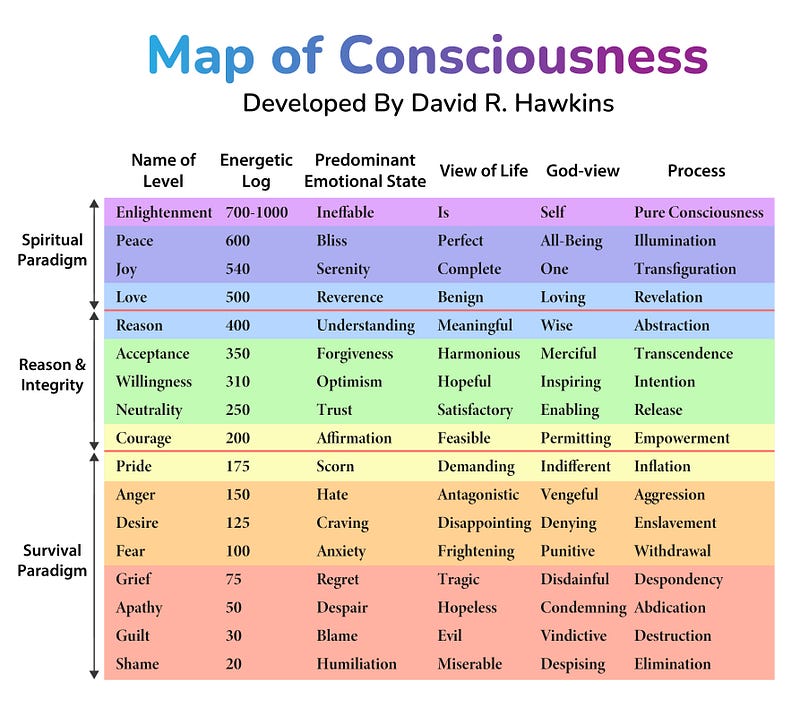
He suggests that our emotions, thoughts, and actions are all influenced by the level of consciousness we operate from. Hawkins introduced the “Map of Consciousness,” a scale that ranges from the lowest levels of shame and guilt to the highest levels of enlightenment and pure awareness.
How to let go?
Letting go isn’t about forgetting. It is the opposite.
To release negative emotions, the first step is to acknowledge them. It’s like shining a light on what you’re feeling, giving those emotions the attention they deserve. That’s where the journey to healing begins.
Think about the experience that made you feel uncomfortable or unsafe. It can be a trivial incident or an extremely emotional event.
Acknowledge Your Emotions
When negative emotions come knocking, we usually do one of four things:
- suppress them (consciously trying to get rid of the feeling),
- repress them (unconsciously stifling emotions),
- express them (constantly complaining — not a great idea),
- or escape them (hello, Netflix binge).
To begin the process of healing, first, acknowledge and accept your negative emotions. Pretending they don’t exist just stirs up more inner chaos.
Emotions are messengers. They carry valuable information about what is going on inside you. By embracing them, you can begin to understand the underlying issues that need attention.
Identify Your Position on the Map of Consciousness
According to Hawkins, each emotion corresponds to a specific level on the map of consciousness. For instance, shame and guilt are at the lowest levels, while love, joy, and enlightenment are at the highest.
Name the emotion you are experiencing. Is it anger, fear, sadness, guilt, shame, or something else? Identifying the feeling helps you understand its source and impact on your life.
You cannot heal what you don’t acknowledge. Recognizing where your emotions fall on the map helps you understand your emotional state and thought patterns.
Feel the Emotion
Allow yourself to fully experience the emotion without resistance. Feel your body “from the inside”. Sit with it. Emotions manifest in your body.
Breathe intentionally. Mindful breathing can be a powerful tool for letting go of negative emotions. Focus on your breath as you inhale and exhale slowly and deeply. It helps you stay calm in the middle of an emotional storm.
By paying attention to the emotion, you deprive it of its negative energy. It is like pulling each emotion out of the rubbish pile you have accumulated throughout the years. It no longer gets to control you because now you can see it for what it is.
Observe Without Judgment
Dr. Hawkins encourages us to be like Zen observers of our emotions. Let them flow by like leaves in a river. Don’t get caught up in their drama.
Practice observing the emotion from a place of detachment. Instead of becoming entangled in the story or narrative behind the emotion, observe it. Think of it like watching a movie without getting involved in the plot. The technique helps you understand where the emotion is coming from.
Letting go involves being aware of a feeling, letting it come up, staying with it, and letting it run its course without wanting to make it different or do anything about it.
Your mind might want to push it away or move on, but that’s just the ego trying to dodge discomfort.
The key is to descend from the mind and feel the emotions at the level of your heart, gut, back pain, or the tension in the muscles.
Allow the Emotion to Release
As you experience the emotion and observe it without judgment, you may notice that it naturally begins to lose its grip on you. Emotions are like passing clouds; they come and go if we allow them to.
You will encounter resistance. You might cry. Don’t argue with your thoughts. Let them come up. It is part of the process. Become aware of the resistance. Shift the focus back to the observation. Watch your sensations. No judgment. No labels.
Acceptance and Surrender
Accept that the emotion was part of your experience, but it doesn’t define you. Surrender to the natural process of letting go. This step involves letting go of any resistance or attachment to the emotion.
Through meditation, I learned to observe my thoughts and emotions without judgment. Each meditation session became a mini-journey into self-discovery and a reminder of the beauty that surrounds us in every moment.
Practice Forgiveness
Forgiving ourselves, forgiving others — it’s like an emotional spring-cleaning. Forgiveness isn’t about saying what happened was okay. It is about freeing ourselves from the heavy chains of anger and resentment that hold us back.
Start by forgiving yourself. You’re human, and making mistakes is part of the deal. Let go of self-criticism and self-blame. Instead, focus on learning and growing from your experiences.
Forgiving is challenging, especially when people have hurt you. However, I realized that by forgiving those who had hurt me, I was not condoning their actions but freeing myself from the chains of anger and resentment.
Forgiving yourself or others can be a powerful way to release emotional burdens and move forward.
Choose Higher Levels of Consciousness
The key to healing lies in choosing to operate from higher levels of consciousness. When you are angry, there is no room for love, gratitude, or any positive emotions, which are crucial to a healthy and fulfilling life.
Self-love and self-compassion became my daily mantras, reminding me that I deserve kindness and forgiveness. Be kind to yourself, practice self-compassion, and treat yourself with the same care and empathy you would offer to a friend.
Every act of kindness, no matter how small, raises your level of consciousness.
By nurturing love and compassion for others, I found that my relationships deepened, and my interactions with people became more meaningful. I understood that everyone carries their own burdens, and by approaching others with empathy, I could help alleviate their suffering and, in turn, my own.
We are all on our individual journeys, and everyone is doing the best they can with their current level of awareness.
The Path to Healing
Letting go of negative emotions is a skill that can be developed with practice. Make it a regular part of your self-care and personal growth journey. The more you practice, the more adept you will become at letting go.
Since applying this technique, my health transformed immensely. I practice it in the morning or before going to bed. It can take 20 minutes or an hour before I feel at ease.
My eczema disappeared as well as many food allergies. Fear from rejection no longer controls me — I have battled the demons of the past. I wake up feeling grateful. Whenever an unpleasant situation comes up, I can feel emotions in my body. The quality of my life improved.
I encourage you to remove the biggest obstacle to living a fulfilling life: your assumptions about negative emotions. They are our precious navigational system, not an obstacle. And your body is a messenger.
Through the power of mindfulness, forgiveness and love, you can embark on a transformative journey towards higher levels of awareness and inner peace.
By raising your own level of consciousness, you inspire others to do the same, creating a ripple effect of healing and compassion in our collective human experience.
Thank you for being here, — Kate


