
How to Know Yourself: A Practical Manual for Budding Entrepreneurs
Tip #3: Become a scientist of your life

Self-knowledge. Self-awareness. These two (actually, four) words usually go hand in hand and mean, basically, the same thing. Everyone knows that we should learn more about ourselves (if there is a secret to success, this is it).
But nobody knows how.
I spent an enormous amount of time being the scientist of my own life. I am so anal, I have stacks and stacks of Moleskine journals on my bookshelf with notes dedicated to figuring out the answer to one question:
Who the hell am I?
When I couldn’t find the answer, I started asking other people how they did it. I interviewed the most successful people I know and wrote a book about it. Still no answer.
Then I decided that maybe, I didn’t go broad enough. So I produced a YouTube show, where a famous Russian life coach interviews people from all walks of life, asking them (among others) this question. They were entrepreneurs, artists, designers, other life coaches and even ordinary people working in corporate offices. Still no answer.
Eventually, I realized, that I got it all backward. You can listen to podcasts, read books and interview others all day long, but all you need to know is inside of you. The answer to this question lies within.
I also realized that this is not something you answer one day. When you’re young, it seems that one day you’ll grow up, understand who you are and be static. Fixed. Unchanged. Unfortunately, this never happens. I look at my father and see that he is still figuring himself out.
Know Thyself
But the whole journey of searching for the answer left me with something valuable, something that I can share with you today — tools. And because I believe everyone should spend a considerable amount of time answering their version of this question, these tools might save you time and effort.
So keep reading.
The Basics
I’ll start with the basics. If I sum up my whole journey of interviewing other people — successful and not as much —into 2 takeaways, it’s going to be this.
In order to find who you are, you’ve got to:
- Try as many things as possible
- Get to know yourself
I know it’s overly simplistic, but no matter who I asked, it was one or the other or both.
You “try as many things as possible” by learning about areas you might be interested in, taking internships, volunteering, working for free (!), blogging about topics you’re excited about, shadowing or being mentored by successful people, attending conferences, workshops, taking courses about whatever you might be interested in. There is no substitute for experience, and that’s the main (only) way to learn.
But in order to try something, you’ve got to know what to try.
You “get to know yourself” by journaling daily, asking other people questions about yourself, writing down your thoughts, reflecting on how different activities make you feel, understanding what makes you excited and what drains your energy, trying psychotherapy, reading self-help, taking psychological tests and analyzing your life with a microscope.
These are the basics. Now off to the practical stuff.
Collin’s Circles
There is a Greek parable that says:
“The fox knows many things, but the hedgehog knows one big thing.”
Jim Collins (the bestselling author of Good To Great) made use of this parable and created something called “The Hedgehog Concept”.
In short, it’s 3 overlapping circles:
- What you are deeply passionate about
- What you can be the best in the world at
- What drives your economics (i.e., what can make money)
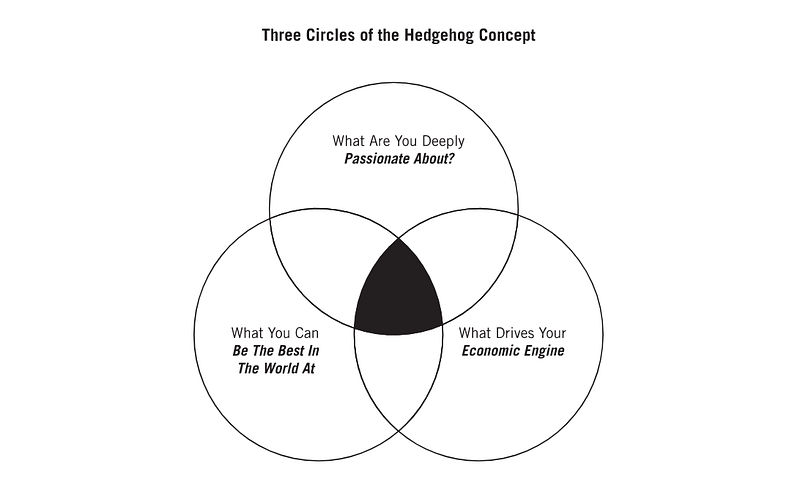
It’s related to companies who wish to become great (rather than merely good) and it’s purely a business concept. Great companies know what they can be best in the world at. Good companies don’t even ask that question (or answer it with bravado rather than deep and honest understanding).
The same, I believe, can be applied to human beings. Successful people know (not think, but actually know) what they can become great at and do only that. Mediocre people do a bunch of different things or pick a new thing they could be great at every 2 months.
If you want to figure yourself out, this is a starting point. Draw 3 overlapping circles. Label them accordingly. And then answer the 3 questions.
The intersection of the 3 circles — is what you should be doing with your life.
If you’re struggling to answer this question, don’t worry. I’ve heard about this lifehack (but haven’t tried it myself though): open Google and type in random keywords related to the answers to these questions and see what pops up.
For example, I am…
- Deeply passionate about content creation
- I can be the best in the world at inspiring people
- I can make money through building businesses
=> I type in Google 3 key things: “content creation”, “inspire people”, “business”. (Unfortunately, for me, Gary Vaynerchuk popped up).
Check it out, it’s worth it.
Becoming a Scientist of Your Life
This is something I deeply believe in. While asking yourself questions and taking tests might feel inspiring and productive, sometimes it can turn into mental masturbation.
What does a scientist do? Two things, mainly:
- Gather data and make conclusions
- Experiment
And that’s what you should do too. There are two main ways you can track your life to be able to make conclusions and experiment:
- Create your own ‘Life Quality Tracker’. It’s an Excel spreadsheet that you use to track your life, sleep, and activities, putting a score to each day. I am not going to go into much detail, as I wrote a whole article on this topic here.
- Write down daily observations about yourself. I set aside a notebook and called it ‘Lizard Sergey’. Every evening I would sit down and write something like this: “Today Sergey was especially excited during the day. It may be because he spent a few hours writing an article for that magazine — maybe writing is something Sergey should do more of…”. Imagine that you are your own scientist and your own guinea pig, that you’re observing under a microscope. It’s crazy, it’s weird, but it works.
These two approaches will allow you to gather data about yourself, that you can then use to make conclusions. For example, you could sort your Excel spreadsheet by analyzing what kind of activities you did during amazing days. Or you could go through your notes in the ‘lizard’-notebook and try to find patterns in what excites you or what actually drains your energy. Gather data. Analyze yourself.
Therapy
When I first heard about psychotherapy, I thought that only crazy people do it. But after 12 months of consistent weekly therapy, I can’t say how much it helped me analyze myself, my behavioral patterns and understand the underlying reasons behind them.
This is an unorthodox approach, but it works. Even if you don’t find anything practical, a good therapist is someone who is deeply interested in you and what you have to say. They listen to your story and ask follow up questions. In a world where everyone is obsessed with their own things, having someone to talk to — is a huge asset.
You’ll learn a lot about your childhood and where your mental patterns come from. You’ll see that you are a product of your past, your genes, and your environment.
And even if you don’t learn about yourself that much (but I did and a lot), you’ll learn to come to terms with yourself and love yourself for who you are, regardless of your success.
Therapy might be the best life hack nobody told you about.
Mayers-Briggs Identification Test (MBTI)
There is a lot of criticism around this hugely popular personality test, but it helped me get to know myself more and embrace certain parts about my personality.
(You can take the test on this website for free and once you’re done, stop by this site to read the full description of your type).
In short, MBTI is a test created in the 20th century that divides the world into 16 types of people. These 16 types come from 4 scales with 2 ends each:
- How you gain energy: Introverted/Extroverted
- Your perspective on the world: Intuitive/Sensing
- How you approach others: Feeling/Thinking
- How you approach problems: Perceiving/Judgemental
You can read more about MBTI on a bunch of different websites. The life coach that I worked with really believed that this approach to analyzing personalities works and he was hired by companies such as Heineken, British American Tobacco, Coca Cola, etc. to teach their employees how they can use this at work.
For us folks, who are interested in understanding who we really are and what we should do with our lives, MBTI is a helpful tool because it takes your innate personality traits and puts you into one category. I believe that it’s important to make use of your innate strengths and forget about your weaknesses, and MBTI allows you to do just that.
For example, my type is INFJ. People with this personality type are Introverted, Intuitive (i.e., live in their heads), Feeling (i.e., use feelings and emotion more than logic), Judgemental (i.e, like orderliness in their lives, as opposed to Perceivers who forget to put their socks on when they leave the house).
Hence, my best jobs (among many others) are writing, life coaching, motivational speaking, and psychology. This is what makes use of my strengths and, to be honest, what I am really most interested in.
Take the test. Understand who you are. Read about famous people with your type. Make some conclusions. But don’t be overly excited, this is just one of the many theoretical frameworks, and it won’t answer 100% of your questions, but it might answer 70–80% like it did for me.
Mentoring
Never underestimate the power of a good mentor.
“The answers to our questions are already there, they are just in other people’s heads”.
With this idea in mind, I created a YouTube show and later, wrote a book, interviewing top-10 entrepreneurs of Russia, asking them for advice on how to become successful, happy and fulfilled. The project is called “10 mentors” and, unfortunately, you won’t be able to read or watch it, because it’s in Russian.
But for the 18–19-year-old version of me, this project was invaluable. I got to ask my role models the very questions I struggled with, like “What’s success for you” or “What’s really important in life?”, or my favorite, “If instead of me, the 19-year-old version of you were standing here, what would you tell them?”.
Mentors are always there. They don’t have to be super-famous, and it may actually be your family member. The goal is to learn from people who have answers to the questions you are struggling with.
But remember, that you’ll still have to answer all of them yourself.
Do What Makes You Excited
The life coach whom I worked with didn’t think that “knowing yourself” is a problem at all. He worked with people of all shapes and sizes during his 20-year-old career as a coach, and he has mentored some of the top companies in the world.
When I asked him how people can find happiness and fulfillment in life, he replied:
I don’t believe in finding yourself. I believe in doing what gives you energy, makes you exited and don’t do what drains your energy. That’s it.
I like that a lot. Even though the tools I described above can be very helpful when you’re forging your path to self-knowledge and success, it’s important not to let them make you stuck. Simplifying is always a better way.
So, learn about yourself. Get to terms with whatever is there. But remember not to make it too complex. Do what excites you, try to get rid of people, events and actions that drain your energy and you’ll be happy.