
How to inspire Midjourney with associative thinking
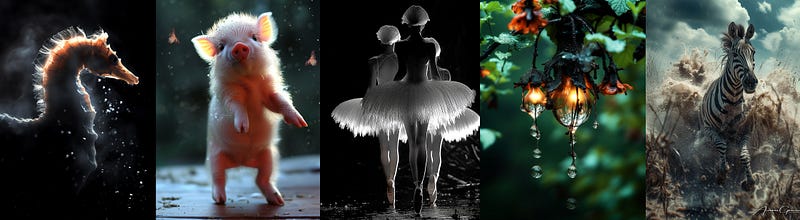
I am a big fan of associative thinking. As an engineer and inventor, I have always used it to come up with original and unexpected solutions for all sorts of problems and challenges.
And now I have found out that it works really well in Midjourney, too.
But first, let me take a little step back and give some background.
Although I am an engineer, I was a bit of an artist all of my life, too. I painted, drew, styled, and designed. I am quite a decent photographer and got some rewards in the 1990s. More than 15 years of my life went into Holywood work—from concept art to creature creation, from shaders to most complex 3D models. I loved it, too. I even learned to play the guitar, but, being honest, only my dear old mom had something nice to say about it.
The point is that I am an artist, and while open-minded, I was very sceptical about generative AI. I neither needed it nor wanted it. But then things changed.
I am a proud owner of a distressingly complete collection of autoimmune disorders. Leaving gory details aside, the outcome of it is gradually deteriorating control over motor functions, arms and legs, and messed-up vision. My artist days were numbered, and even as a photographer, I had to face some very serious challenges. Unless I wanted to make only blurry pictures and only abstract art, I had to find some other way to express myself. So I rediscovered a generative AI.
But first, I had to change my mindset about it. You see, artists more or less always have a mental image of their creation in mind long before it is materialized. But with generative AI, no matter how hard you try, you will never get THE image you had in mind. You will get an image, more or less in the direction you imagined it, but it will never be your exact imagined thing.
So, I started to think not as an artist but as a movie director. Here is the thing: the director does not write a screenplay, does not operate the camera, does not set the light or scenography, and does not act. But a good director's touch is always there in the final result. You can recognise Spielberg's movie from afar. So the trick is to learn to orchestrate all those independent, sometimes very creative agents to produce your vision. And I suppose it is still not exactly the same thing that Spielberg had in mind, but it is definitely a work of art.
This change of mindset improved all the results with generative AI very much. I stopped thinking about it as a single entity but as a film set crew. There is a cameraman, a light guy, a costume designer, and an actor. Giving instructions to all of the crew in one simple sentence is a trick and makes work rewarding. Your prompts become better, per definition.
But the biggest change came when I started to apply associative thinking to my prompts. And here is what I mean: associative thinking implies that you make associations between seemingly unrelated objects or phenomena to illustrate your idea for generative AI to get it to do the things you want.
I used associative thinking in Midjourney with great success. It became much easier to get out original, closer-to-my-imagination images. And it is easy, too.
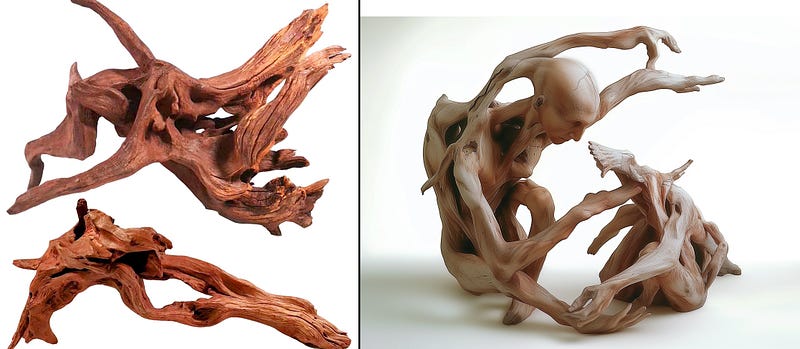
Here is an example. I saw an image of driftwood. For me, this image is associated for some reason with a human body, distorted strange poses, but still a human body. So I uploaded the driftwood image to Midjourney, and, in prompt, I instructed to make a sculpture out of human bodies. The result was cool.
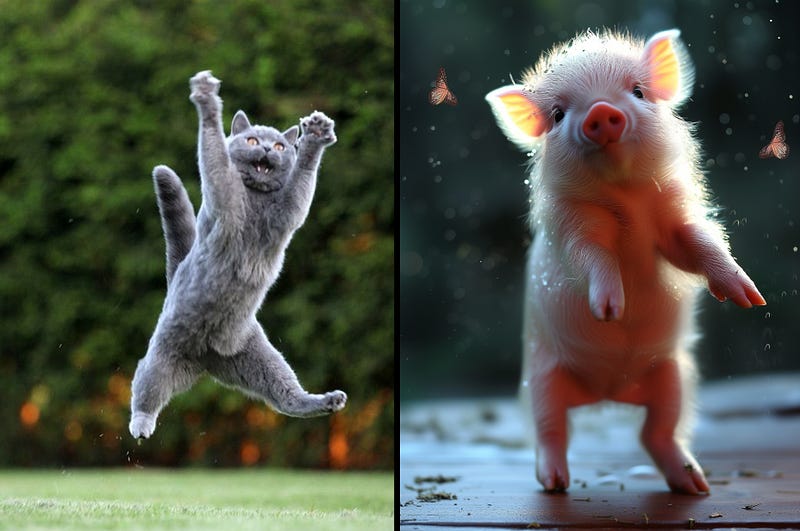
Sometimes, I use associative thinking to get the desired pose, which otherwise could be quite difficult to coax out of Midjourney. So, for example, I wanted to make a cute picture of a piggy in a somewhat unusual pig pose. I found a picture of a cat jumping in the air and used that as inspiration.
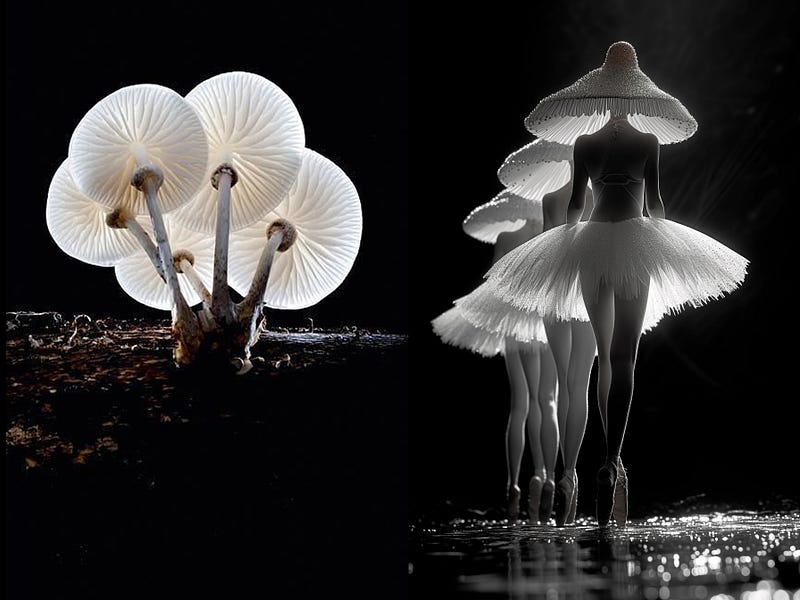
Sometimes, associations seem to be quite far-fetched, but that is even better. I love high-contrast black-and-white photography and often look through piles of it for inspiration. I stumbled upon this image of mushrooms and immediately formed an association with ballerinas. The result was lovely.
Sometimes, associations could be rather literal. I saw a beautiful, high-contrast image of a horse. I immediately imagined a beautiful image of a seahorse in a similar style. And here is the result:
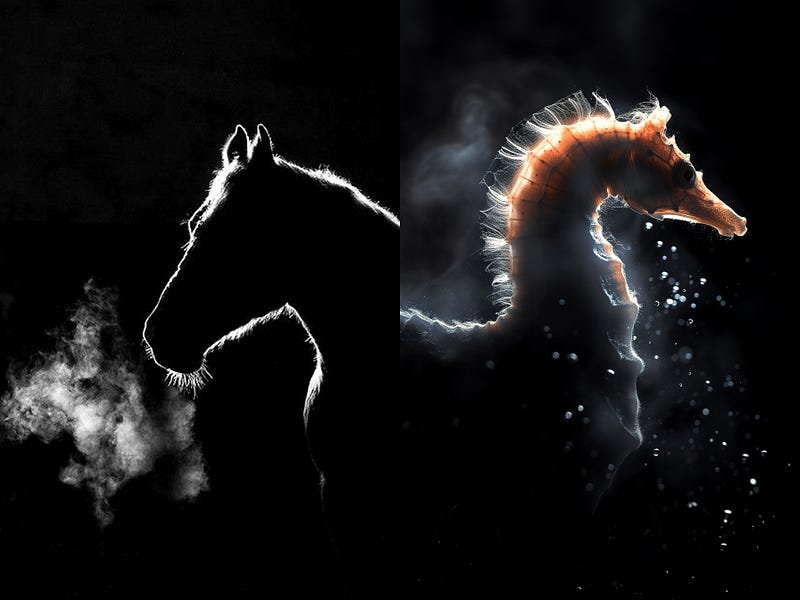
So here you go. Use associative thinking to create amazing images in Midjouney. It is easy and fun; just let your imagination run.
I often find that rerunning the prompt a few times will finally give a better result. Using stylize at high values would create better images. Midjourney will indeed attempt to blend your inspiration image with a target object in unexpected ways, but even that could act as an inspiration for the next unique piece of work.
I hope you liked this article and found it useful. It is just the first in a series about working with Midjourney and chatGPT, so please follow me, like it, comment on it and help me write more.
Aivaras Grauzinis
If you liked this article, there are many others in my publication, “Let There Be Prompt”, that might interest you.
If you feel like buying me a coffee for my efforts, I would appreciate it a lot!


