
How to Increase Your Motivation with 2 Simple Visual Tools
And utterly destroy your to-do list
Lacking motivation has always been a problem that the self-help community, and psychological research, has been interested in overcoming.
Especially for those who work on a lot of passion-driven projects, motivation is something that you may find yourself reading about more often than other topics.
I’ve noticed something exciting lately… I’m tracking the outputs and performance for both my podcast and Medium articles, seeing how they perform over time, but I’m not tracking how my workshops and coaching are doing, and that’s my main business!
Can you guess which one I’m more motivated to work on? That’s right, the ones I can see and measure the progress for. Medium gives me the stats and progress over time, and so does my podcast analytics platform (Anchor).
Emphasis on the “visual” part
The reason why having visual measurements of your progress over time is so impactful is because the mind believes what it sees a lot more readily than if it hears it or imagines it. Hence the saying “I’ll believe it when I see it.” Giving you the extra drive to work on the stuff that’s progressing.
Of course, the opposite can also be true. If you don’t see any visual growth, it can be very demotivating; but on a positive note, then you can know with more certainty if your work is going in the direction you want. As for any project, I would follow the rule of trying it out for 6 months to be able to more accurately tell whether it’s going the way you wanted it to or not.
Let’s look at a few different tools you can use to track progress more visually, in both a digital and physical sense.
A methodology to track work-related progress
If you want to track a big project as I’ve now set up for my coaching business, which has multiple work streams in it, then the VPM (Visual Project Management) tool works great.
This is where you detail out the different parts of your work into rows/streams on a piece of paper, and write all the outcomes on post its, putting them on the horizontal axis which serves as a timeline.
I made the example below to show what creating a VPM to track the progress of my writing would look like.
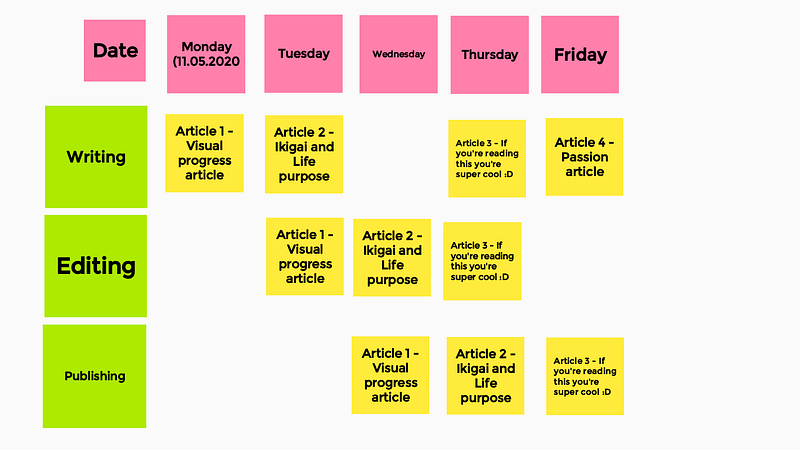
As you can see, on the vertical axis I have the different parts of writing that I need to perform in green, and on the horizontal axis in pink, I’ve got the days at which each article needs to be done at the given stage.
This one is quite specific as I detail out the different aspects of getting an article from my head out to the world, but you could make it a lot broader, creating green post its with “reaching out to companies for writing opportunities”, “writing and publishing”, and “emailing leads to get coaching clients”. You choose and then create yellow post-its according to the details that need to get done.
Tracking your personal development
Sometimes it can be hard to “define” progress when it comes to personal growth. I’m actually curious, how would you measure personal growth?
Nevertheless, it’s still crucial to define something that you can measure in order to determine if growth is happening or not. One of the most common aspects that people choose to measure here is by using habits.
Enter: The habit tracking calendar
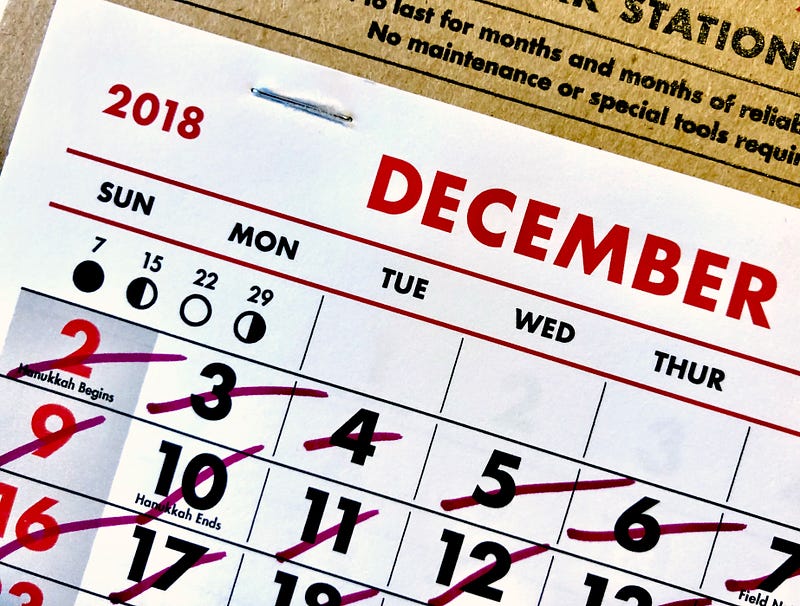
Let’s take the habit of creating the habit of daily exercise; defining exercise as any physical activity which produces sweat (make your definition). The idea is to create the habit of exercising regularly which you can check off the calendar every time you do it.
It works very well when you have a physical calendar in which you can write a big check mark each day to indicate that you’ve done the habit, as this visually creates momentum in your mind. The crucial part is to create a chain of check marks that you don’t want to break.
I suggest starting with a 30-day challenge because then you can see how it makes you feel and gradually changing and adapting the difficulty along the way.
If you get a friend to do the challenge with you, then you’re even more likely to stick with it because they’ll keep you accountable. This is when you really start creating kickass habits.
The backbone of motivation
Know your “why”
Now you know a couple of tips and techniques which can be implemented to organize your life and progress more clearly, but such tools are only the surface level of great performance.
The reason for the above statement is because visual progress is a type of external motivation. And unfortunately, internal motivation is what needs to be clear before these can make a significant impact. So I simply ask you to reflect on the following question when embarking on your new habits and workflows:
Are your current beliefs and goals aligned with your work and mission in life?
To wrap up, I highly encourage you to try out these techniques to represent your work and life progress more visually. It’s one of the best and most consistent ways of driving my motivation over the long term when I align them with my mission and goals.
To learn more and stay up to date, why not be email friends here :)


