
How to Improve Your Mental Health Playing the Bagpipes
Bagpipes are vilified the world over. Delve into their secret life, however, and discover an unusual therapy…
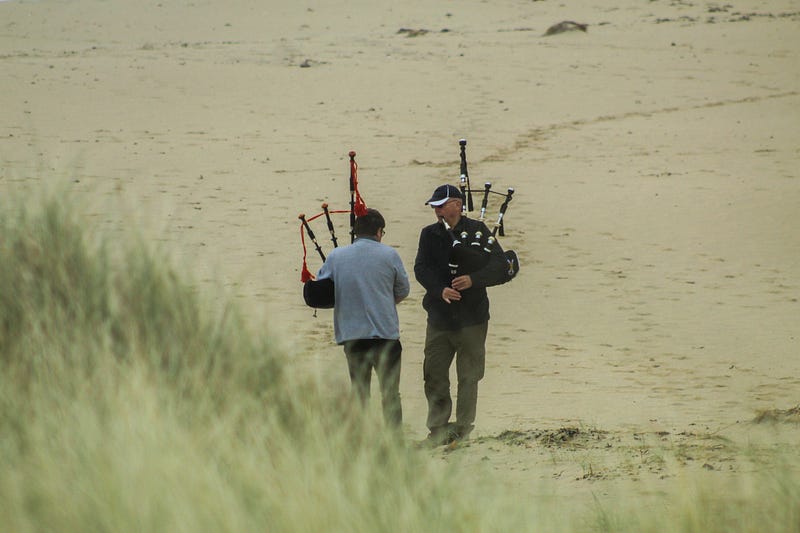
When I took up the bagpipes at the age of thirteen, a pianist friend asked me why I wanted to learn an instrument that sounded like a vixen on heat being attacked by an octopus.
I have spent my life rebutting such opprobrium. There is a famous joke that the definition of a gentleman is someone who knows how to play the bagpipes and doesn’t. You only need to Google quotes about bagpipes to see that, from William Shakespeare to Jane Austen to Alfred Hitchcock, they are held in contempt.
How could the bagpipes possibly be good for mental health?
Superficially, it’s easy to see why bagpipes and mental health might not be bedfellows. The Great Highland Bagpipes (the well-known Scottish ones beloved of pipe bands), at least, are noisy, have only one dynamic — LOUD — and a mere nine notes based on a pentatonic scale with a flattened low G. The drone accompaniment is monotonous. The repertoire of marches and “light music” limited.
Why, then, would anyone begin to suggest that playing the bagpipes might be good for mental health? Surely playing such an instrument would be likely to agitate, rather than soothe, the mind? Depress, rather than uplift, the spirits?
Well, think again. As a preliminary, The Great Highland Bagpipes are not the only form of pipe. There are many others from all around the world, including the Irish uilleann pipes which have two octaves, can be keyed up to achieve a full chromatic scale, and are an indoor instrument. Anyone who has watched Riverdance will have seen the wonderful uilleann pipes in action.
For myself, these days I play the Scottish smallpipes, again an indoor instrument blown with bellows rather than a mouthpiece, but the chanter work is based upon the Great Highland Bagpipes chanter. A video of me playing my Scottish smallpipes with my friend Peter is linked below.
The musical focus of the Scottish smallpipes
The Scottish smallpipes are nice and quiet, and a joy to play. When you are learning you are indeed reminiscent of an octopus as you negotiate the bellows with one arm and the bag with another. It’s a battle of wills.
The first point to be made here is that, when you are playing the pipes, as with any musical instrument, you are focussed on the music and the technique, so it takes your mind off your troubles. It gives you a focus on striving for musical Nirvana rather then the grime and stress of your daily circumstances. For a time, it is a cooling bathe in an oasis of calm in a world of concern.
The second point is that the monotonous droning and the single dynamic and the limited range actually works in favour of improving one’s mental health. When you tune in and ultimately surrender to the beauty of the instrument you are transported to a world of soothing, mesmerising hypnotic effect. The popping and rippling effects of the grace-notes simply adds to that mix.
Listening to the Scottish smallpipes is a massage for the mind. Rather than agitating, it relaxes. Rather than upsetting, it soothes. Lie back, relax and let those mental muscles unwind…
Whenever I feel anxious or a little unbalanced, I strap on my pipes and play for twenty minutes, focussing in on the drones and the clipping of the grace notes, and soon all is right with the world again. I don’t need to phone my psychiatrist, I don’t get anxious that I should perhaps be upping my medication. I just play. Everything snaps back into balance.
The repertoire is broader than you think
Finally, it’s not true that the bagpipes repertoire is superficial or limited. There is a very wide range of marches, strathspeys, reels, slow airs, hornpipes and jigs to choose from. But if that weren’t enough, there is a more intellectual canon of work called Piobaireachd (or Scottish laments to Sassenachs — pronounced pee-broch) which is really the classical music of the Scottish bagpipes. It was, after all one Piobaireachd called Lament for the Children which was hailed as the finest single-line melody in the entire canon of Western music.
As with much classical music, the appreciation of Piobaireachd takes time and commitment, but in my view the theme tunes of many Piobaireachd are some of the most beautiful melodies known to man.
Piobaireachd has enriched my soul musically, spiritually and intellectually. Anyone who is interested should Google up a rendition Lament for the Earl of Antrim, or the Battle of Auldearn, or Lament for MacSwan of Roaig. How can you fail to be moved?
A more distressing Piobaireachd, though, perhaps best to be avoided in the early stages, is A Flame of Wrath for Squinting Patrick where, the composer, having lost his son in a skirmish with a neighbouring clan, burned down their village and played A Flame of Wrath as he walked round and round the village walls as its inhabitants were consumed by the flames.
It’s extremely agitating, designed to unbalance rather than soothe.
This, of course, raises an important point. If Piobaireachd is all about murder and death and is unapologetically “sad”, how can it possibly be good for mental health? Well, when playing, you can of course disassociate yourself from the story behind the Piobaireachd and concentrate on the musicality, execution and phrasing. I have never found a difficulty with that.
Furthermore, there are plenty of jolly, uplifting Piobaireachd, such as all those “Salutes” like Salute to the Little Waterfall which nimbly describes and simulates the sound of a waterfall cascading downwards in spate. The Bells of Perth (the same thing for the Bells of Perth) and Scarce o’ Fishing (a eulogy on fishing) are other pleasing Piobaireachds that don’t focus on death and destruction.
Lockdown piper
Ten years ago, partly as a function of my bipolar, I gave up the bagpipes. I was persuaded to take them up again at the beginning of Lockdown by Peter, a very good friend of mine, who is a doctor but also happens to be a top piper. To my surprise, the weekly Zoom coaching sessions with Peter fitted me like a glove, and I soon found the pipes helped my illness rather than hindered it.
I practised and practised, and all that practice helped to give structure to my day.
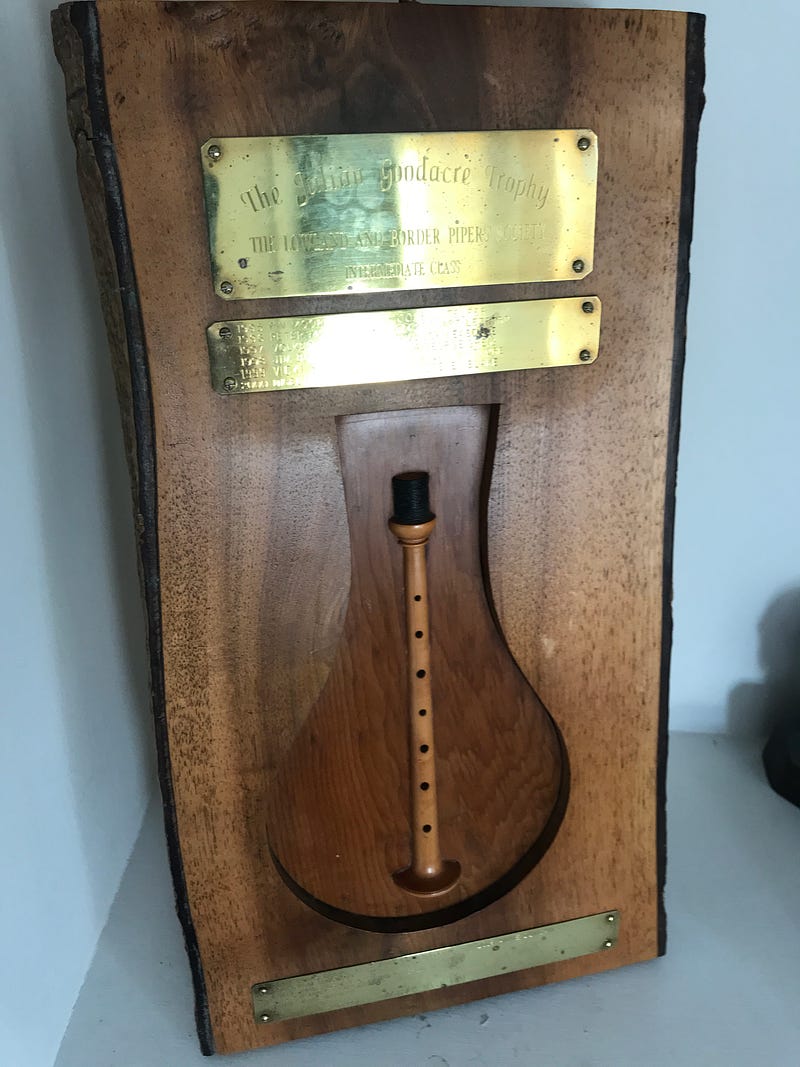
Eventually, a few weeks ago, I won three classes — Intermediate, Duet and Pipes and Song — in the 2022 Lowland and Border Pipers’ Society Annual Meet in Linlithgow near Edinburgh. A video of Peter and I playing in the Duet competition on the Scottish smallpipes is set out at the end of this paragraph (note the bellows). These pipes are typically played sitting down but can also be played standing up, as here.
That triumph, too, was excellent for my mental health. It gave me a sense of purpose, confidence and ultimately accomplishment and success. A picture of my Intermediate trophy can be seen at the end of this article.
Anyone who says playing the bagpipes would necessarily be detrimental to mental health doesn’t know the instrument well. Contrary to being an aural demon to whisk up dissent and agitation, if applied wisely it is instead a balm for the soul.
Beyond that, it is also a spur to socialising and camaraderie. Speaking for myself, after the traumas of my illness I really needed taking out of my shell; and bagpiping served as a catalyst for that.
It’s my opinion that anyone who likes music, is intrigued by the mesmeric joy of monotonous droning, the vague eccentricity of the piping fraternity, and thinks they might eventually come to love the intellectual rigours of Piobaireachd could do worse than take up the Scottish smallpipes. It will give you discipline, structure, a balm to your mind, a spring in your step and hope to your soul.
And one day, it might even earn you a trophy like this:
Get skirling, and soothing…!
Anyone with a burning interest in reading more about my interactions with bagpipes could do worse to order my book ADVENTURES IN BAGPIPING, available on Amazon on Kindle or in paperback.