
To Be a Great Leader You Must Know Yourself
Increase your self-awareness and learn how to be a better leader

“Knowing yourself is the beginning of all wisdom.” — Aristotle
Self-knowledge and self-reflection are paramount in taking your leadership to the next level.
Leadership training and leadership articles often focus on knowing your leadership style. Do you have a transactional leadership style or a situational?
Secondly, they focus on knowing your team members. What are their communication preferences? How do you influence them? How do you grow them? How do you motivate them?
What is missing is the part where you understand yourself. How well do you know yourself?
What are your strengths and preferences?
What is your natural communication style?
Your natural influencing strategy?
To be a great leader, you need to know yourself well enough to compensate for your weaknesses and to promote your strengths. Not all leaders have to be the same and not everyone needs to have the same style.
The question is, do you know yourself? Do you know who you are as a leader?
1. Using Johari’s Window for insights
In 1955 psychologists Joseph Luft and Harrington Ingham developed the technique of the Johari window as a tool for understanding communication within groups. Since then it has become a tool for leadership development, self-development, organizational development, and communication training and is still considered a strong tool for reflective practice.
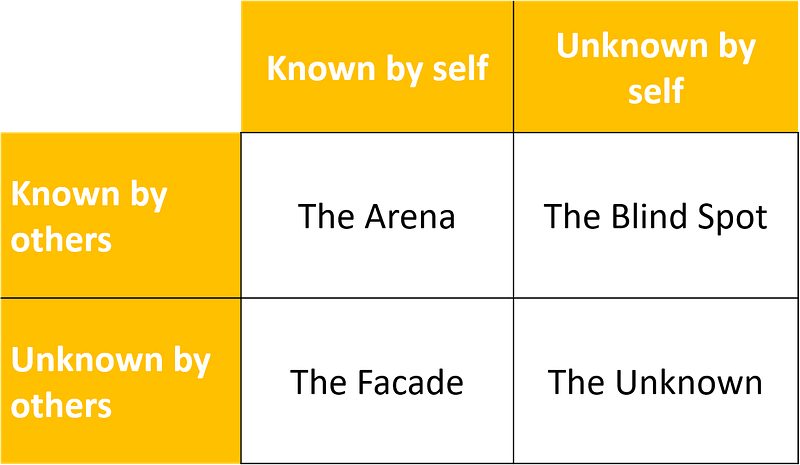
The idea of the Johari window is that we can see ourselves and each other from four different perspectives and thus the window is divided into four quadrants:
- The Arena. The area that is open to ourselves and others. This is what we consciously share with other people. The skills and traits we know we have and that others recognize in us.
- The Facade. This is what we consciously (to some degree) hide from others. Our secrets, hopes, and dreams and the things we want but do not want to share with others.
- The Blindspot. This is what other people see and know about you, but you are not aware of yourself. This is the most important area for you to explore to grow as a leader.
- The Unknow. This is not known to you or others. These are your inner traumas or skills, that have not yet seen the light of day.
The most important idea of the Johari window is working on shrinking your blind spot. You will find weaknesses and sometimes even strengths that you are not using to the fullest potential.
Growing your Arena opens new opportunities and new tools to grow as a leader.
“Knowing your own darkness is the best method for dealing with the darkness of other people.” — Carl Jung
So how do you get to know your blind spot?
Get Feedback. Get tons of feedback and learn to take that feedback in.
The behaviors to implement:
- Ask for feedback when you have completed an assignment and listen with an open mind! Remember you don’t need to act on all feedback, so listen, reflect, and learn.
- Notice what people are saying to you, that you may not recognize as feedback. For instance, what are your children communicating to you that you may not be picking up on? Or your Spouse? What jokes are your friends or colleagues saying about you?
- Send out an annual survey to co-workers, managers, and peers and ask them for feedback. (You can get the one I use for free here)
2. Take a personality test and reflect on the result
“We do not learn from experience. We learn from reflecting on experience.” — John Dewey
I find personality tests to be immensely fun and useful. Both for my development but also as a tool for team building.
I know a lot of people who dislike personality tests and they find that it puts them in a category that they cannot get out of or that will define their behavior. You don’t have to take them that seriously, but instead, use them as contextual dependent input for your reflection.
I have taken the Meyers Briggs test a few times over the years with slightly different results every time as I grow and work on myself. (I have used 16 Personalities’ free test — no affiliation to them by the way).
Taking that test, I am an ENTJ if you want to know, has given me great insight into my personality and how that affects the way I conduct myself at work.
The first time I took this test, probably 15 years ago I was a little taken aback about my strong prevalence of thinking and less so emotional. I did not find that correct at all. I am a pretty sensitive guy and have always been good at relating to people and to be empathetic.
But when it comes to working it is pretty accurate. I tend to focus on the subject matter to a degree where I (At least in the early days of my career) sometimes forgot to take care of the people side of collaboration.
I still have to consciously remind myself to do a little more small talk and get to know people for more than their skills and that sometimes the rational arguments are not enough to move the agenda. You have to have the PEOPLE with you along the way.
Ok, I was sidetracked a bit.
What is important to know is that many personality tests, Meyers Briggs included, tend to be contextual. Meaning you will answer from the context that you are in when taking the test. E.g. relating to your work personality. That does not mean that you are completely that way in all aspects of life.
We continue to shape our personality all our life. If we knew ourselves perfectly, we should die. — Albert Camus
Secondly. These are not either one or the other. They are scales. The first E means I am an extrovert. That is true. But I am a very moderate extrovert. I have a strong introverted side as well and enjoy and recharge from spending time in my own company and doing e.g. writing.
What you need to reflect on is how does your personality type influence the way you lead?
Are you using all tools available to you or are you limited by your personality type?
The behaviors to implement:
Take a personality test and reflect on the result
- What does this mean for your management style?
- How does the result mean for your communication style?
- What do you like about your profile?
- What do you dislike? and how can you work on mellowing that out?
- Discuss your personality result with a friend and a co-worker. What do they think about your result? Is that accurate? What does that mean to them?
- Do it annually to prepare for your Development conversation and do different ones. Check-in with your manager and get his/her perspective on your result.
Summary
Teaching yourself to reflect on your leadership practices and how your personality influences your leadership style can vastly improve your results as a leader.
Getting feedback and reflecting on your Blind Spot can bring you new knowledge even epiphanies when lucky and help you take your leadership to the next level.
Still worth to remember:
Always be yourself, express yourself, have faith in yourself, do not go out and look for a successful personality and duplicate it. — Bruce Lee
And lastly, just because I love that quote
Try not to become a man of success, but rather try to become a man of value. — Albert Einstein
Thanks for reading, I hope you enjoyed it. Let me know what you think and if you are interested you can download the free “Annual Leadership Reflection” form.
This may also interest you: