
How to implement real-time integrations using streaming technologies?
In today’s digital world, organizations are generating and collecting vast amounts of data at an unprecedented rate, with the increasing need of managing this data Realy-time. Real-time data integration is the process of collecting, storing, and analyzing this data in a timely manner to make informed decisions. The importance of real-time data integration is evident in various industries such as finance, healthcare, e-commerce, and manufacturing. As businesses look to gain a competitive edge, the ability to make data-driven decisions in real-time is becoming a crucial aspect of any business strategy. Streaming technologies play a vital role in solving the problem of real-time data integration by providing a way to handle large volumes of data and process it in real-time. Streaming technologies such as message queues, publish-subscribe systems, and stream processing frameworks allow organizations to collect, store and process data in real-time, making it possible to make informed decisions on the fly.
Types of streaming technologies
There are several types of streaming technologies that organizations can use to solve the problem of real-time data integration.
Message queues, also known as message-oriented middleware, are systems that allow for the asynchronous exchange of messages between systems. This type of technology is useful for decoupling systems and ensuring that data is processed in a reliable and consistent manner.
Publish-subscribe systems, also known as event-driven architectures, allow for the distribution of data to multiple systems or consumers based on certain criteria. These systems are useful for scenarios where multiple systems need to receive and process the same data in real-time.
Stream processing frameworks, such as Apache Kafka and Apache Storm, provide a way to process and analyze large volumes of data in real-time. These frameworks provide a way to perform complex data processing tasks such as filtering, transformation, and aggregation on streaming data.
Real Time Integration Use Cases
Real-time data integration has a wide range of applications across various industries.
In the finance industry, real-time data integration is used to monitor and analyze financial transactions to detect fraudulent activity. For example, a bank may use streaming technologies to process transactions in real-time and flag any transactions that deviate from the expected pattern. This allows the bank to take immediate action and prevent possible fraudulent activity.
In the healthcare industry, streaming technologies can be used to monitor patients’ health and provide early warning of potential health issues. For example, a hospital may use real-time data integration to process patient vital signs in real-time and flag any signs of distress. This allows the hospital to provide timely medical attention and prevent serious health issues.
In the e-commerce industry, real-time data integration is used to track customer behavior and personalize the shopping experience. For example, a retail company may use streaming technologies to process customer data in real-time and provide personalized recommendations to customers. This allows the retail company to increase customer engagement and boost sales.
In the transportation industry, real-time data integration is used to monitor the location, speed and maintenance status of vehicles in real-time. For example, a trucking company may use streaming technologies to track the location and speed of their vehicles in real-time, and also monitor the maintenance status of the vehicles. This allows the trucking company to optimize routes, reduce fuel consumption, and avoid breakdowns.
Additionally, in the energy industry, real-time data integration is used to monitor and control the power grid. For example, power companies use streaming technologies to process sensor data from power plants and substations in real-time. This allows them to detect and prevent power outages, control the flow of power, and optimize the use of renewable energy sources.
In the manufacturing industry, real-time data integration is used to monitor and control the production line. For example, factories use streaming technologies to process sensor data from machines in real-time. This allows them to detect and prevent equipment failures, optimize production, and reduce downtime.
In the smart city industry, real-time data integration is used to monitor and control the city infrastructure. For example, cities use streaming technologies to process sensor data from traffic lights, public transportation, and public services in real-time. This allows them to optimize traffic flow, reduce energy consumption, and improve the quality of life for citizens.
Architecture
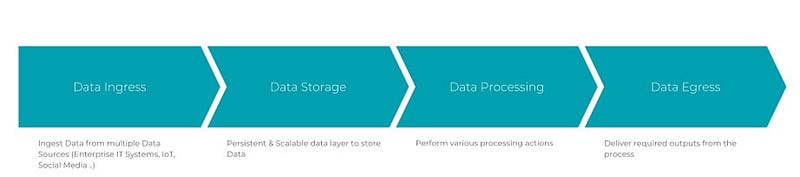
A streaming data integration architecture typically consists of several key components that work together to collect, store, and process data in real-time. The first component is the data sources, which can include various types of data such as sensor data, social media data, and transactional data. Data ingress (or Data Ingestion) is the process of collecting data from these sources and bringing it into the system. This can be done using a variety of techniques such as APIs, connectors, and data collectors. Data ingress typically includes steps such as data validation, data filtering, and data transformation to ensure that the data is in the correct format and meets certain quality standards before it enters the system.
Once the data is ingressed (or ingested), it is typically stored in a data storage component, such as a distributed database or a data lake. This component is responsible for providing a scalable and reliable way to store large volumes of data. The data storage component can also be used to perform data retention and archiving policies.
The data processing component is responsible for performing various types of data processing tasks on the data, such as filtering, transformation, and aggregation. This can be done using a variety of techniques such as stream processing frameworks, data pipelines, and complex event processing (CEP) systems. The data processing component can also be used to perform real-time analytics and machine learning tasks.
Finally, the data egress component is responsible for delivering the processed data to the appropriate systems and applications. This can be done using a variety of techniques such as APIs, connectors, and data collectors.
An important aspect of a streaming data integration architecture is its ability to handle large volumes of data, handle real-time data quality, and ensure data consistency. The architecture should also be flexible and extensible to allow for new data sources and processing tasks to be added easily.
Data Processing
Data processing is a crucial step in a streaming data integration architecture, as it allows to extract value from the data they collect. There are several types of data processing tasks that can be performed on streaming data, including filtering, transformation, and aggregation.
Filtering is the process of removing unwanted data from the stream. This can be done based on certain criteria such as data quality, data relevance, or data security. For example, an organization may filter out data that does not meet certain quality standards or data that is not relevant to the business.
Transformation is the process of converting the data from one format to another. This can be done to ensure that the data is in the correct format for further processing or to enable integration with other systems. For example, an organization may transform sensor data from a proprietary format to a standard format such as JSON or XML.
Aggregation is the process of combining multiple data points into a single value. This can be done to perform real-time analytics and gain insights from the data. For example, an organization may aggregate sensor data to calculate the average temperature or the total number of events in a given time period.
Another important aspect of data processing is the ability to perform complex data processing tasks, such as machine learning and real-time analytics. Machine learning tasks can be used to perform tasks such as anomaly detection, predictive maintenance, and customer segmentation. Real-time analytics can be used to gain insights from the data and make data-driven decisions in real-time.
In addition, it’s also important to consider the scalability and fault tolerance of data processing systems. Streaming data integration architecture should be able to handle large volumes of data, and be able to process it in real-time. This can be achieved by using distributed processing frameworks, such as Apache Kafka, Apache Storm, and Apache Flink, which provide a way to scale out the data processing tasks across multiple machines.
In sum, data processing is a crucial step in a streaming data integration architecture, as it allows organizations to extract value from the data they collect and make data-driven decisions in real-time. By filtering, transforming, and aggregating data, organizations can gain insights and perform complex data processing tasks such as machine learning and real-time analytics on streaming data.
Challenges
Data Integration in real-time usging stream techniques face some key challenges when implementing it, among them:
Handling high volumes of data: Streaming data integration architectures need to be able to handle large volumes of data, and process it in real-time. This requires scalable and fault-tolerant systems that can handle high throughput and low latency.
Real-time data quality: Ensuring the quality of data in real-time is a challenging task. Organizations need to implement data validation and filtering mechanisms to ensure that only accurate and relevant data is processed.
Data consistency: Maintaining data consistency across different systems and applications is a challenging task. Organizations need to ensure that the data is consistent across all systems and applications, and that any updates are propagated in real-time.
Security and Privacy: Real-time data integration architectures need to be secure and protect the privacy of data. This includes ensuring that data is encrypted both at rest and in transit, as well as implementing access control mechanisms to ensure that only authorized users can access the data.
Integration with existing systems: Integrating real-time data integration architectures with existing systems can be a challenging task. Organizations need to ensure that the data is in the correct format and that the existing systems are able to consume the data.
Managing complexity: As the number of data sources and processing tasks increases, the complexity of the architecture also increases. Organizations need to ensure that the architecture is easy to understand, maintain, and extend.
Managing costs: Real-time data integration architectures require significant resources and infrastructure. Organizations need to ensure that the architecture is cost-effective and can be scaled up or down as needed.
Conclusion
In conclusion, real-time data integration is the process of collecting, storing, and analyzing large volumes of data in a timely manner to make informed decisions. Streaming technologies, such as message queues, publish-subscribe systems, and stream processing frameworks, play a vital role in solving the problem of real-time data integration. These technologies allow organizations to collect, store and process data in real-time, making it possible to make informed decisions on the fly.
Real-time data integration has a wide range of applications across various industries, such as finance, healthcare, e-commerce, transportation, energy, manufacturing, and smart cities. It allows organizations to improve efficiency, reduce costs, and increase revenue by making data-driven decisions in real-time.
However, implementing real-time data integration is not without its challenges. Organizations need to handle high volumes of data, ensure real-time data quality, maintain data consistency, ensure security and privacy, integrate with existing systems, manage complexity and costs.
Real-time data integration is like a conveyor belt
To put it simply, real-time data integration is like a conveyor belt in a factory, where raw materials are collected, processed, and then delivered to the end user. Similarly, real-time data integration collects data from various sources, processes it and then delivers it to the systems and applications that need it in real-time. This allows organizations to make data-driven decisions and optimize their operations.
If you want to learn more about Data Integration, feel free to follow this Udemy course or read the Data Integration Guide!
Originally published at https://dataintegrationguide.com on January 22, 2023.


