AI-Generated text detection
How to Identify chatGPT stories?
FREE Output Detector Demo

🟣 How to Detect OpenAI’s ChatGPT Output
As an editor of a few publications, I don’t need a detector to alert me when an article contains GPT-generated text. I can feel it immediately, Yes, I have a sixth sense ; )
⚪️ online DETECTOR
🟣 How to identify GPT generated AI text content in easy way
Here are some editor secrets on how to recognise generated text:
One way to spot fake AI-generated stories is to look for telltale signs of machine-generated text, such as:
- repetition of phrases,
- lack of detail,
- absence of realistic human emotion
Another option is to read the story carefully and compare it to other stories on the same topic to see if there are inconsistencies or factual errors. You can also run the story through a plagiarism checker to see if it matches existing content. In addition, check the information in the story against other sources.
textGPT Detector
Texts generated in this way contain a lot of mistakes, GPT3 allows you to set the temperature of the text, but chatGPT has no such possibility — it often creates “imagined” facts. The ideal author for Data-Driven Fiction!
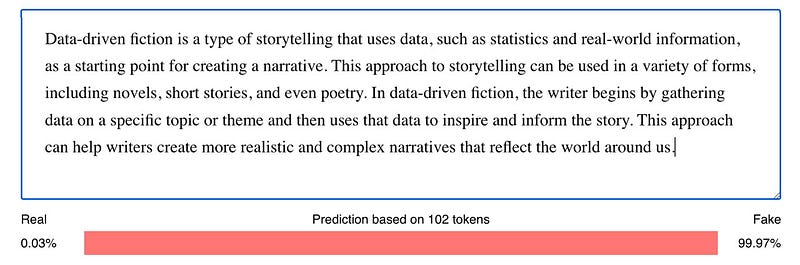
Contrary to rumors, detector GPT detects text generated by textGPT well
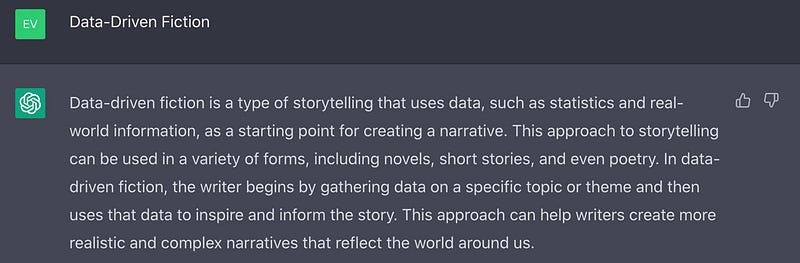
Unfortunately, the detectors are often wrong. Since 2019, there has been a lot of AI-generated content that has “contaminated” the training datasets. Just like in real life, the difference between fake and real content blurs.
It’s worth trusting your common sense. As a publications editor, I take a broader view of the LLM (Large language models) issue. Before publishing a submitted article, it is worth screening the author of the text. For the past two weeks, I have observed busy authors who publish several daily stories. The stories have very regular editing. One could say they are ideal. You can’t accuse them of anything — just as perfect as chatGPT!
This is the best detector; the perfect text cannot be written by a human. We are not perfect, unlike machines.
Using statistics to prove the level of confidence | CODE
In summary, you can identify texts produced by the GPT with a detector or by their layout and writing style. But in the end, it does not matter who or what wrote the text.
What matters is how well it satisfies our informational, entertainment, and emotional needs.
Yes, I publish articles by authors who use GPT, but one condition must be met: What value are you giving your readers?
🟣 These AI tools dramatically increase your productivity
HERE an online demo of the GPT-2 output detector model,