avatarIndra Raj Pathak

Free AI web copilot to create summaries, insights and extended knowledge, download it at here

3621

Abstract

id="da39" type="7">“These skills are critical for success in all life’s aspects and are sometimes more predictive than even IQ or socioeconomic status. Understandably, there is great interest in improving Efs.”</p><p id="0710" type="7">“They can be improved at any age through training and practice, much as physical exercise hones physical fitness.”</p><h1 id="91ca">Development of Skills with Age</h1><figure id="8e1c"><img src="https://cdn-images-1.readmedium.com/v2/resize:fit:800/0*2syNLcFHafu65YPA"><figcaption>Photo by <a href="https://unsplash.com/@anniespratt?utm_source=medium&amp;utm_medium=referral">Annie Spratt</a> on <a href="https://unsplash.com?utm_source=medium&amp;utm_medium=referral">Unsplash</a></figcaption></figure><p id="b7de">Working memory and shyness control that develops reasoning and problem-solving are among the earliest executive functions to come to light, with first signs observed in infants, 7 to 12-months old.</p><p id="937d">Then in preschool years, children open out advance in performing tasks of restraint and working memory, usually between the ages of 3 and 5 years.</p><blockquote id="ff29"><p>During this time thought flexibility, goal-directed behavior, and planning begin to develop.</p></blockquote><p id="fb7c">In preadolescence, children show marked increases in:</p><p id="f93c" type="7">Verbal Working Memory.</p><p id="cb60" type="7">Goal-directed Behavior (with a possible increase around 12 years of age).</p><p id="271c" type="7">Response Restraint and Selective Attention.</p><p id="c487" type="7">Tactical Planning and Organizational Skills.</p><blockquote id="ef1e"><p>In adolescence, functions such as attention control( with a possible increase at age 15), along with working memory, continue developing at this stage.</p></blockquote><h1 id="1713">Strengthen in Formative Years</h1><figure id="13ea"><img src="https://cdn-images-1.readmedium.com/v2/resize:fit:800/1*sjUNjkIepecVvS1J-SbPvg.jpeg"><figcaption></figcaption></figure><p id="18a9" type="7">Researchers have found that uplifting of Executive Functions early in life promise lifelong achievement, health, wealth, and quality of life.</p><blockquote id="5bc5"><p>It’s important to help young children have good executive functioning.</p></blockquote><p id="92b2">Here, we talk about seven specific practice models to raise Children’s Executive Functions:</p><figure id="7736"><img src="https://cdn-images-1.readmedium.com/v2/resize:fit:800/1*b55EzUF8uTlfB9Ayl173Ng.jpeg"><figcaption></figcaption></figure><p id="5fb2"><b>1. Thought flexibility:</b></p><p id="29de">We know this is also a reversal, within dimension switching or shifting.</p><p id="1c68"><a href="http://www.progressiveschool.in/boosting-childrens-7-executive-functions/">For example, in Task 1 –one might press left for peacock and right for tiger. While in Task 2 that would be reversed. And one would press right for peacock and left for tiger. Children of 2 years of age can perform these tasks.</a></p><p id="5290" type="7">Thought flexibility allows being flexible enough to adjust to changing demands or priorities, to admit for being wrong, and to take advantage of sudden, unexpected opportunities.</p><p id="eec0"><b>2. Attention control:</b></p><p id="5e0f">There is a turn of mind to continue to focus attention on what had been suited. Errors seem to occur due to difficulty in turning off previous learning.</p><p id="2b60" type="7">Children of three years old can correctly sort out by either color or shape. But they can not control previous attention despite knowing the difference between shape and color. Once a c

Options

hild of three has focused on color. It is difficult for the child to change the mindset and focus on its shape.</p><p id="9ae8"><b>3.Self- regulation:</b></p><p id="9df1">This gives us power to turn down the lure and stop doing without thinking. It is the form of inhibitory control that checks behavior and emotions.</p><p id="b6aa"><a href="https://zh.wikipedia.org/wiki/%E8%87%AA%E6%88%91%E7%AE%A1%E7%90%86">Self-regulation empowers to stay on task despite distractions and complete a task despite temptations to give up, to move on to more interesting work, or to have a good time instead.</a></p><p id="24a1"><b>4.Organizing skill:</b></p><p id="73d0">This is a skill to set the task that one needs to do by time and manner. One must understand the requirements of a task to get them organized.</p><blockquote id="f802"><p>When teens are disorganized, they can get overpowered by the school. Many classes, time limits, and assignments in middle and high school can be hard to manage.</p></blockquote><p id="0024">Learning organization tactics, teens can be more capable and confident.</p><p id="32a3"><b>5. Working Memory:</b></p><p id="a2a4">Working Memory functions by holding information in mind and mentally working with it. We find two types of Working Memory (WM) by content — verbal WM and nonverbal WM.</p><p id="b6cf" type="7">WM is decisive for making sense of anything that happens over time, for that always requires holding in mind what happened earlier and relating that to what comes later.</p><p id="c52d"><b>6. Planning and problem solving:</b></p><p id="6601">Problem-solving framework works in different phases such as to</p><p id="715f" type="7">(a) represent a problem,</p><p id="7788" type="7">(b) plan for a solution by selecting and ordering strategies,</p><p id="2c51" type="7">( c) maintain the strategies in short-term memory to perform them by certain rules, and then</p><p id="f5b1" type="7">(d) test the results with error detection and error correction.</p><p id="6693"><b>7. Comparative reasoning power:</b></p><p id="2183">Comparative reasoning is first to human thought. It plays a key role in a wide range of problem-solving.</p><p id="a36e" type="7">Reasoning in adolescence is markedly important because this is the period when adolescents face their most complex learning time at school.</p><figure id="197e"><img src="https://cdn-images-1.readmedium.com/v2/resize:fit:800/0*1KONXLrHfV86OSGa"><figcaption>Photo by <a href="https://unsplash.com/@allentaylorjr?utm_source=medium&amp;utm_medium=referral">Allen Taylor</a> on <a href="https://unsplash.com?utm_source=medium&amp;utm_medium=referral">Unsplash</a></figcaption></figure><p id="88b0">If you want to help your child to achieve the desired goal.</p><p id="f1c4">You can’t wait for the next research to further verify. Act fast.</p><p id="7451">You can’t just put your son into a good school and hope for him to succeed.</p><p id="3fdf">Parenting isn’t about leaving your child on others. It is about working to make sure that your child is moving towards a goal.</p><p id="ec8c">That means spending one hour daily with no excuse for your child.</p><p id="a405">That means using one of the above models instead of all at the same time for your child.</p><p id="1635" type="7">Help your child to practice each model for three weeks and look at improvement. Then pick another cycle or include all for daily practice. Exercise tools for each model suitable to the age group are easy to find on the internet.</p><p id="c142"><b>Hope more. Worry less.</b></p><p id="dee0"><b>Gain something. Lose nothing.</b></p></article></body>

How to Help Your Child to be An Amazing Goal Achiever

Not Destiny, You can turn your Dream to reality

Photo by Ben White on Unsplash

We’ve all been there…

You’ve carefully acted upon teachers’ advice.

You’ve done everything you could. You’ve shaken your brain for the very best career option.

You wait for the best with true hope. That’s done.

But when you look at your son’s achievements. You notice that it isn’t as good as you’d hoped, and his success graph is hardly praising. It’s depressing.

Does it feel like a big challenge to help your child to be a goal achiever?

It doesn’t need to be so hard. You’re about to learn the most important advice. I’ve found for nurturing the children to be caring, capable, goal achiever and responsible future citizens.

I have worked in schools several years among children and attended parents with a dream peeping through eyes for their wards. That is to see them at the top. Then I used to advise them to get the best teaching and learning facilities. But I admit the truth. Till then I was least conscious about the role of specific brain training of children despite knowing it a psychological concept.

We have gathered so much knowledge from child psychology and other branches of studies about the mental development of a baby to becoming a man.

But hardly we apply that knowledge to bring up our children.

Role of Brain Functions

Photo by Holger Link on Unsplash

The study reports that we get to know from time to time to improve brain functions. They do not match with one another. Because Human Psychology is not a positive science like Physics and Chemistry.

But the facts that a genuine study proves, we need to put them into practice to take benefit out of it.

The brain gains knowledge and experience which works through various processes and Executive Functions.

What are Executive Functions?

Executive Functions are skills required for mental and physical health, success in school and life, and intellectual, social, and psychological development.

We also call them executive control or cognitive control. Some mark out executive control as the CEO of the brain. Only one who is planning and achieving the goal or performing tasks.

“The ‘Executive Functions’ (EFs) of inhibitory control, working memory, and cognitive flexibility enable us to think before we act, resist temptations or impulsive reactions, stay focused, reason, problem-solve, flexibly adjust to changing demands or priorities, and see things from new perspectives.”

“These skills are critical for success in all life’s aspects and are sometimes more predictive than even IQ or socioeconomic status. Understandably, there is great interest in improving Efs.”

“They can be improved at any age through training and practice, much as physical exercise hones physical fitness.”

Development of Skills with Age
Photo by Annie Spratt on Unsplash

Working memory and shyness control that develops reasoning and problem-solving are among the earliest executive functions to come to light, with first signs observed in infants, 7 to 12-months old.

Then in preschool years, children open out advance in performing tasks of restraint and working memory, usually between the ages of 3 and 5 years.

During this time thought flexibility, goal-directed behavior, and planning begin to develop.

In preadolescence, children show marked increases in:

Verbal Working Memory.

Goal-directed Behavior (with a possible increase around 12 years of age).

Response Restraint and Selective Attention.

Tactical Planning and Organizational Skills.

In adolescence, functions such as attention control( with a possible increase at age 15), along with working memory, continue developing at this stage.

Strengthen in Formative Years

Researchers have found that uplifting of Executive Functions early in life promise lifelong achievement, health, wealth, and quality of life.

It’s important to help young children have good executive functioning.

Here, we talk about seven specific practice models to raise Children’s Executive Functions:
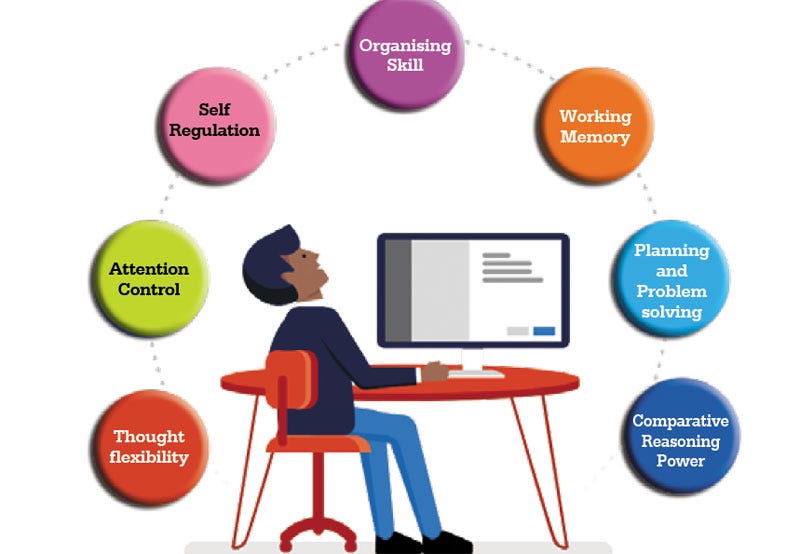
1. Thought flexibility:

We know this is also a reversal, within dimension switching or shifting.

For example, in Task 1 –one might press left for peacock and right for tiger. While in Task 2 that would be reversed. And one would press right for peacock and left for tiger. Children of 2 years of age can perform these tasks.

Thought flexibility allows being flexible enough to adjust to changing demands or priorities, to admit for being wrong, and to take advantage of sudden, unexpected opportunities.

2. Attention control:

There is a turn of mind to continue to focus attention on what had been suited. Errors seem to occur due to difficulty in turning off previous learning.

Children of three years old can correctly sort out by either color or shape. But they can not control previous attention despite knowing the difference between shape and color. Once a child of three has focused on color. It is difficult for the child to change the mindset and focus on its shape.

3.Self- regulation:

This gives us power to turn down the lure and stop doing without thinking. It is the form of inhibitory control that checks behavior and emotions.

Self-regulation empowers to stay on task despite distractions and complete a task despite temptations to give up, to move on to more interesting work, or to have a good time instead.

4.Organizing skill:

This is a skill to set the task that one needs to do by time and manner. One must understand the requirements of a task to get them organized.

When teens are disorganized, they can get overpowered by the school. Many classes, time limits, and assignments in middle and high school can be hard to manage.

Learning organization tactics, teens can be more capable and confident.

5. Working Memory:

Working Memory functions by holding information in mind and mentally working with it. We find two types of Working Memory (WM) by content — verbal WM and nonverbal WM.

WM is decisive for making sense of anything that happens over time, for that always requires holding in mind what happened earlier and relating that to what comes later.

6. Planning and problem solving:

Problem-solving framework works in different phases such as to

(a) represent a problem,

(b) plan for a solution by selecting and ordering strategies,

( c) maintain the strategies in short-term memory to perform them by certain rules, and then

(d) test the results with error detection and error correction.

7. Comparative reasoning power:

Comparative reasoning is first to human thought. It plays a key role in a wide range of problem-solving.

Reasoning in adolescence is markedly important because this is the period when adolescents face their most complex learning time at school.

Photo by Allen Taylor on Unsplash

If you want to help your child to achieve the desired goal.

You can’t wait for the next research to further verify. Act fast.

You can’t just put your son into a good school and hope for him to succeed.

Parenting isn’t about leaving your child on others. It is about working to make sure that your child is moving towards a goal.

That means spending one hour daily with no excuse for your child.

That means using one of the above models instead of all at the same time for your child.

Help your child to practice each model for three weeks and look at improvement. Then pick another cycle or include all for daily practice. Exercise tools for each model suitable to the age group are easy to find on the internet.

Hope more. Worry less.

Gain something. Lose nothing.

Education
Life Lessons
Personal Development
Parenting
Goals
Recommended from ReadMedium