
How to Have Life-Changing Insights Whenever You Want
All you need to do is get better at reading books
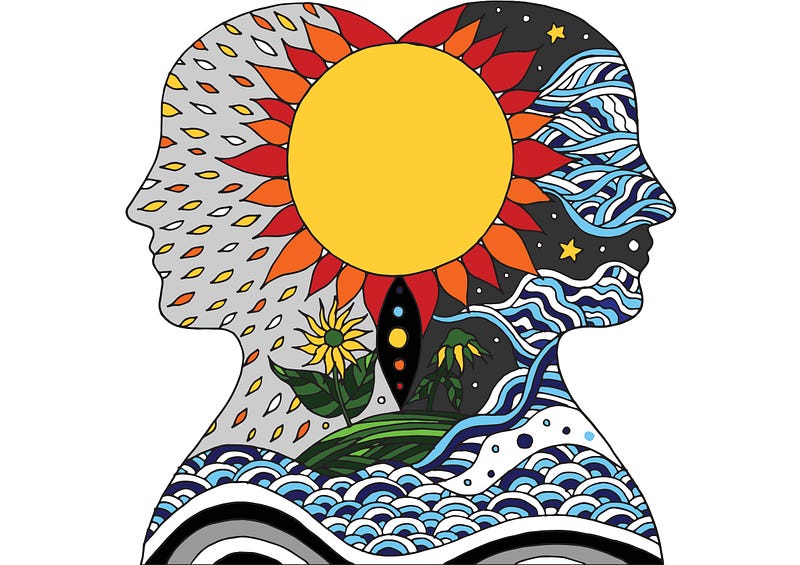
The human mind is basically a giant network.
In our minds, we know individual things. These are the nodes of our network. Then, we connect each thing we know to an uncountable amount of other things we know. Each node has thousands of connections to other nodes, forming millions of connections. All of these nodes, and the connections between them, form a network of all the things we know — our knowledge network.
If you’ve ever let your mind wander, moving from one thought to the next in an idle way, you’ve taken a joyride down your own knowledge network.
Most of the time, our knowledge network grows organically. New growth paths emerge along the edge, causing it to grow a little every day.
As we learn more about different subjects, clusters of knowledge begin to form. All the things we know about a topic, like “living in an RV,” form their own cluster. All the things we know about software engineering form another.
Then, our minds link related knowledge clusters together. “RV living” and “minimalism” are related to each other, so there are a lot of connections between them. “RV living” and “software engineering” don’t have much to do with each other, though, so they don’t have many connections. If you were to let your mind wander, it would stop at many stops between RV living and software engineering.
Insights are new connections between clusters.
An insight isn’t just any old new connection.
An insight is a new connection between two clusters that previously didn’t have anything to do with each other.
This single connection acts as a bridge, allowing dozens more to form in its wake. This instant formation of hundreds of new connections produces the heady rush of understanding accompanying an insight.
Most people think they can’t do anything to trigger insight. They think epiphanies just come out of the clear blue sky. As a result, they don’t experience insight often.
But flashes of insight are not out of your control. You don’t have to wait for them to come to you. You can teach your mind to make these connections far more often.
There’s only one thing you have to do.
Read more books — and read them right.
Every book is its own cluster of information. Each chapter, paragraph, and sentence is a new node of information.
As you read more books, you form more clusters of information. As you form more clusters of knowledge, you create more opportunities for clusters and nodes to link together.
But you have to be careful. You can’t just read books any old way. You have to read them carefully and take in what they say.
Storytime: In a past life, I was very Christian. I was a well-educated one, too; not only did I read Christian classics like C.S. Lewis and Lee Strobel, I also read books by dead guys like Saint Augustine.
Not wanting to be accused of a shallow understanding of the world, I also made a point of reading atheist works like those by The Four Horsemen of Atheism.
But none of these books, atheist or Christian, expanded my worldview even one iota.
Why? Because I read them with an agenda.
- When I read pro-Christian books, I didn’t question them. When they made a pretty-sounding argument, I accepted it uncritically.
- When I read anti-Christian books, I immediately engaged every intellectual faculty I have in refuting them.
It took me a shamefully long time to realize most people regard highly that which confirms their biases and shy away from that which does not.
So, while I may have read every book discussing Christianity that came out from 2000 to 2015, I might as well not have read any, because all they did was add to my cluster called “Christianity is right and atheism is wrong.”
You can only learn from books and form new connections if you’re reading to learn. Reading for fun, reading for specific research, and reading to satisfy an agenda all cause you to filter more information. You have fewer insights as a result.
Start reading now, because insights take time.
It takes time reading for conceptual networks of information to start forming in your head. A lot of time.
Last year, I read 82 books, and I didn’t begin to regularly feel the now-familiar rush of understanding until book 60. Now, after 120 books, I feel that rush of understanding several times per book.
A larger network of information means each book can make more connections within my knowledge network. Concepts that would have wowed me at book thirty now seem to be only a small part of a much larger picture.
The big ideas haven’t gotten any smaller, but like overlooking a city from a cliff, I now have a much better vantage point.
When I recall my life before reading, it was like I was stumbling around, drunk and blind. Thanks to books (lots and lots of books), my eyes are starting to open.
Want More Great Articles?
If you want to read more thought-provoking articles like this one, my weekly digest is just the thing for you.