avatarZen Liu

Free AI web copilot to create summaries, insights and extended knowledge, download it at here

4640

Abstract

at the target improvement?</li><li>How confident are we on these estimates?</li></ul><p id="3ca5">Once you have gone through a few rounds of open questions and allowed other SMEs to clarify, you would have a list of tasks with estimates that can be prioritized.</p><figure id="1d15"><img src="https://cdn-images-1.readmedium.com/v2/resize:fit:800/1*zLPVmvb5mRDhcXwJZMVnEA.png"><figcaption>This is an oversimplified version of RICES scoring. Refer to <a href="https://readmedium.com/experimentation-series-1-benefits-of-experimentation-for-product-development-356b2ad1209">this</a> for a more detailed version.</figcaption></figure><p id="d153"><b>(4) Align on the target & the timeline</b></p><p id="713c">Congratulations! By doing the above, you would have collaborated with your SMEs in the prioritization and alignment of targets.</p><p id="5ac1">This is why I had earlier mentioned holding off from sharing your proposed improvement targets at the initial stage. This is because , firstly, your target could be way off given that you didn’t have any of the new information that was just discussed.Secondly, as it will likely be the SMEs who will be working on these tasks, I would highly recommend letting them decide how and when to complete it. People tend to have <a href="https://er.educause.edu/blogs/2015/6/why-autonomy-is-important-for-peak-performance">better work performance and satisfaction</a> when they are given the ownership and accountability to complete tasks on their own terms.</p><p id="fc9b">However, this does NOT mean that the<a href="https://hbr.org/2021/12/when-autonomy-helps-team-performance-and-when-it-doesnt"> SMEs should have the full autonomy</a> on what/how to prioritize. This is where you, as a Product Manager, come into play. However, as PMs rarely have any authoritative power, what I would encourage you to do is to provide context from the business and/or customer perspective to rally support from SMEs towards your proposal</p><p id="7038">For example, you could say</p><blockquote id="a327"><p>“Bear in mind that this is for short-term (4–6 months) and we want to be realistic about the ROI of our effort. We should not put in too much effort/resources/$ for <task a="">, unless the benefits can be transferred to <task b=""></task></task></p></blockquote><p id="55d7">or</p><blockquote id="e943"><p>“This solution may not work for our users in South-East Asia (SEA) where a majority of them (at least 75%) do not have emails and have poor internet connections</p></blockquote><p id="c71a">The team might disagree on the prioritization and/or the targeted improvement at this stage. It is important to help everyone recognize the fact that many of the assumptions laid out are at best a “guesstimate” until the team starts executing and gets real-life feedback. It is OK if a consensus cannot be reached. Use your best judgment to make a decision and invite your team to <a href="https://www.inc.com/jeff-haden/jeff-bezos-uses-disagree-commit-rule-to-overcome-an-uncomfortable-truth-about-teamwork.html">disagree and commit</a> if it comes to that. It is far more effective and efficient to favor “execution over deliberation” given that most decisions are reversible and can be changed if things go awry.</p><h2 id="bb8c">Closing Thoughts</h2><p id="8b0e">Going into meetings with SMEs from different functions without a structure or proper facilitation can result in confusion, misunderstanding, frustration and worst of all,lower you credibility as a product leader. Therefore, always remember to</p><ol><li><b>Tell a story</b></li><li><b>Share the goal(s)</b></li><li><b>Collectively </b>figure out & decide the next course of actions</li><li><b>Align on the improvement target & the timeline</b></li></ol><p id="6d93">Here are a few more tips that I have garnered over the years. Feel free to add on in the comment section.</p><ul><li>Send an agenda and reading materials at least 1–2 days in advance so that everyone can be prepared for the discussion</li><li>Include a note in the meeting invite to remind everyone to refrain from checking emails, Slack, Instagram (*wink)</li><li>When using metrics, select a few key ones so that the tendency to fact-check data and debate them becomes lower and less time-consuming</li><li>Debate and critique ideas but never make it personal</li><li>Build trust & humility in the room; no one knows everything or is 100% correct all the time</li><li>For discussion with SMEs, there is no need to explain technical terms to (who?) unless you are trying to align on a common definition. However, if in doubt, always err on the side of

Options

clarity!</li><li>Follow-up with meeting minutes that capture the summary of the discussion, decisions made and deadline by end-of-day</li></ul><p id="a21b">If you have made it till here, I hope that you have some meaningful takeaways. Do leave a comment, clap for the article, share this around. Lastly, follow me on <a href="https://zen-liu87.medium.com/">Medium</a> and <a href="https://www.linkedin.com/in/zen-liu/">LinkedIn</a> for more great content.</p><h2 id="5b0a">Essential Reading</h2><div id="ab69" class="link-block"> <a href="https://hbr.org/2018/05/the-surprising-power-of-questions"> <div> <div> <h2>How to Ask Great Questions</h2> <div><h3>In Brief The Problem Some professionals such as litigators, journalists and even doctors, are taught to ask questions…</h3></div> <div><p>hbr.org</p></div> </div> <div> <div style="background-image: url(https://miro.readmedium.com/v2/resize:fit:320/0*kTRS7xNgp7uIGsr8)"></div> </div> </div> </a> </div><div id="c70d" class="link-block"> <a href="https://hbr.org/2015/03/relearning-the-art-of-asking-questions"> <div> <div> <h2>Relearning the Art of Asking Questions</h2> <div><h3>Proper questioning has become a lost art. The curious four-year-old asks a lot of questions - incessant streams of…</h3></div> <div><p>hbr.org</p></div> </div> <div> <div style="background-image: url(https://miro.readmedium.com/v2/resize:fit:320/0*_xWe7OyrFVuWaSFP)"></div> </div> </div> </a> </div><div id="93ff" class="link-block"> <a href="https://er.educause.edu/blogs/2015/6/why-autonomy-is-important-for-peak-performance"> <div> <div> <h2>Why Autonomy Is Important for Peak Performance</h2> <div><h3>Joan F. Cheverie is Manager, Professional Development Programs, EDUCAUSE. Sarah's boss has just told her that her unit…</h3></div> <div><p>er.educause.edu</p></div> </div> <div> <div style="background-image: url(https://miro.readmedium.com/v2/resize:fit:320/0*l3Rc1xrBzBLuPUJA)"></div> </div> </div> </a> </div><div id="c7ec" class="link-block"> <a href="https://hbr.org/2021/12/when-autonomy-helps-team-performance-and-when-it-doesnt"> <div> <div> <h2>When Autonomy Helps Team Performance — and When It Doesn’t</h2> <div><h3>How much autonomy is too much autonomy? While some companies take a rigid approach to assigning tasks, it’s become…</h3></div> <div><p>hbr.org</p></div> </div> <div> <div style="background-image: url(https://miro.readmedium.com/v2/resize:fit:320/0*vALD2NHR4KaMBiY3)"></div> </div> </div> </a> </div><div id="bb81" class="link-block"> <a href="https://www.inc.com/jeff-haden/jeff-bezos-uses-disagree-commit-rule-to-overcome-an-uncomfortable-truth-about-teamwork.html"> <div> <div> <h2>Jeff Bezos Uses the 'Disagree and Commit' Rule to Overcome an Uncomfortable Truth About Teamwork</h2> <div><h3>In college, I worked in a wholesale wallpaper warehouse that shipped orders to paint stores, home interior retailers…</h3></div> <div><p>www.inc.com</p></div> </div> <div> <div style="background-image: url(https://miro.readmedium.com/v2/resize:fit:320/0*rgqhoUelFkukzBeY)"></div> </div> </div> </a> </div><div id="6934" class="link-block"> <a href="https://www.atlassian.com/blog/teamwork/how-to-run-effective-meetings"> <div> <div> <h2>How to run effective meetings, and thrive - Work Life by Atlassian</h2> <div><h3>If I told you that only 50% of meeting time is used effectively, would you believe me? (Don't answer. I can hear you…</h3></div> <div><p>www.atlassian.com</p></div> </div> <div> <div style="background-image: url(https://miro.readmedium.com/v2/resize:fit:320/0*Qp-3Gnna0_ywZ4pz)"></div> </div> </div> </a> </div></article></body>

Running effective meeting as a PM

As Product Managers (PMs), we have to collaborate with Subject Matter Experts (e.g. Software Engineers, Data Scientists, Lawyers) to identify ideal solution(s) to complex problems which often have several business and technical constraints. However, as these meetings are typically cross-functional and involve SMEs with different expertise and perspectives, it can easily become unwieldy and costly (duration of meeting * no. of people present).

Image from thriveglobal.com

Hence, it is important to get everyone on the same page for these meetings to be effective. Here is a template I use to structure the discussions to be easy-to-follow & collaborative:

Structure

  1. Tell a story: Set the stage for discussion by explaining the background and purpose of the meeting,
  2. Share the goal(s): Express the business goal in both qualitative (objective) and quantitative terms (metric)
  3. Collectively figure out and decide the next course of actions: This is where you will spend the bulk of your time eliciting information from your SME
  4. Align on the improvement target and the timeline

Here’s an example

(1) Tell a story:

For instance, “We discovered a significant number of our users have unknowingly created multiple duplicate accounts when signing up for our service using social logins. This causes frustrations for the users as they may have paid for a subscription on “Account X” but did not see the subscription benefits when they’re unknowingly logged into “Account Y”. As a result, they often seek the help of our customer success officers who need to spend significant time and effort to help the user find the right account and delete the duplicate one.”

(2) Share the goal

For instance, the goal here is to reduce

  • the no. of duplicate accounts, which currently stands at 10K/week
  • the no. of hours spent on handling such support tickets, which currently stands at 100 man hours/week.

Note: If you have an expected target in mind, it is highly recommended to only share it at the end. I will explain why later. For now, the key objective is to clarify, clarity and clarify until everyone is on the same page.

Use this opportunity to facilitate the discussions and encourage everyone (including you, the PM *wink) to ask as many questions as possible to ensure ample information exchange. Here are 3 tips on how to become a better facilitator:

  • Listen and Observe: Watch out for technical terms used by various SMEs and observe if people are on the same page. If anyone appears to be in doubt, be the one to ask questions, even if it may risk making you sound “dumb”. It’s almost always better to err on the side of clarity now than to put the entire project at risk because of a fundamental miscommunication.
  • Ask open questions: Open questions are powerful because they avoid making people feel like they’re being interrogated and forced into a ‘yes/no’ answer. Contrast “is this easy to implement” with “what would it take for us to implement this”. An open question like the latter uncovers more information that could be essential for cross-functional collaborations.
  • Oftentimes, discussions can go so deep into the details that people get lost in it and/or go off-tangent. Use your best judgment to gently remind everyone to take a step back and focus on the goal

(3) Collectively figure out and decide on the next course of actions

Invite the SMEs to suggest the tasks needed to be done to achieve the goals moving forward. Make a list of all the tasks needed to be done to achieve the goals and prioritize them according to impact (how would this move the needle for our goal), effort to implement and confidence level (how confident are we on the estimations on impact and effort).

Encourage the SMEs to estimate the above to the best of their abilities. Don’t be afraid to ask open questions and go deep:

  • How likely will the target metric improve if we do Task A, B and C together?
  • How did you arrive at the target improvement?
  • How confident are we on these estimates?

Once you have gone through a few rounds of open questions and allowed other SMEs to clarify, you would have a list of tasks with estimates that can be prioritized.
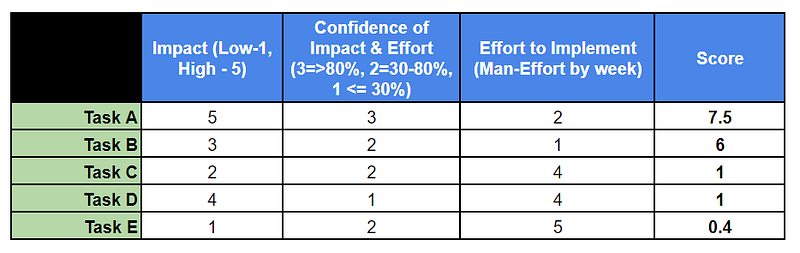
This is an oversimplified version of RICES scoring. Refer to this for a more detailed version.

(4) Align on the target & the timeline

Congratulations! By doing the above, you would have collaborated with your SMEs in the prioritization and alignment of targets.

This is why I had earlier mentioned holding off from sharing your proposed improvement targets at the initial stage. This is because , firstly, your target could be way off given that you didn’t have any of the new information that was just discussed.Secondly, as it will likely be the SMEs who will be working on these tasks, I would highly recommend letting them decide how and when to complete it. People tend to have better work performance and satisfaction when they are given the ownership and accountability to complete tasks on their own terms.

However, this does NOT mean that the SMEs should have the full autonomy on what/how to prioritize. This is where you, as a Product Manager, come into play. However, as PMs rarely have any authoritative power, what I would encourage you to do is to provide context from the business and/or customer perspective to rally support from SMEs towards your proposal

For example, you could say

“Bear in mind that this is for short-term (4–6 months) and we want to be realistic about the ROI of our effort. We should not put in too much effort/resources/$ for , unless the benefits can be transferred to

or

“This solution may not work for our users in South-East Asia (SEA) where a majority of them (at least 75%) do not have emails and have poor internet connections

The team might disagree on the prioritization and/or the targeted improvement at this stage. It is important to help everyone recognize the fact that many of the assumptions laid out are at best a “guesstimate” until the team starts executing and gets real-life feedback. It is OK if a consensus cannot be reached. Use your best judgment to make a decision and invite your team to disagree and commit if it comes to that. It is far more effective and efficient to favor “execution over deliberation” given that most decisions are reversible and can be changed if things go awry.

Closing Thoughts

Going into meetings with SMEs from different functions without a structure or proper facilitation can result in confusion, misunderstanding, frustration and worst of all,lower you credibility as a product leader. Therefore, always remember to

  1. Tell a story
  2. Share the goal(s)
  3. Collectively figure out & decide the next course of actions
  4. Align on the improvement target & the timeline

Here are a few more tips that I have garnered over the years. Feel free to add on in the comment section.

  • Send an agenda and reading materials at least 1–2 days in advance so that everyone can be prepared for the discussion
  • Include a note in the meeting invite to remind everyone to refrain from checking emails, Slack, Instagram (*wink)
  • When using metrics, select a few key ones so that the tendency to fact-check data and debate them becomes lower and less time-consuming
  • Debate and critique ideas but never make it personal
  • Build trust & humility in the room; no one knows everything or is 100% correct all the time
  • For discussion with SMEs, there is no need to explain technical terms to (who?) unless you are trying to align on a common definition. However, if in doubt, always err on the side of clarity!
  • Follow-up with meeting minutes that capture the summary of the discussion, decisions made and deadline by end-of-day

If you have made it till here, I hope that you have some meaningful takeaways. Do leave a comment, clap for the article, share this around. Lastly, follow me on Medium and LinkedIn for more great content.

Essential Reading

Product Management
Communication
Collaboration
Product Leadership
Meetings
Recommended from ReadMedium