
How to Hack Your Brain to Build a Habit That Sticks Like Superglue
The only habit-building blueprint I hope you’ll ever need
“Habits are the compound interest of self-improvement.”
— James Clear
Ten years. That’s how long I have been hitting the gym. Four to six times a week, missing less than 2% of my workouts every year. Like clockwork.
Seven years. That’s how long I have been tracking my caloric intake with an app. Day after day, I put in how much I eat so I can hit my daily caloric target.
Five years. That’s how long I have been preparing my weekly meals every Sunday. No exceptions, unless I visited the family over Christmas and stuffed myself with grandma’s homemade deliciousness and goodies.
I know what you think. You must be obsessed with your body. You’ve got an eating disorder. You must be crazy disciplined. You’ve got no life.
Actually, nothing of that (apart from the eating disorder, but hey, we’ve all got our skeletons in the closet).
The truth is that you don’t have to be crazy disciplined or conjure insane amounts of willpower to achieve this consistency. Your willpower and discipline are like muscles. Yes, they can be trained, but they can also be burned out.
If you rely on your willpower, every day will be a constant battle.
Definitely not very reasonable if your goal is long-term improvement and success.
Smart people automate as much of their behavior as possible so they can save their mental energy for important decisions. The more you can rely on your habits, the more of your progress and success will run on autopilot.
Building rock-solid habits can be very easy if you’re smart about it. That is why I want to give you a fool-proof and easy to follow habit-building blueprint.
In his book Atomic Habits, author James Clear makes the following case: If you improve something by just 1% every day, by the end of a year, you will be 38 times better at it (1.01³⁶⁵ = 37.78).
One percent. No giant quantum leaps. No magic pills. No exhausting power sessions until 2 am. Just a consistent daily improvement of 1%. That’s all it takes.
And that’s all it took for me. After reading his book, I realized that in all of the areas of my life where I had built solid habits — like cooking, working out and reading — I had made massive progress. On the flip side, everything that I tackled on an irregular basis, but then spent long, drawn-out power sessions on it, seemed to not move much at all. Who would’ve thought that studying Spanish for five hours every other week or spending four consecutive days on building a website and then expecting it to monetize itself wasn’t going to really move the needle?
It doesn’t matter if you want to lose weight, become a better writer or learn to talk to strangers.
Consistency and the power of compound improvement beat everything by a mile. And to build clockwork-like consistency, you need habits that stick like superglue.
Now, how exactly do you build these habits? I’ll show you.
The four components of all habits
Any habit — whether it’s hitting the gym, eating healthy or going to bed early — is built the same way.
This habit loop consists of four parts: Cue, Craving, Response, and Reward.
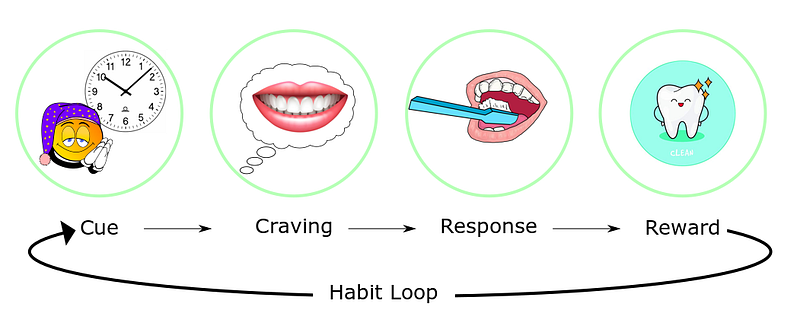
When you look at the clock late at night and realize that you need to go to sleep, your brain recognizes this as a cue that it’s time to brush your teeth. This triggers a craving for clean teeth, and to satisfy it, you brush. Your reward: Squeaky-clean teeth. Your craving has been satisfied, which reinforces the habit loop and tells your brain to do the same thing again next time.
The first step: Make the cue obvious
Allow me to take your hand and guide you through our first step, the cue. A cue can be anything that predicts a reward. For a smoker, it’s seeing someone else light a cigarette. For someone addicted to sugar, a Dunkin’ Donuts sign gets them going. For me, looking at my gym bag gives me the urge to lift weights. Even locations can be cues. A friend of mine used to buy a piece of cake at the same bakery multiple times a week. After the shop closed down, her mouth still started watering every time we walked past it.
How can you take advantage of that? I’ll show you. Our brains are easily manipulated. Our attention quickly shifts to whatever screams the loudest and shines the brightest. Ergo, you have to make the cue as obvious as you can. I have been struggling with my evening routine and going to bed early for a long time, simply because I forgot about it too often. By the time I was tired and thinking about going to bed, it was already too late. The easy solution was to create an obvious cue — a simple alarm on my phone every night fixed what I had been struggling with for months in less than a week.
Whatever habit you are trying to build, make sure you have an obvious cue.
Bonus tip: Let your environment work for you, not against you. I was able to triple my reading by putting a book on my desk for me to see. Cues can be everywhere. Place some fruit on the kitchen counter for healthier eating. Set an alarm to remind yourself to get out of your chair and stretch your legs. Or pull the Medium app to the front page of your phone if you want to read more articles.
Make it attractive
Chances are you have heard about dopamine, or more commonly known as the happy hormone. Not only does it make you happy, but it also plays an important role in the formation of habits — although not quite as you might think.
When you build a habit, the most dopamine is not released when you satisfy your craving (e.g. by smoking a cigarette), but right after you recognize the cue (e.g., merely seeing a cigarette).
Aha. So if you want to form a habit, this is your chance. Jump in and ramp up that dopamine.
How do you do that? By making the desired behavior as attractive as possible. The more attractive the behavior, the higher the dopamine release.
Here are some ways to make any behavior more attractive.
Envision your desired outcome. Trying to eat healthy food and hit the gym more? When it’s time to move the weights but you don’t feel like it, envision your dream body. Take a glimpse or two at photos of fit people. Imagine running up a hill or playing soccer with your kids without gasping for air.
Utilize the power of social status and peer groups. Humans are social animals and even if your only face-to-face contact with other human beings is tipping the delivery guy, that still applies to you. You will always, subconsciously or consciously, try to fit into your peer group and represent their values. Therefore, surround yourself with people who are like you want to be. You don’t have to ditch your friends because they are missing some of the traits you’d like to acquire. Join a likeminded Facebook group or forum to help keep you on the right track and inspire you. I recently saw this principle in action after I wrote about my 2019 reading challenge and several of my friends messaged me to say that I inspired them to read more, setting challenges of their own for 2020.
Focus on the positive. Getting up early can be hard if all you think about is leaving your warm bed. Instead, focus on the additional time you will have at your disposal in the morning and all the things you can do. Breaking a sweat at the gym might be the last thing you want after a long workday, but the sexy woman or buff guy you’ve caught a glimpse of last time might be there again. In anything you do, there will always be something for you to enjoy. You just have to focus on it.
Bonus tip: Temptation bundling. Some habits are a pain in the neck to build. Especially if you are trying to change a behavior that has been there for all of your life. For me, getting up early is such a case. During winter, when it’s dark, rainy and cold outside, it takes some major convincing to get me out of bed in the morning. Entrance: Temptation bundling. I listen to podcasts during my morning routine. The thought of having my favorite podcast play and teach me something new helps me move my body from horizontal to vertical.
If you struggle to make the habit itself attractive, bundle it with something desirable — this is often enough to kick you into gear.
Remove friction
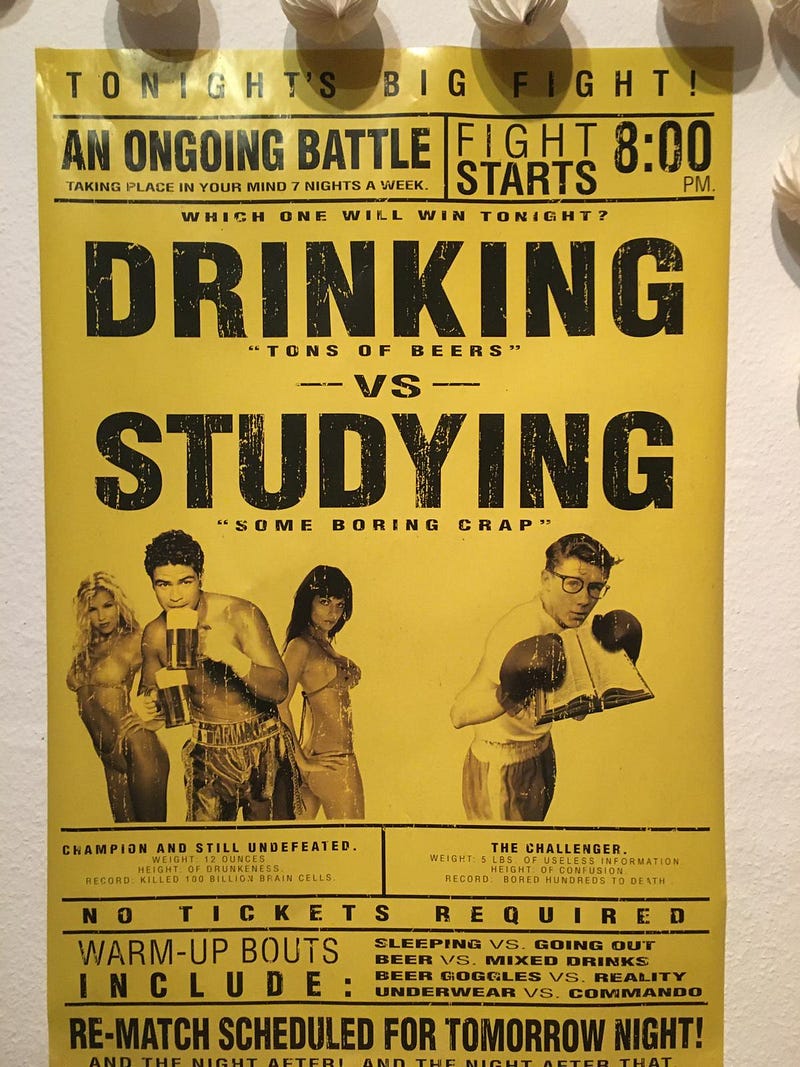
Anything you do or don’t do in life that is not a habit yet is a result of an everlasting battle. Motivation vs. Friction. It’s on all day, every day, on every channel, from the moment you wake up to the moment you fall asleep.
Simple case: You want to drink more water during the day because you know, it’s healthy and Huffington Post says it will, like, quadruple your productivity or something. (Jokes aside, drink more water. You’ll feel the difference.)
If you have a small glass next to your couch while watching Netflix, good! The problem is, you’ll have to fill it up regularly. Although your motivation might be high, this increases friction since you’d have to pause the movie and get up. So you end up not drinking anything because of the friction produced by having to get up and refill it is greater than the motivation you have. My personal solution? I carry around one of these big, BPA-free plastic bottles that I rarely have to refill since it holds a whole liter.
Make it as convenient as possible for yourself and you’ll adapt the behavior much quicker.
Bonus tip: Standardize before you optimize. Start off with small sessions at the gym. Read for ten minutes before you go to bed. Increase your water intake slowly. This way, you can build a habit without burning yourself out. Start small and once you have the habit in place, it will be easy to scale up.
Reward yourself
You are one step from building a habit. This crucial last step, the reward, is what satisfies your craving and reinforces the habit loop. It tells your brain “Yo dawg, whatever you just did worked. Do it again next time!”
Obviously, the more satisfactory a reward is, the more it reinforces the habit loop.
So how do you make a reward as satisfactory as possible? Here, timing is crucial. Your brain is wired to value immediate rewards more than delayed ones. Look at how procrastination works — you choose a short-term reward over a long-term benefit.
The problem here is that many achievements come from long-term efforts: career-building, weight loss and learning a foreign language don’t come overnight. Instead, they are the result of consistent work. The question is: How can you reward yourself in the meantime? You have to be a little bit creative here and come up with instant gratification for yourself. For example, if you want to cook more instead of eating out, put the money you saved in a special jar every time when you decide to ditch the restaurant. This gives you instant gratification and a way to save up for your next holiday. Talk about killing two birds with one stone.
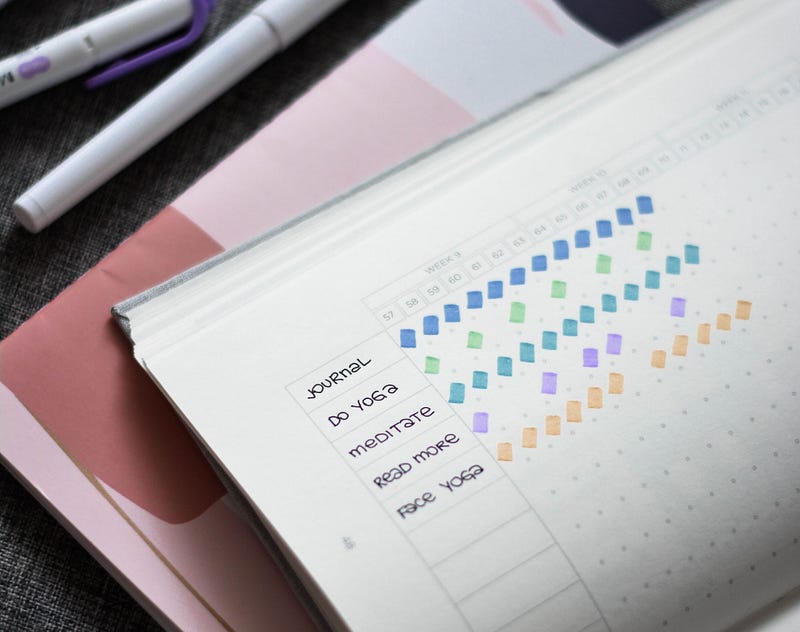
Bonus tip: Habit trackers. Progress can often be hard to see, especially in the short run. Creating your own tracker can be fun and rewarding as you see your progress unfold in front of you. If you want to write ten pages per day (make ten sales calls, drink five liters of water, etc.), stack ten coins and move one to a new stack after every page. Or watch a tea light burn down as you spend hour after hour reading.
Don’t make it too complicated — keep it simple instead. Once you have taken your first step, the satisfaction from seeing your progress unfold and pile up in front of you will keep you going.
Identity change, or: habits on steroids
“We are what we repeatedly do. Excellence then, is not an act, but a habit.”
— Will Durant
Now that you know how to build a habit, you have another burning question in your mind: How long will it take? I’d be a liar if I gave you a simple number here. Yes, I am aware of the research that says it will take 66 days on average. Unfortunately, the range is still immense, anything between 18 and 254 days.
The simple answer is the following: It depends. It depends on multiple factors, such as the kind of habit and how easy you made it for yourself with the above steps.
What is important though is the following: It will depend on your identity. Building a habit of eating healthy, home-cooked meals for dinner can be super easy or super hard, depending on what kind of person you are. If you see yourself as an athletic person who does lots of sports and is very health-conscious, you will have less trouble than a couch potato who thinks of chips rather than an ab-exercise when he hears the word crunch.
The more a habit is in line with your identity, the easier it will be to build and maintain it.
I know what you are going to say. “No wonder I can’t do this or that regularly. I’m just not that kind of person.” Well, I have got some good news for you. You aren’t stuck with who you are. Your identity can and will change over time.
Yes, it might be hard for you in the beginning to pick up certain habits. But if you stick to them, day after day, week after week, they will reshape your identity and how you see yourself. Over time, it will become easier and easier for you to pick up new habits that are in line with your new identity. So don’t despair, just give it time.
Never skip twice
We all know it: On good days, it is easy to stick to our goals and follow through. But what about when things get hard? Life will hit you in the face every now and then. On some days, you will feel like doing jack shit. You will be tempted to say Ah, fuck it, I’ll do it tomorrow.
Don’t worry. We are all human. We aren’t perfect. Making mistakes is part of our nature.
The important part isn’t if or how many mistakes you make. The important part is how you deal with them.
Even with a detailed blueprint, building habits can be hard. You’ll have to push yourself past your comfort zone, but at the same time, you want to avoid burning yourself out. Our goal is long-term results, after all.
A good way to strike this balance is to follow the Never skip twice rule. It gives you some leeway while keeping you on track for your long-term goals and is as simple as effective:
When you mess up, don’t sulk or beat yourself up over it. Instead, focus everything you have on following through next time. Make sure you never miss twice in a row and you’ll never stray off the path.
The habit-building blueprint
That’s it. You’ve got everything you’ll ever need to build a habit that sticks like superglue. Here is a summary of the habit-building blueprint, so you have it all in one place and can come back when you need it.
Although every step you take makes it easier for you to build a habit, you don’t have to apply all of them. Depending on what your plan is, applying just two or three is often enough to put a solid habit in place.
1. Make the cue obvious
You need an obvious cue to start the habit loop and kick your brain into action. Set an alarm. Put your books, yoga mat or healthy fruit where you can see them. Design your environment so it works for you, not against you.
2. Make the action attractive
The most dopamine gets released in your brain right after you recognize a cue. To make use of that, make the desired behavior as attractive as you can. Envision your desired outcome and surround yourself with people who are like you want to be. If you’re still struggling to make the habit something you like to do, bundle it with something you enjoy. Listening to good music or a podcast or drinking a nice cup of tea can make a lot of things more attractive.
3. Remove friction
Anything you do is the result of a constant battle of motivation (how much do you want it) and friction (how hard is it to do). Reduce the friction to make it easier on yourself. Pick a gym that’s close to your home or on your way back to work. Have your dishes cleaned up and groceries bought ahead of time. Get up early enough so you have time to meditate without running late. Most important: Standardize before you optimize. Start with small steps, because they generate very low friction. Once you built the habit, it will be easy to scale it up.
4. Make it rewarding
Your brain values rewards more when they are instant. Find ways to reward yourself instantly for behaviors that pay off in the long run. One way to do so is through habit trackers. Anything that lets you see your progress works, like stacking coins or burning down a small candle.
Take action
You have got everything you need now. If you follow the above steps, building a habit has never been easier. The only thing that is left to do for you is to take action.
For most people, this is the hardest step. But at the same time, it is also the most important one. Habits won’t build themselves and change won’t happen without you taking action.
The best time to take charge of your life is now. So, take a minute or two and think about what behavior you have been trying to pick up. Is it regular exercise? Reading? Meditation? Studying after you finish work? Calling your mum more often?
Pick one thing that you have been struggling with. Then, go through the steps I described above and think about how you can apply them to change a constant struggle into a habit that sticks like superglue.
If you need help with forming a habit, feel free to drop a comment and I’ll do my best to help you out.
“Motivation is what gets you started. Habit is what keeps you going.” — Jim Ryun
Start now. Build your habits. Live your best life.
P.S.: If you like my style of writing and don’t want to miss out, feel free to subscribe to my tiny little newsletter. No spam, no weird stuff, no requests to wire money to an offshore bank account. Just a simple notification whenever I publish a new article and a lot of love. Thanks!


