
How To Give Your Screenplay Its Best Chance at Getting Produced
I became an award-winning screenwriter in 3 months. This is how it works.

My first screenplay was rated a #1 feature by producers at the Los Angeles Independent Film Festival Awards—even though I was a novice screenwriter with no connections or experience.
The wondrous world of Hollywood works in mysterious ways… or does it?
They say you need connections to make it in the entertainment industry; that it’s all about who you know, not what you know (or how talented you may be), and that you may have to offer up unsavory favors to go from unknown to rising star…
I don’t dispute that many who’ve quickly risen the ranks of Hollywood may have benefited from nepotism, good looks, or an endurance through less-than-professional relationships.
But that wasn’t my experience and I don’t think that’s the only way.
I’m not going to pretend that I’m some big A-list star; I’m not. However, I did go from idea to completed screenplay feature in less than three months and in the subsequent months had my script considered by Amazon Studios, garnered interest from a wide array of producers, and won first place at the Los Angeles Independent Film Festival Awards. See below the LAIFFA email and award, for anyone who thinks I’m talking out of left field here:
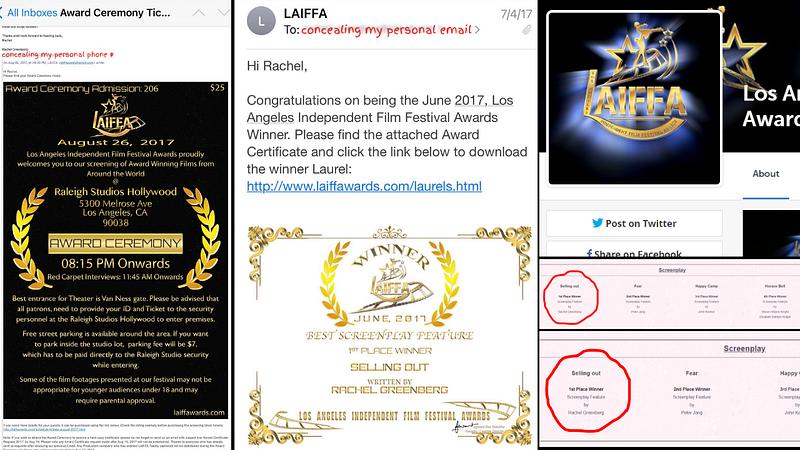
I ended up pulling the plug, myself, on the producer who wanted to bring it to the big screen, for reasons I’ll go into later.
So I do have a little bit of experience here, and I’m happy to share my account and the steps I took to get my screenplay to award-winning status, into the hands of studio decision-makers, and to receive an actual offer from a real producer.
The truth is, I believe independent screenwriters and “nobody actors” are actually the way of the future in Hollywood.
More affordable professional technology, an increase in talented full-time freelancing creatives, and the surge of crowdfunding sites like Seed and Spark all lend to the idea that perhaps the next generation of successful big-screen stars won’t be the ones repped by the likes of CAA, UTA, and WME.
In fact, knowing that alone inspires entrepreneurs like myself to possibly capitalize on the democratization of Hollywood with new platforms aimed towards the furthering and success of independent creative newbies, from screenwriters to actors to videographers, etc. There’s definitely a wealth of opportunity here.
Screenwriting is probably a lot like most semi-subjective, semi-luck-based disciplines (startups, writing books, becoming an influencer, etc.): it’s a combination of art and science. The artsy part is really the topic, genre, or plotline you choose, and your writing style altogether.
There are a ton of resources out there pretty clearly defining the science part that will make the art a lot more likely to succeed. That’s what I’m going to get into, as that’s a large part of what contributed to my fast and positive reception from studios and producers alike.
Step 1: The Actual Screenplay Has To Be Good
There is a pretty straightforward and methodical way to go about this. Do your research! That means at the least, perusing the following bullets and committing to at least a few of them.
Read the classics
Read one or more of the major screenwriting books that every aspiring screenwriter needs to read. There’s a more robust list here, but I would suggest at the least to start with Screenplay by Syd Field, Story by Robert McKee, and maybe Save the Cat by Blake Snyder.
I read Screenplay and got halfway through Story, but I was also doing a ton of research online. If (or when) I do revisit my screenwriting pursuits, I will likely finish up Story and read a few more books on that list.
Read screenplays
Read actual, real screenplays from the most successful movies. Believe it or not, a lot of them are out there, and from what I’ve seen, many are even available for free.
My favorite was Aaron Sorkin’s “The Social Network”, but it also tied into my chosen genre and subject matter, so perhaps you’ll want to seek out and read screenplays more similar or relevant to your chosen topic.
Here are a few places where you can find and read or download scripts (free or mostly free): SimplyScripts, Screenplays For You, and The Script Lab. There’s also a more exhaustive list from No Film School, as well as some other helpful resources: Find scripts to read.
Research structure
Spend a ton of time Googling “how to write a great screenplay” and “professional screenplay structure”. Screenplays and movies of varying genres typically follow somewhat of a formula. There are certain beats at specific points in the script, and while you might like to add a little variety for some avant-garde flavor when you’re just breaking into the industry, it might help to follow the basic rules.
You probably don’t want to put the climax ten pages into a 120-page script, or else you’re going to have a very short film (once they ax the last 110 pages) or record-breakingly-low retention. Here’s one helpful resource from New York Film Academy. I think I used something similar to that, at least for my initial outline structure.
Make an outline
Seriously. I love to free write; it’s fun and cathartic and can be a great creative outlet. But save that for the blog posts. Screenplays are organized, and they need to be… and by the way, that brings us to the next point.
Don’t write your screenplay like a book
It’s not a book. A book and a screenplay are two very different styles of writing, and while you can have a book turned into a screenplay, they typically hire a screenwriter to do just that… because a screenplay and a book are not the same things.
For anyone who loves long, descriptive paragraphs and flowery language, this is going to suck. I get it; I’m that way, too. But I wasn’t in my screenplay, since I knew it wouldn’t translate. That’s the whole point about screenwriting; you’re not writing for a reader, you’re writing for a viewer.
More to the point, you’re really writing for a producer to be able to read a page and quickly identify the necessary actors, setting, props, special effects, and budget. That’s part of how they decide if your screenplay is good (that means a good plotline and clear instructions for the producer and director), feasible, and affordable.
Producers (the ones who read your script) will be thinking with both a viewer’s and a businessperson’s hat on. They need to make the movie good enough that viewers like it, but they also need to do this in a way that makes financial sense and will result in a positive return on their upfront investment. Movies can be expensive, so these budget-related decisions are often why scenes, characters, or stories altogether end up on the cutting room floor.
Suffice it to say, I did the research to hopefully give my screenplay the best opportunity when it did come time to get it in front of producers.
Step 2: Copyright
Copyright your work before you send it to ANYONE. This is kind of the opposite of startups. With startups, there’s really no way to protect your idea (you can’t patent an idea), unless you have some proprietary technology or brand new invention for which you actually secure a patent.
Screenplays are kind of different; they’re written works, much like books, and you can and should copyright them, even before you send them out to a potential actor, friend, or long-lost relative who may or may not work in the film industry.
I would suggest copyrighting with both the LOC (Library of Congress) and the WGA (Writers Guild of America), to ensure you secure maximum protection for your work. Also, if you make any changes to the script, you do need to re-submit it for another copyright. That might sound tedious, but it’s pretty quick and easy, and it isn’t that expensive (maybe between $25 and $40 or so, depending on which site you use).
If you don’t do this, producers and studios may not even look at it. They don’t want the liability of some weird aspiring writer lawsuit over a supposed stolen idea when you couldn’t simply take the time and $25 to copyright your work. Some may even request proof of this, so it really isn’t optional.
Step 3: Create a Low-budget Trailer and/or Entering Competitions
There are two routes you can take for Step 3. I’ll tell you what I suggest you do, and then I’ll tell you what I actually did.
Produce a low-budget version
This is the third step that I didn’t take, but I will in the future and suggest others make this their step 3.
Get an amateur team together and make your low-budget, boots-on-the-ground version. Even though you’re just the screenwriter, you may need to get your feet wet with casting, set design, costume creation, and production in order to get a basic trailer, pilot, or otherwise mini beta version of your feature out there.
This is the type of thing you can actually shop around to producers, studios, and even actors’ agents to see if they might want to hop on board the real thing. Alternatively, you might decide to go 100% indie and make or crowdfund the whole thing yourself.
Submit your screenplay to competitions
Rather than trying to create a low-budget, jerry-rigged version of the whole thing myself, I started submitting it to competitions. I thought this might be a long shot, but I also figured I wouldn’t know if I didn’t try.
There are sites like FilmFreeway that have countless screenplay competitions you can enter, some for free, and many for a fairly affordable price (under $50). This might seem like a waste, but if you can find a genre-specific competition and submit the right story, or particularly a topic they’re looking for, you just may bag yourself a win.
That’s pretty much exactly what I did. I submitted to a ton of these. I probably spent about $500 on submissions altogether. And then I just let them sit, planning to kind of forget about them and take a more active approach for Step 4.
The competitions are great for a long-shot, and if you win some, it could definitely open up the doors to real industry connections and opportunities, but I wouldn’t suggest anyone just sit back on their laurels and wait for the possibility that happens. By the time I won the award, I had already garnered significant interest from producers and studios, so while the award was nice, it definitely wasn’t necessary.
Why choose getting some film made
If you have the time and the interest, I would suggest attempting the first option, where you try to round up the necessary props and players to make it yourself.
You just might end up like Damien Chazelle with his little “short” project Whiplash, which turned into a Sundance success and grossed $49 million on a $3.3 million budget. It was also the start of his journey that’s so far resulted in even bigger hits like La La Land and its $449 million box office earnings (on a $30 million budget).
That all may not have happened if he went straight to submitting his Whiplash script to screenwriting competitions, waiting on some title or award that would give him the credibility or connections to get the big shot producers interested in making the real thing. Those awards may not have materialized, and the producers may not have either.
Step 4: Be Proactive and Start Getting Your Work Out There
So much of professional success may come down to digital research of who’s who… it’s a shame they didn’t teach that in business school. Anyhow, you’re going to be looking for a few different types of people and then contacting them directly.
The ones I focused on were mostly producers, but you may also want to focus on agents, semi-attainable talent (not Brad Pitt, but also not Jim Bob from Whoknowswhere), and maybe even filmmakers seeking to collaborate with up-and-coming screenwriters. Here are the differences and the reasons you may pursue each:
Producers
Producers are kind of like the glue that holds movies together. They wrangle up the necessary funding (or provide it themselves), call in their network of appropriate directors, tap the right agents (who have access to the right talent), and pretty much make the whole thing happen.
Getting a yes from a producer may not be the ultimate finish line (you may still need the studio execs to agree to greenlight the piece or start pitching it to various networks until it finds a home), but a producer can make the success of that a lot more likely.
Agents
Agents represent talent. They can also represent screenwriters and other players in the web of creatives that make Hollywood hits happen.
Part of my being productive did mean reaching out to a handful (or more) of screenwriting agents, but this didn’t amount to much. I also didn’t focus too much on agents, once I realized that many screenwriting agents won’t really help advance your script along until you’ve already done quite a bit of legwork on your own.
In fact, it seems like that’s how a lot of managers and agents operate these days, which is perhaps why there are more independent creatives wondering if they need that representation at all… or at least pondering whether it’s worth giving up 10% to 20% of their earnings for it.
Talent
This might come as a surprise, but talent can play a big role in moving a screenplay forward or winning over a producer or studio that’s otherwise on the fence. You don’t necessarily need to sign or commit talent to your script right now, but if you can successfully make those inroads with the talent (or their agents or managers) who you think would be a perfect fit for one of your screenplay’s major roles, you could give yourself quite a leg-up on those who don’t.
While getting a “maybe” or a noncommittal “possible yes” from talent or their manager won’t guarantee their involvement, it sure is a vote of confidence to the producer considering the project.
But you actually don’t have to go this far; all you really need to do is determine who is the right talent. In fact, this is a question I was asked by multiple producers, and thanks to one awful conversation I had with one of the first interested producers, he let me in on this secret before hanging up in disgust: How dare I not have assigned each role in my script to a mid-tier actor who was attainable (affordable), had a proven track record in that genre, and would draw the ideal target audience?!
Sorry, I just didn’t know any better… but now I do, and so do you. Showing the producers that you’ve thought about the best actors for the characters in your script helps paint a picture for those producers of how the project could look in real life.
It also shows that you understand the holistic process that is turning a screenplay into a big-screen, real-life feature, and you’re willing to be an integral part of that process, beyond the initial writing.
Filmmakers
Now, this might be a hard one to find all in one place, but if you can identify filmmakers who are (1) seeking a new project and are (2) eager to work with an independent, unknown, up-and-coming screenwriter, you could have yourself a great partnership.
I would suggest looking at places like Seed and Spark or other creative crowdfunding sites or even freelancer marketplaces. However, you may have better luck looking in places that already have an RFP (request for proposal) out to screenwriters.
The hard part here is that they may have specific requirements for the genre, length, and topic for the script, but it’s definitely worth looking into. A few places to search for relevant screenwriter RFPs include Screenwritingstaffing, NetworkISA, and TheScreenwritersMarket, among many others that Google will likely point you to.
Studios
Some studios actually allow pitches or screenplay submissions from non-professional, independent (not represented by an agent), and otherwise total newbie nobody hopefuls.
I believe Netflix used to have open submissions, and back in 2017 when I was writing my screenplay feature; Amazon Studios did too. In fact, mine made it most of the way through the Amazon Studios consideration process—it was really cool actually. You could see if it passed the logline test, then the first read-through, then review by a supervising editor, then assistant producer, etc.
I got to see the status updates to see my screenplay go through the chain of command at Amazon Studios and make it all the way to the final round. Unfortunately, I’m pretty sure Amazon has stopped allowing for open submissions (likely because they were inundated with more submissions than they could review, or possibly because they wanted to put more budget towards projects from the already proven, traditional Hollywood players).
However, things change, and if I were looking to shop my screenplay around right now, I would most certainly investigate which studios might still be accepting open submissions from newbies and give it a shot.
Among those four options, I had my best luck with producers, but that’s also mostly where I focused my searching.
Also Consider Paid Marketing to Producers
I did a screenplay blast. I used a website where I believe I paid a few hundred dollars (maybe $300 or $400), and they blasted my script out to hundreds of producers. And believe it or not, I actually got responses and interest…quickly. I think I probably got at least 10 to 20 responses within a week, a quarter of which were actually interested and progressed into something more.
- “Something more” in this case may have meant moving from the producer reviewing my logline to my full treatment or straight to the full screenplay.
- Sometimes it meant going as far as a phone call.
- In one case (the producer who actually offered to turn my script into a movie), it meant multiple emails, phone calls, feedback and revisions, and meeting him in person at the cast-only screening of his latest movie. As I said, it was pretty cool and for the experience alone, the ~$400 was well worth it to me.
Here’s a recent list of these opportunities (the company I used seems to have vanished, probably bought out by a bigger company): FreshmenScreenplay — 10 Places to Submit Your Script.
Another resource that’s worth using is ScriptReaderPro. This will provide you with good feedback (from the people qualified to give it), plus the opportunity to connect with and possibly gain entree to the gatekeepers of more traditional Hollywood if that’s what you’re looking for.
The Recap/TLDR of Everything Above
- Write a really good screenplay. Everything else is a waste of time if you don’t do this (and do it really well, starting with the above-mentioned research and resources so you actually know what you’re doing).
- Protect your work by copyrighting it.
- Decide between creating a trailer or low budget version, or submitting to competitions.
- Especially if you decide to forego 3A and you have yet to hear from those competitions from 3B, it’s time to really take matters into your own hands. This means proactively doing the networking and outreach required to get your screenplay in front of as many useful, relevant, and potentially valuable people out there. Cast a broad net and give yourself the greatest chance at success by reaching out to producers, script supervisors, studios, assistant producers, rising talent, talent managers, screenwriting agents, independent filmmakers, etc.
Why I Backed Away From Production
You might wonder why I decided to pull the plug on my screenplay production shortly after getting the offer from that producer.
I’m not going to bore you with every detail, but it all comes down to two things: focus and priorities. The truth is, I wasn’t just an aspiring screenwriter. That wasn’t my #1 primary goal in my life or career at that point. It was an interest and a passion I had, but I would be lying to myself, that producer, and everyone else if I told them I prioritized screenwriting over my startups. It just wasn’t true. And that was the biggest problem.
I honestly feel that screenplays (or nurturing them into produced, successful, well-marketed movies) are a lot like startups; they’re an all-consuming process that requires 100% of your time and dedication.
Unfortunately, while also trying to get a few other startups off the ground and running one already-launched business, my time was limited and my life and goals seemed too splintered and not quite conducive to the potential success of my screenplay production.
You can also sell a screenplay and simply wash your hands of it, take your money, and walk away. That wasn’t what I necessarily wanted to do, and that also wasn’t the offer my producer proposed.
My screenplay was specific to both my investment banking experience (think the show Industry) and also my tech startup experience (think The Social Network). Even though the story wasn’t autobiographical, the producer felt that I needed to be a key involved player in each step of the development. And he was probably right.
I just knew I wouldn’t be able to dedicate the necessary amount of time or attention required, and turning a screenplay into a movie, shopping it around to the appropriate studios, and marketing the finished product is no small feat. Not only is it a big job, but it’s also a collaborative effort.
That’s the one interesting thing I’ve learned about screenwriting that’s a bit of a double-edged sword.
It’s the one type of art that really can’t be done all by one person. Most screenplays have editors, sometimes multiple co-writers, and then directors who make further changes. Producers, actors, set designers, casting agents, costume designers, videographers, editors, and many more people will become a part of the web woven by your script.
You can’t simply half-a** a screenplay, toss it to a producer or filmmaker and expect it to magically become a feature-length movie. That’s not how it works.
I don’t believe I’ve had my last brush with screenwriting.
When the time is right, I do hope to return to screenwriting and possibly even revisit my award-winning 2017 script. However, I likely won’t do so until I can set aside a good chunk of time solely towards my screenwriting pursuits.
I don’t want to be a half-a**ed screenwriter. I don’t want to do anything half-a**ed… I guess this brings me to my last point. These are the three universal lessons my screenwriting experience taught me about life:
- Master the skill first. Seek recognition, acclaim, money, and fame later.
- Most things can be achieved through research, effort, and being methodical in your actions. You don’t have to be a rocket scientist to learn the structure of a screenplay or to network with producers.
- If something is your passion, go for it all the way. If it isn’t, you may be wasting your or other people’s time.
For any aspiring screenwriters out there, people who are just curious about the world of Hollywood, or anyone seeking to break into a brand-new field with a pretty low acceptance rate, I hope you found these tips and life lessons helpful and inspiring. Good luck — maybe one day I’ll be watching your work on the big screen!


