
How to Give the *Right* Number of Medium Claps and Amazon Stars
According to science. Odds are, you’ve been doing it all wrong.
Trust me. I’m a writer.
And, you’re a reader.
But are you an expert on how to give accolades to authors of books posted on Amazon and Goodreads and to writers of articles on Medium? Unless you review for a living, you are not.
And odds are, you’ve been doing it all wrong.
As virtually any writer or author who has their work judged via a rating system will tell you, the majority of people haven’t got an f’n clue about what they’re doing when they click their mouse.
It’s like handing a salt shaker to a 3-year-old and asking them to season the baked potatoes. Some will give a tentative shake, others will empty the entire cat-shaped container, but precious few will season it just right. They’ll let their mood or personality influence the amount of salt they shake.
So, as a public service, I offer you the science of how to give the appropriate number of stars and claps when acknowledging the work of authors and writers.
⭐️ Let’s start with the stars ⭐️
Before I published my book on Amazon I shared Advanced Reader Copies with readers on Goodreads, in exchange for honest reviews. I was warned by all my published author pals not to look at the reviews. As with most advice I’m given by people who are wiser and more experienced than I, I ignored them.
And I’m glad I did because it taught me a few things about how w̶e̶i̶r̶d̶ wrong people are with their star-rating systems — if in fact they even have a system. I believe the 1- and 2-star reviews that my book got on Goodreads and on Amazon tell us more about the reviewers than the quality of my story or my storytelling… at least, that’s the story I tell myself.
For example, this is the most critical review I received on Amazon:
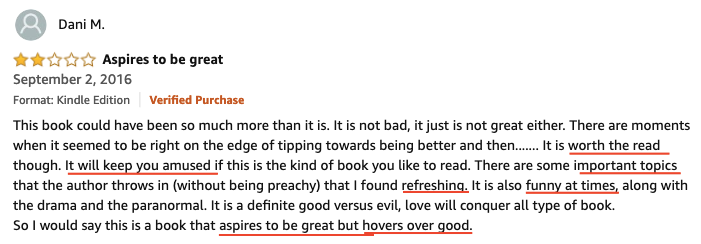
This reader assumed I aspired to write high art, to achieve greatness with a story that is based on the joke premise, “What if a man-hating sociopath was able to harness the power of The Secret?” And the answer, she’d start a psychic serial-killing business. D’uh! Bad assumption, lady.
On the science-based star-rating scale (which I share below), Dani M’s narrative review tells us that this book would be worth at least 4 stars. Reviewer rating: fail.
Goodreads reviewers are notoriously more critical and stingy with their stars than Amazon reviewers. This is my all-time favourite negative review on Goodreads:
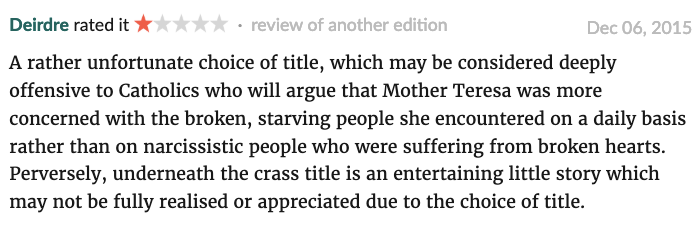
So, let me understand this. Deirdre enjoyed my book but gave me 1 star since my title might offend someone else? On the science-based rating scale, a writer gets an automatic, minimum of 3 stars if the reader finished the book, 4 if it made her laugh. Reviewer rating: fail.
As grateful as I am to every person who takes time to read my words, I’d really appreciate if you all understood how star-rating works. Like with baking, there is a science behind rating writing.
1 star ⭐️
- You did not finish the book.
- You would have preferred to have dropped your $20 on the ground and have it bring joy to the stranger who finds it.
- NOTE: Never leave a 1-star rating or review. If you can’t say something nice, you probably weren’t the right audience and you need to own that mistake. Walk away. Make a better buying decision next time.
2 stars ⭐️ ⭐️
- You did not finish the book.
- If a friend recommended it to you, insist they buy you a coffee and explain what the f they were thinking.
- NOTE: Never leave a 2-star rating or review. Like with 1 star, you need to own the fact that you got sucked into buying a book that wasn’t meant for you. Blame the book’s marketing. Do not punish the author.
3 stars ⭐️ ⭐️ ⭐️
- You managed to read the whole book but never connected with the story or characters and know that within a week you won’t remember it.
- Take the book to your local thrift store to make room on your shelf for something new.
- NOTE: It’s okay to leave a 3-star review but try to say at least two nice things about the book. Authors have sensitive stomachs and need the bread from your shit sandwich to digest whatever criticism you have with it.
4 stars ⭐️ ⭐️ ⭐️ ⭐️
- Obviously, you read the whole book and you enjoyed it.
- It made you think, laugh and/or cry enough times to really ‘feel’ it. This applies to both fiction and non-fiction.
- NOTE: Always make time to leave a 4-star review. Authors rely on your opinion—especially when it’s positive. Try also to leave a one- or two-sentence review. You owe the author at least that for the 100,000 words of hers you’ve just enjoyed.
5 stars ⭐️ ⭐️ ⭐️ ⭐️ ⭐️
- You read the whole book in one or two sittings, staying up too late since you just couldn’t put it down.
- It goes without saying that you either took notes, ugly-cried and/or laughed so hard you peed (just a little).
- NOTE: Take the same actions as a 4-star review plus—buy the author’s next damn book.
👏 Now, the science of proper clapping protocol 👏
As Jennifer Schmidt pointed out in her piece about Medium claps,
“I never clap, I applaud. Every. Single. Time. Why? I believe it is a matter of courtesy.”
Jennifer provides her rationale and a lovely visual of her clapping scale which makes an amount of sense. What’s missing are the qualifications that make a piece “Worth the read,” “Pretty good,” “I liked this!” and so on.
Here’s the scientific approach that you can use to defend your clap numbers when a friend notices that you gave Leslie Wibberley 50 claps for her story called No One Prepared Me For This and only 25 claps to Donna Barker 💜 for her (my) story Why My Husband is Spending the Night With His Ex-Wife—and Mick Jagger.
0 claps
You didn’t make it to the bottom of the article. That’s okay. It wasn’t written for you. Give your claps to someone else.
10 claps 😊
If the story keeps you engaged to the end, it gets a minimum of 10 claps. 10 claps suggest a nice smile to the writer. Think of the 10 clap emoji as a smiley face.
11 to 25 claps 👍
The story made you smile or feel something in your heart. The more you felt, the more you should clap. And if you highlight something, that naturally is accompanied by more claps. With 11 to 25 claps the writer can feel your appreciation, can hear you saying, “Nice job!” Think of 11 to 25 claps as giving the writer a thumbs-up.
26 to 40 claps 🙏🏼
If the story prompts you to comment it deserves between 26 and 40 claps. You’ll only comment when the writer has connected with you on a personal level, when his or her story resonates deeply with you or reminds you of an experience of your own. When you give 26 to 40 claps you’re saying, “I appreciate you.” Think of 26 to 40 claps as making gratitude hands.
41 to 50 claps 💜
41 to 50 claps should be reserved for about 10% of the stories you read. There may be writers who get this number of claps from you with virtually every story they write. These are stories that make you feel deeply, that teach you something, either about the world or yourself. When you give 41 to 50 claps you’re psychically communicating to the writer, “OMG, I love you! Please be my friend.” Think of 41 to 50 claps as a psychic hug represented by a big ole purple heart.
That, my friends, is the science behind starring and clapping.
Print these guidelines out. Use your votes wisely.
You are the monkeys on the first island. Your starring and clap actions are teaching all the monkeys on all the other islands how to use the tools they have to show writers and authors the appropriate amount of appreciation for their hard work.
And remember that one day a reader may be clapping for your post or starring your book… Karma is real and she is fierce with comeuppance.
And for readers who’ve bought/read a #1 book and wondered how on god’s green earth it could have earned that accolade, I share the secret to becoming an Amazon bestseller. Seriously, reaching #1 is dead easy—if you’re happy to hang your integrity in the closet:


