
How to Get Your Stories on Medium Chosen for Further Distribution
What’s the deal with curation anyway?
A question I often get from readers is, “How do I get curated?”
That’s a big question. And one not easily explained. I have some suggestions that will help you get curated, but ultimately it is up to you. Of the last ten articles I published, nine of them were “Chosen for further distribution.”
Before Medium’s recent change, writers could see which topics a story was curated in listed in all caps above their story’s title on the stats page.
Since Medium rolled out recent changes to its platform in early October, a few things regarding curation have changed. When your story is “chosen for further distribution,” you can no longer see the topics in which it is curated. Medium no longer gives writers this metric.
More from Medium,
While we will continue to use topics behind the scenes to improve our recommendations to readers, we will no longer show topic designations to writers. That’s because topics are just one avenue, of many on Medium, for readers to connect with your writing.
Medium is using topics “behind the scenes.” If your story is “chosen for further distribution,” I’m wondering if this means anything at all now since many writer’s views have plummeted in the last month. My high curation rate has continued since these new changes rolled out, but my views have dropped. I have noticed one of my stories chosen for further distribution did nothing in terms of views and claps. Which is unusual.
More from Medium,
We are still reviewing stories (and authors and publications) for promotion and featuring across Medium (as mentioned above). But as Medium places a greater emphasis on the connections between readers and writers, we don’t want curation to be a bottleneck to those connections. Instead of focusing or waiting on curation, creators are free to focus on creating — doing their best work for themselves and their audience.
While we don’t review every published post, if we do select your writing for featured promotion, you will see that on your post stats page.
Let’s assume further distribution pushes your story the way curation did in the past. How do you get “chosen for further distribution.”
Here is a checklist you can use before you hit “publish” on your Medium story.
There are three things to concentrate on:
One — Formatting
Medium is going for a specific high-quality magazine-style look and feel that translates not just to the web but to the Medium mobile app. When you view your story on the mobile version, it needs to look good. You can view the mobile version on your computer by clicking on your profile picture and scrolling down to ‘Design your profile.’
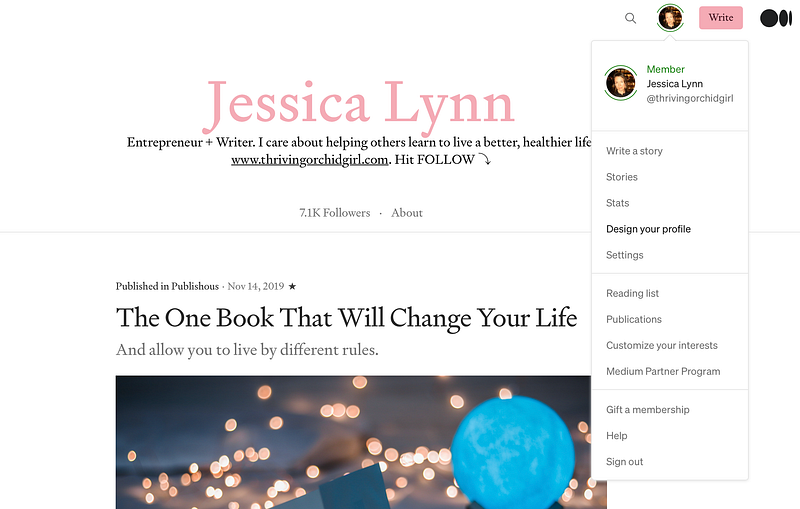
Then click the ‘Mobile’ icon.
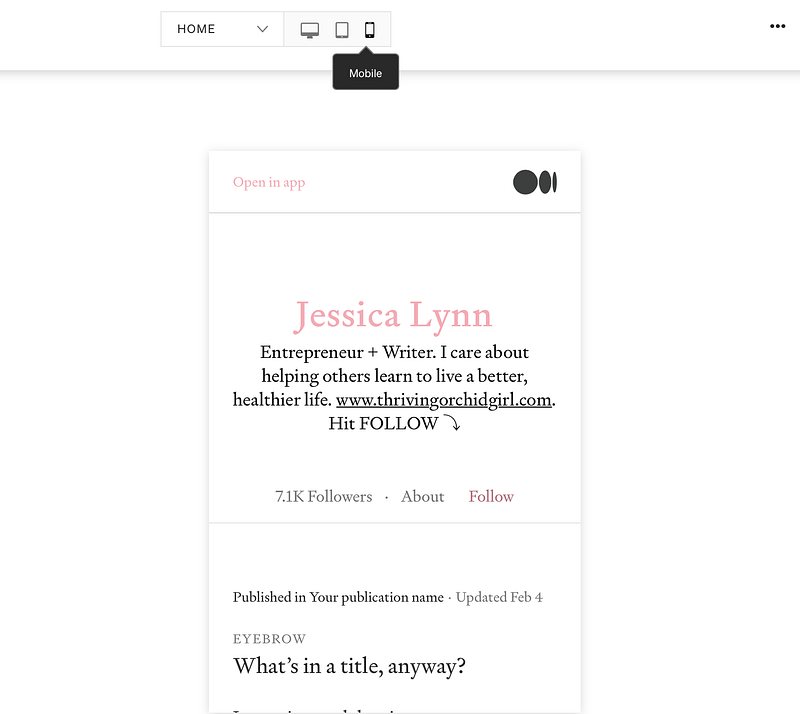
And you will see what your stories look like in the mobile version.
Medium is pretty clear on what it wants for proper formatting. Good formatting is determined in paragraphs, spacing, styling, section breaks, and quotes. Use these formatting techniques to increase readability. Always keep the reader in mind when formatting. I’ve written about formatting a lot in the past, but I’ll give you the short version here.
Title: format in title case. In the editor, after you highlight your title, choose the large ‘T.’
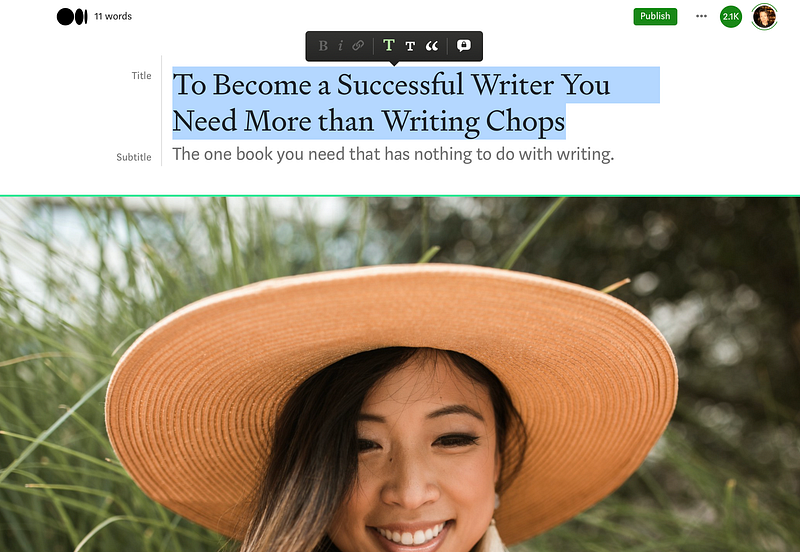
Subtitle: Highlight your subtitle and in the editor, choose the small ‘t.’ This feature will format your subtitle properly, in sentence case.
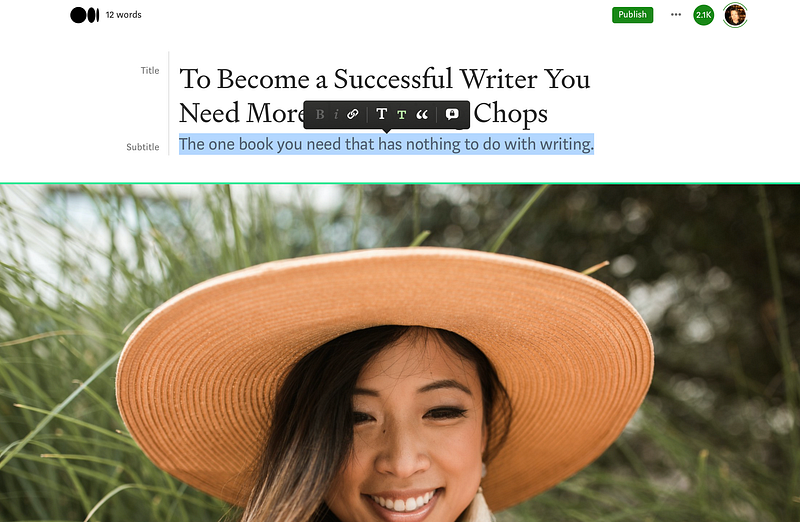
Image: the largest image option, all the way to the right, looks best. Use a horizontal image. I occasionally use a vertical one, but not often. It doesn’t look as good as a horizontal image, neither on the web, mobile or on Facebook share groups.
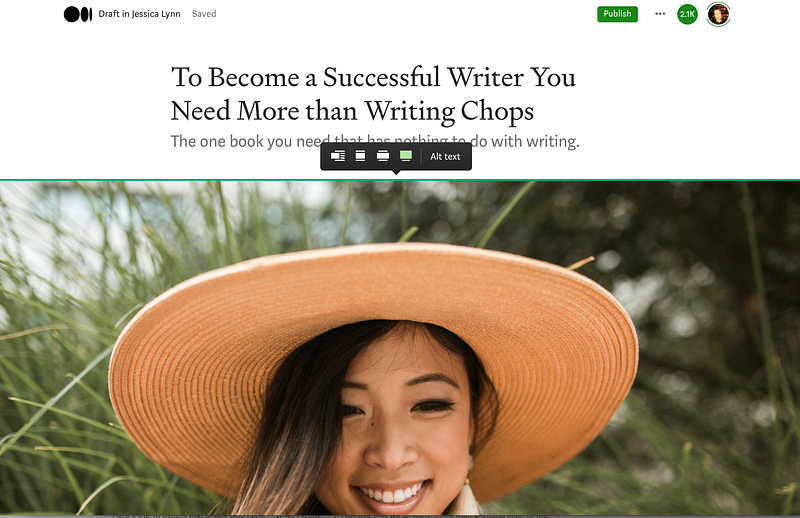
Medium prefers the largest image size, and for any image, properly cite the artist’s name under the image. Even if you use your own photo, you need to cite the photo by author.
Put thought into your image; choose one reflective of your story.
Two — Quality
Quality is subjective. But some things are not. Your story needs to be free of grammatical and spelling errors. When you make a typo (as we all do), it looks unprofessional, like you don’t care. Your story needs to be well-written and easy to follow, with a strong narrative, and compelling.
The title needs to be interesting, like a snippet of the entire story. It needs to reflect the larger part of the text — the takeaway.
Keep the reader in mind.
Medium loves when you get deep and personal. The stories that do best are the ones you’d only tell your best friend. People love to hear stories about how you transcended significant failure or trauma or a relationship that went awry. These stories get promoted and distributed even when they have errors in them. Medium likes stories that give the reader a takeaway. Stories that allow the reader to learn something and get a deeper understanding of a topic that enriches their lives.
Things to think about when writing a story for Medium.
When you write what interests you, it jumps off the page as confidence.
Readers like reading writers who write with the force of their opinion clearly and concisely. Readers are savvy. Take a stand on something you believe in and write with conviction.
There is so much content on the internet vying for your reader’s attention, you need to stand out. One way to do this is to write in topics you have firm beliefs about and convey it in a way that resonates with your audience so that they believe you believe it.
Read aloud
If you read something in your head, your eyes skip over the typos. When you read your story aloud slowly to yourself, it helps you find mistakes and improve flow. The eyes miss awkward parts, the ears do not.
Run it through Grammarly, but be selective about what suggestions you take and edit.
I use Grammarly for typos, spelling mistakes and to fix some grammatical errors. If you fix everything, like fragmented sentences you’ve used for effect, writing can get stale and boring. Fragmented sentences set the pace. Punctuation. Sets. Pace. As well.
Be creative with your sentence structure; it adds to your distinct voice and writing style.
To get a good idea of what Medium considers a featured article, click here. Here you will find what is popular on Medium. Visit this page every once in a while. Reading these articles is the best way to see what stories work on Medium and what they’re looking to distribute.
Three — Play by the rules
There are some stories that violate Medium’s rules and are disqualified, and could even get the writer suspended.
Things that disqualify a story from distribution:
- Headlines with clickbait titles. Clickbait is designed to get the reader to click — clickbait over-promises and under-delivers. You want to do the opposite. Over-deliver. The headline has to reflect what is in the volume of the text. Chose a title that reflects the story. The same goes for your subtitle and image.
- A headline in all caps, has a typo, links, no headline, or profanity. Although for profanity Medium adds, “exceptions for demonstrable necessity.”
- Stories written about Medium will not be curated, like this one.
- Stories containing undisclosed affiliate links.
- Duplicate content. You can’t publish a story, delete it, and republish it. Your account can be suspended for this.
- Calls to action that are out of control. You are allowed a one-sentence call to action. I have been using the same call to action at the bottom of my stories since I started publishing on Medium. Make it short and sweet, like, “join my email list here.”
Summary
Medium makes it clear that if your goals are to be featured on Medium across the homepage, the featured section, or chosen for further distribution, quality is what you need to concentrate on first, in addition to following their distribution guidelines. You no longer have to worry about curation if you do so.
More Medium inspiration…
Jessica is a writer, an online entrepreneur, and a recovering type-A personality. She lives in Los Angeles with her extrovert daughter, two dogs, and two cats.


